

TL;DR:
- In 2026, helmet standards now require rotational impact testing, making modern helmets significantly safer than older models. Upgrading to a certified helmet with MIPS or WaveCel reduces concussion risk by up to 60 percent compared to outdated helmets. Riders, especially e-bike users, should prioritize certified, technologically advanced helmets designed for real-world crash forces and their specific riding speed and environment.
Most cyclists choose their helmet once and rarely think about it again until something goes wrong. That logic made sense a decade ago, when helmet technology changed slowly. In 2026, it’s a different story. Safety standards have shifted dramatically, crash science has revealed how older helmets actually fail your brain, and new protective systems have moved from lab experiments to proven, affordable gear. Whether you ride urban streets, open roads, or an e-bike at higher speeds, the helmet on your head may be working a lot harder than you think — and protecting you a lot less.
Table of Contents
- New standards and rotational impact protection
- Upgraded helmets reduce concussion risk
- Specialized helmet needs for e-bike and high-speed riders
- When should you replace your existing helmet?
- The truth experts won’t tell you about helmet upgrades
- Explore top-rated helmets and gear for your next upgrade
- Frequently asked questions
Key Takeaways
| Point | Details |
|---|---|
| Rotational impact matters | Post-2026 helmets protect against angled crashes better than previous models. |
| Lab-tested concussion reduction | Helmets with 5-star VT ratings show clear evidence of lower concussion risks. |
| E-bike riders need special gear | High-speed and e-bike cycling require extended coverage and NTA certification. |
| Foam age isn’t everything | Helmets degrade slowly, but standard upgrades and impacts matter most for replacement. |
| Tech-driven decisions win | Upgrading based on safety advancements offers more protection than merely replacing by age. |
New standards and rotational impact protection
The single biggest shift in helmet safety in 2026 isn’t a new material or an aerodynamic shell shape. It’s the recognition that most crashes don’t happen in a straight line. When you hit the ground at an angle, your head rotates. That rotation is what tears brain tissue, causes concussions, and leads to traumatic brain injuries (TBIs). Older helmets were designed to handle direct, linear impacts. They were never tested for what actually happens in real crashes.
That changed when 2026 CPSC standards now require rotational impact testing, specifically angular acceleration, making helmets certified under these new rules genuinely safer than pre-2026 models that lacked this requirement entirely. This isn’t a minor update. It’s a foundational change in how helmet safety is measured and enforced in the United States.
Technologies like MIPS (Multi-directional Impact Protection System) and WaveCel work by allowing the helmet’s liner to move slightly relative to your head during an angled impact. That small movement reduces the rotational forces transmitted to your brain. Helmets built with these systems have measurably better performance in the exact crash scenarios that older helmets ignored.
“The brain is far more vulnerable to rotational acceleration than to pure linear impact. A helmet that doesn’t address rotation is only solving half the problem.” — Dr. Peter Halldin, co-inventor of MIPS technology
Here’s what older helmets simply can’t offer compared to modern 2026-certified models:
- Rotational force dissipation during angled impacts
- Angular acceleration testing under CPSC’s updated protocols
- MIPS, WaveCel, or equivalent sliding-layer technology
- Updated shell shapes designed for improved oblique impact performance
Understanding integrated helmet design helps clarify how these protective layers work together as a system rather than isolated components. Upgrading isn’t just about getting something newer. It’s about getting a helmet that was engineered for the crashes science actually sees on real roads. High-speed e-bike riders should also check relevant resources like e-bike battery tips to understand how power demands and riding style affect how hard your helmet may need to work.
Upgraded helmets reduce concussion risk
Knowing that newer helmets are safer in theory is useful. Knowing by exactly how much, measured through rigorous independent testing, is genuinely convincing. Virginia Tech’s Helmet Lab runs one of the most respected independent rating programs in cycling safety. Their methodology is demanding: each helmet undergoes 24 impact tests per helmet across a range of locations, speeds, and surface types, yielding a real-world performance score from 1 to 5 stars.
Five-star helmets are proven to reduce concussion risk compared to lower-rated models. The gap between a 3-star and a 5-star helmet can represent a 40 to 60 percent difference in concussion probability under the same impact conditions. That’s not a marketing claim. It’s reproducible lab science.
| Feature | 3 to 5-year-old helmet | 2026 modern helmet |
|---|---|---|
| Rotational impact protection | Rarely included | Standard (MIPS/WaveCel) |
| Virginia Tech 5-star rating | Unlikely | Widely available |
| CPSC 2026 certification | No | Yes |
| Extended rear/temple coverage | Uncommon | Increasingly standard |
| Weight and ventilation balance | Variable | Optimized |
Understanding the cycling helmet types explained across road, urban, and e-bike categories helps you zero in on the right certification and feature set for your specific riding style.
Here’s how to evaluate a helmet upgrade using the features that actually matter:
- Check for Virginia Tech 5-star certification — this is the most reliable independent indicator of concussion protection.
- Confirm MIPS or equivalent rotational protection — not just a label, but documented in the product specifications.
- Verify 2026 CPSC compliance — helmets still in retail channels may carry older certifications; check the label.
- Look for extended shell coverage at the rear and temples, especially if you ride on roads with traffic.
- Test fit rigorously — even a top-rated helmet performs poorly if it shifts during an impact.
“A helmet is only as good as its rating system allows you to evaluate. Independent testing closes the gap between marketing and measurable protection.”
The clearest takeaway: if your current helmet predates the MIPS era or has never been Virginia Tech rated, an upgrade to a 5-star certified model dramatically changes your concussion risk profile.
Specialized helmet needs for e-bike and high-speed riders
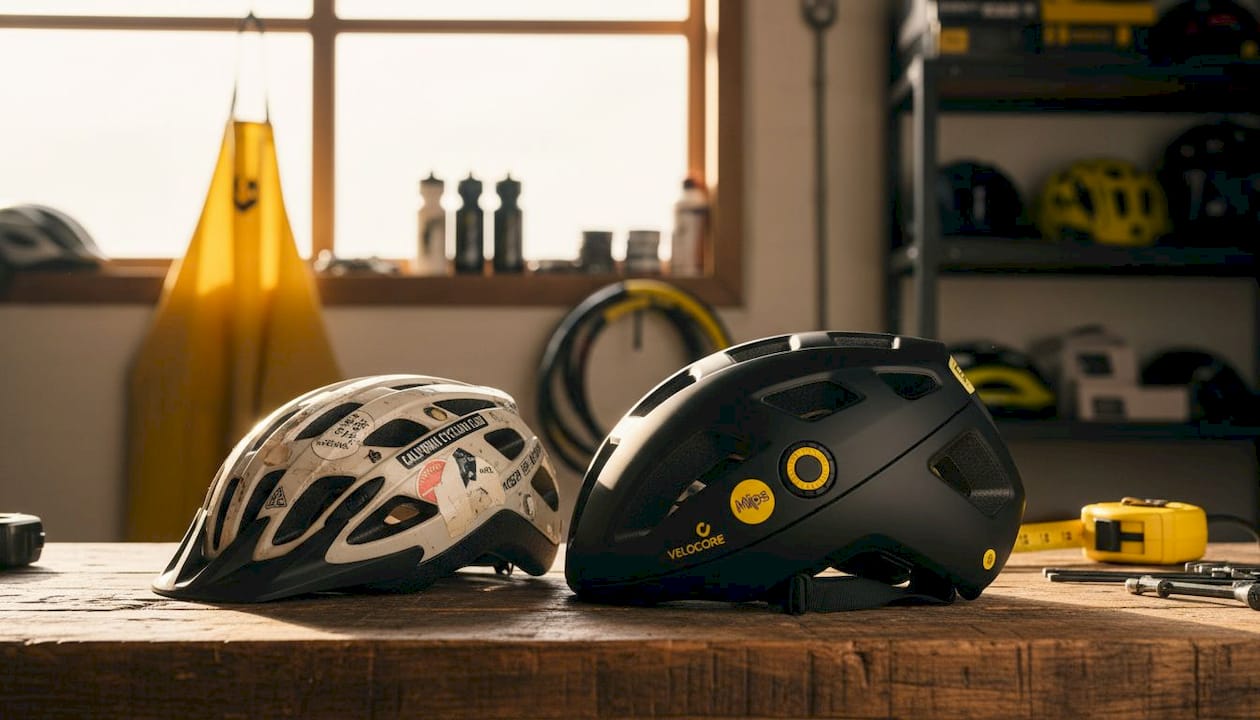
Not every rider faces the same crash physics. An urban commuter cruising at 15 km/h and an e-bike rider pushing past 30 km/h experience very different impact forces if they go down. The certification landscape reflects this. E-bike riders need helmets with extended coverage and NTA 8776 certification, a standard specifically developed for speeds above 25 km/h where impact forces are substantially higher than standard cycling helmets are rated to handle.
The NTA 8776 certification is not optional for serious e-bike riders. At speeds above 25 km/h, the kinetic energy in a crash scales exponentially. A standard helmet designed for 20 km/h impacts will not protect your skull and brain at 35 km/h. Extended rear coverage, reinforced chin bars in some models, and stiffer foam densities are physical requirements, not luxury features.
| Rider type | Key certification | Critical features |
|---|---|---|
| E-bike (>25km/h) | NTA 8776 | Extended coverage, dense EPS foam |
| Road cyclist | CPSC 2026 + VT 5-star | MIPS, aerodynamic shell, low weight |
| Urban commuter | CPSC 2026 | LED visibility, reflectors, comfort fit |
| Gravel/mixed terrain | CPSC 2026 + VT 5-star | MIPS, full temple coverage, ventilation |
For road cyclists, the priority list looks different. Aerodynamic shell geometry reduces wind resistance, but it should never come at the expense of MIPS integration or Virginia Tech rating. Many premium road helmets now offer all three: low drag, 5-star rating, and rotational protection. The compromise between speed and safety that road cyclists once accepted is largely gone in 2026.
Urban riders face a different problem: visibility. In city traffic, being seen is as important as protection. Urban helmet safety features like integrated LED lights, high-visibility reflectors, and bright colorways directly reduce the probability of a crash occurring in the first place. An upgrade here isn’t just about better foam. It’s about making yourself harder to miss at an intersection.
Pro Tip: If you ride an e-bike that assists up to or beyond 25 km/h, look specifically for NTA 8776 on the label, not just a CPSC or EN 1078 mark. Those older certifications weren’t developed for the speed and force profiles of modern e-bikes. You can explore best e-bikes 2026 to understand the speed capabilities of current models and match your helmet choice accordingly.
When should you replace your existing helmet?
Most helmet manufacturers recommend replacement every three to five years. That advice is well-intentioned but not fully supported by the science of foam degradation. A study by MEA Forensic that tested 675 old helmets including models up to 26 years old found that foam performance degraded minimally, measuring only a 0.7g increase per year in peak impact acceleration. That’s a remarkably slow decline.
This doesn’t mean you should ride a 20-year-old helmet indefinitely. It means age alone is a poor reason to replace it. The real drivers of replacement are standard changes, technological leaps, and crash history.
Here’s a practical checklist for when an upgrade is genuinely necessary:
- Your helmet was involved in any crash, even one that looked minor. Internal foam damage is invisible and compromises protection permanently.
- Your helmet predates MIPS or rotational impact technology, especially if you ride at higher speeds or in traffic.
- Your helmet lacks 2026 CPSC certification, meaning it was never tested for angular acceleration.
- You’ve switched to an e-bike or started riding at higher average speeds than when you bought the helmet.
- The retention system, straps, or buckles are degraded, making proper fit impossible.
- Your helmet is visibly damaged: cracks in the shell, foam compression marks, or delamination.
Pro Tip: After any crash, even a low-speed tip-over where you felt nothing, replace your helmet. EPS foam is a single-use material. It compresses to absorb energy and does not recover. You won’t see the damage, but it’s there.
Age-based replacement cycles are a reasonable default for people who want a simple rule. But cycling safety gear benefits become most tangible when you upgrade based on what actually changes: standards, crash exposure, and technology access. Don’t replace a perfectly functional helmet just because a calendar year ticked over. Do replace it the moment it’s been in a crash or can’t meet current standards.
The truth experts won’t tell you about helmet upgrades
Here’s something worth saying plainly: the three-to-five year replacement rule exists partly because it’s simple to communicate, not because the foam in your helmet is about to fail on its own. The MEA Forensic data makes this clear. Foam degrades slowly. Age isn’t the crisis.
What most cyclists miss is that the most important reason to upgrade isn’t that their current helmet is getting worse. It’s that newer helmets are dramatically better. That’s a completely different argument, and it’s far more convincing when you understand what MIPS, WaveCel, and 2026 CPSC compliance actually do for your brain in the kind of angled, real-world crashes that happen on actual roads.
We also see a pattern with e-bike adoption. Riders upgrade their bike to a more powerful, faster model but keep the same helmet they bought for casual weekend rides. The physics of that mismatch are serious. A helmet rated for 20 km/h impacts worn at 35 km/h isn’t a small safety gap. It’s a certification failure.
The honest framework for upgrade decisions: check your crash history first, then check your certification and technology stack against current standards, and let age be the last factor you consider. Explore innovative helmet design to understand how far protective engineering has moved in just a few years. The gap between what was available in 2019 and what you can buy today is not incremental. It represents a generational leap in how helmets are built, tested, and certified for the crashes that actually injure cyclists.
Upgrade because the technology is genuinely better. Upgrade because your riding has changed. Upgrade because you’ve been in a crash. Those are reasons that protect your brain. “My helmet is five years old” is a reason to inspect it carefully, not necessarily to replace it.
Explore top-rated helmets and gear for your next upgrade
If anything in this article made you pause and think about what’s protecting your head right now, that’s exactly the right response.
At THE BEAM, we design helmets and safety accessories specifically for riders who take protection seriously without sacrificing comfort or style. Our VIRGO integral helmet integrates MIPS technology, meets current certification standards, and is built for urban, road, and e-bike riders who want real-world protection engineered in France. Browse our full shop helmets collection to find models matched to your riding discipline and speed. Pair your new helmet with visibility and protection upgrades from our helmet add-ons range, including rear-view mirrors, high-visibility reflectors, and connected accessories designed to make every ride safer.
Frequently asked questions
Do I need to upgrade my helmet if it’s older than five years?
Not necessarily; a study that tested helmets up to 26 years old found foam degrades minimally, but evolving safety standards and any post-crash damage are far stronger reasons to replace your helmet than age alone.
What is rotational impact protection, and why does it matter?
Rotational impact protection reduces the angular acceleration transferred to your brain during angled crashes, and it’s now required under new 2026 CPSC standards because the vast majority of real-world crashes involve rotational forces that older helmets were never designed to handle.
What helmet features are critical for e-bike riders?
E-bike riders require extended shell coverage and NTA 8776 certification for speeds above 25 km/h, since standard cycling helmet certifications don’t account for the higher impact forces generated at e-bike speeds.
Does helmet rating matter for concussion protection?
Yes; helmets rated 5-star by Virginia Tech are proven to lower concussion risk, with each model tested across 24 independent impacts that simulate real-world crash scenarios at various speeds and angles.


