

Yes. For most road cyclists, a helmet built with MIPS is worth choosing over one without it, as long as it also fits correctly and carries a valid safety certification. MIPS won’t fix a poorly sized helmet, but as an added layer of protection against rotational impact forces, it’s a reasonable upgrade for the price most riders already pay.
Before you buy, do two things:
- Confirm the helmet carries CE certification and, ideally, an independent rating like Virginia Tech’s five-star system.
- Try the helmet on and test the retention system and pad fit in person, or check the sizing chart carefully if buying online.
Thebeamofficial builds its VIRGO helmet around this same logic: MIPS plus a fit system that actually holds up on long rides.
TL;DR:
- MIPS is most effective in reducing rotational forces during angled, oblique impacts, which are common in real-world road crashes.
- Correct helmet fit and proper adjustment are critical, as poorly fitted MIPS helmets offer less protection than a snug non-MIPS helmet.
- Swapping included pad thicknesses can significantly improve fit and helmet stability before adjusting retention systems.
- Helmets should be replaced after a moderate or hard impact and roughly every three to five years due to foam degradation.
- MIPS helmets remain a baseline feature in mid-range and premium models, but emphasis on fit and certification should guide purchases over MIPS alone.
Table of Contents
- What Is a Casque Route MIPS, Exactly?
- How Does MIPS Actually Work?
- Does MIPS Actually Make a Difference for Road Cyclists?
- How Should You Evaluate a MIPS Road Helmet Before Buying?
- What’s the Best Way to Fit and Size a Road Helmet?
- When Should You Replace a MIPS Helmet?
- How Thebeamofficial Approaches MIPS in Helmet Design
- MIPS vs. Non-MIPS: What Actually Changes?
- Are There Downsides to MIPS Helmets?
- Which Road Helmet Models Include MIPS?
- How Much Should You Expect to Pay for a MIPS Road Helmet?
- What Do Riders Actually Say About MIPS Helmets?
- Can MIPS Work Alongside Other Helmet Safety Technologies?
- An Editorial Take: Where the Conventional MIPS Advice Falls Short
- Get a MIPS Road Helmet Built Around Fit, Not Just the Feature
- Key Takeaways
- Sources
What Is a Casque Route MIPS, Exactly?
A casque route MIPS is a road cycling helmet built with the Multi-directional Impact Protection System, a slip layer that sits between the foam liner and your head. During a crash, if the helmet hits the ground at an angle rather than straight on, that layer lets the helmet shell move slightly relative to your skull. That small motion is designed to reduce the rotational force transmitted to your brain, according to MipsProtection’s own explanation of the technology.
You’ll see MIPS marketed under a few different names depending on the helmet:
- MIPS Evolve — a slimmer version often used in lighter road helmets.
- MIPS Air — designed to work with heavily ventilated shells without blocking airflow.
- Spherical / MIPS Spherical — a ball-and-socket design built into the helmet’s two-layer shell rather than added as a separate liner.
These are implementation names, not competing brands. One important caveat: MIPS is a supplement to good helmet design, not a substitute for it. A poorly fitted MIPS helmet protects you less than a well-fitted helmet without it.
How Does MIPS Actually Work?
Picture your head slipping slightly inside your helmet, the way your foot slides a little inside a shoe when you plant it and pivot. That’s roughly what the MIPS layer allows. It’s a low-friction liner that decouples the outer shell’s motion from your skull during an oblique impact, the kind where the helmet strikes the pavement at an angle instead of dead center.
Straight-on impacts mostly generate linear force, which foam absorbs reasonably well. Angled impacts generate rotational acceleration, a twisting force on the brain that’s been linked to concussion risk. MIPS exists specifically to blunt that rotational component, letting the shell rotate a few millimeters while your head keeps moving in its original direction for a fraction longer.
That said, MIPS has limits. It doesn’t reduce the force of a direct, straight-on hit, and it can’t compensate for a helmet that sits too loose, too high, or too far back on your head. The foam structure, the shell’s coverage area, and correct fit all still carry as much weight in an actual crash. Treat MIPS as one variable in a larger equation, not the whole formula.
Does MIPS Actually Make a Difference for Road Cyclists?
The honest answer is: probably, but the size of the benefit depends heavily on the crash. Rotational injuries specifically are what MIPS targets, and oblique impacts, the kind most common in real road crashes where a rider goes down at speed and hits at an angle, are exactly the scenario MIPS is engineered for. MipsProtection frames the whole system around that low-friction slip layer reducing rotational motion transferred to the head, which is a plausible and well-documented mechanical principle rather than a marketing gimmick.

MIPS is now standard on the majority of helmets that earn top independent safety ratings. Product pages for models like the Mavic Syncro SL MIPS cite independent lab testing alongside MIPS integration and extended shell coverage as complementary safety features, not competing ones. Virginia Tech’s star ratings, referenced across many manufacturer pages, are a useful shortcut for comparing helmets, though they test specific drop scenarios and won’t capture every possible crash angle or speed.
Practically, this means MIPS is most likely to matter in a moderate-speed fall where your head strikes at an angle, which describes a large share of everyday road crashes. It’s less relevant in a severe, high-speed direct impact, where the limiting factor becomes the shell and foam’s total energy absorption rather than rotational slip.
How Should You Evaluate a MIPS Road Helmet Before Buying?
Run through these checks in order. Skipping straight to “does it have MIPS” and ignoring the rest is the most common mistake road cyclists make when shopping.
- Test the retention system first. Adjust the rear dial and chin strap in person if you can. A helmet that shifts when you shake your head side to side has already failed the most important test, regardless of what’s inside it.
- Try different pad thicknesses. Many premium road helmets, including models like the Giant Rev Elite MIPS, ship with multiple pad sets, often 2mm and 6mm options. Swapping them changes how the helmet contacts your skull and can noticeably improve stability.
- Balance ventilation against your riding style. More vents mean better cooling on climbs but slightly more drag at speed. Sprinters and time trial riders often favor fewer, more aerodynamic vents; climbers and endurance riders usually want more airflow.
- Check for CE certification and any listed independent ratings. This is non-negotiable. MIPS is a bonus feature; certification is the baseline.
- Confirm accessory compatibility. Check that the helmet accommodates sunglass arms, front and rear lights, and any mount you plan to use.
Pro Tip: Don’t rely only on the rear dial to fix a loose fit. If a helmet still moves after tightening the retention system, try the thicker pad set before assuming the whole helmet is the wrong size.
What’s the Best Way to Fit and Size a Road Helmet?
Start with a tape measure, not a guess. Wrap it around your head about an inch above your eyebrows, at the widest point, and match that number to the manufacturer’s size chart. Most road helmets cover a range, so borderline measurements usually mean sizing down for a snugger, more secure fit.
Once it’s on, run the one-finger test: you should be able to fit roughly one finger between the strap and your jaw when the buckle is closed, no more. Push the helmet gently front to back and side to side. It shouldn’t rock, slide, or ride up off your forehead.
- Try both pad thicknesses if the helmet includes them, and pick whichever eliminates pressure points while keeping the fit tight.
- Tighten the rear retention dial until the helmet feels locked in place without pinching.
- Do a short test walk or a quick head-tilt check before committing. If it shifts noticeably, size down or adjust the pads before buying.
When Should You Replace a MIPS Helmet?
Replace it immediately after any moderate or hard impact, even if the shell looks undamaged. Foam liners and MIPS layers can absorb their one big hit invisibly, then offer far less protection the second time. Beyond that, most manufacturers recommend swapping a helmet out roughly every three to five years, since UV exposure, sweat, and general wear degrade foam and adhesive over time.
Clean the shell and pads with mild soap and water only. Skip solvents or harsh cleaners near the MIPS liner, since they can weaken the adhesive bonding it to the foam. Register your helmet with the manufacturer when possible; it speeds up warranty claims and recall notices.
How Thebeamofficial Approaches MIPS in Helmet Design
Thebeamofficial designs road and multi-use helmets around a simple priority order: fit first, retention second, ventilation third, with MIPS layered in as reinforcement rather than the headline feature. That’s the same order we’d recommend to any rider standing in front of a wall of helmets trying to make a decision.
Our flagship VIRGO helmet integrates MIPS alongside an adjustable retention system and multiple pad options, so riders can dial in stability without compromising airflow on long climbs. If you want a deeper technical breakdown of how the slip-layer mechanism works, we cover it in more detail in our guide to MIPS technology in cycling helmets, and our piece on whether MIPS is worth the extra cost walks through the buying decision from a few more angles.
MIPS vs. Non-MIPS: What Actually Changes?
The shell, the foam, and the certification stay identical between MIPS and non-MIPS versions of the same helmet model in most product lines. What changes is the thin slip layer inside, and the small amount of added weight and cost that comes with it, usually somewhere between 15 and 30 grams and a modest price bump.
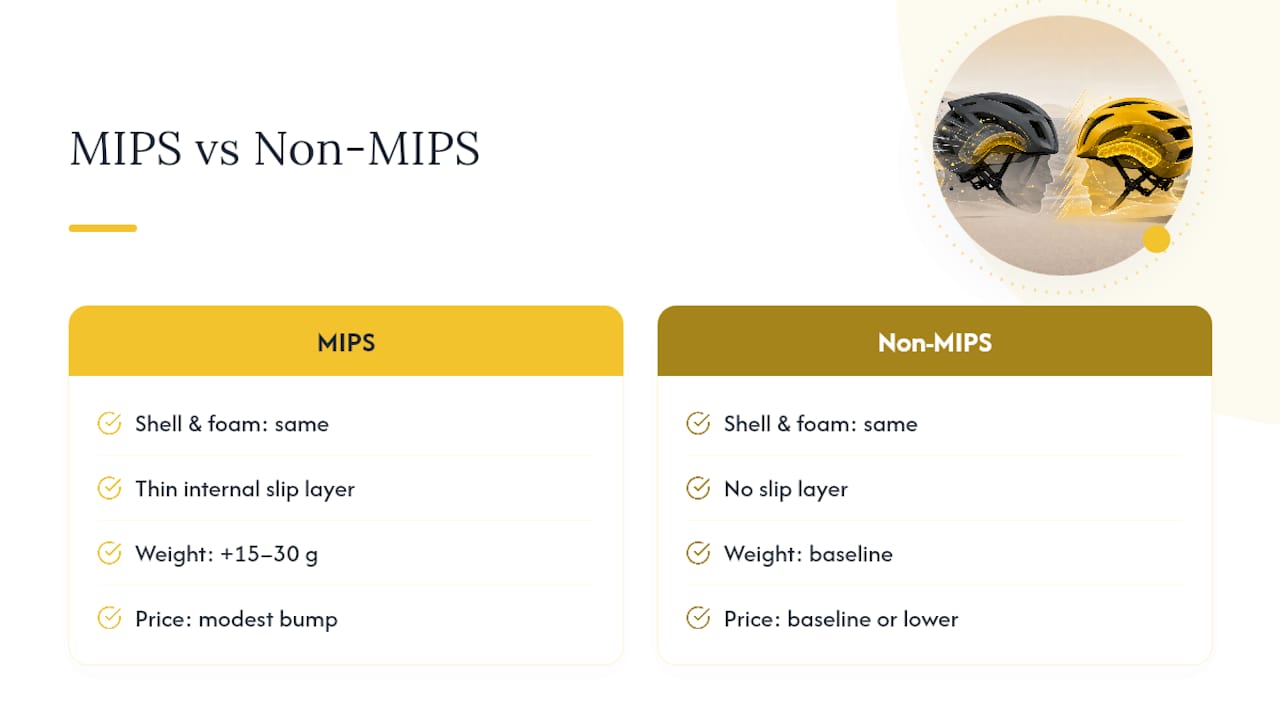
For a road cyclist deciding between two otherwise similar helmets, the MIPS version is the safer default. It targets a real failure mode, oblique impact, that a straight foam-only design doesn’t specifically address. Independent lab tests and manufacturer pages, including Mavic’s Syncro SL MIPS listing, consistently pair MIPS with strong safety ratings, which suggests the two work well together rather than one making the other redundant.
Where the comparison gets less clear-cut is at the budget end of the market. A cheap MIPS helmet with poor ventilation, a weak retention dial, and only one pad thickness can end up less protective in practice than a well-built non-MIPS helmet from a brand that’s put more engineering into shell geometry and coverage. MIPS is additive, not a shortcut past the fundamentals.
The practical rule: given two helmets at a similar price point and build quality, take the one with MIPS. Given two helmets at wildly different price points where the cheaper one has MIPS and the pricier one doesn’t, look harder at the actual construction before deciding.
Are There Downsides to MIPS Helmets?
The most common complaints are weight, price, and fit adjustment, and none of them are dealbreakers, but all three are real.
MIPS adds a small amount of weight, usually under a few dozen grams, which most riders never notice once the helmet is on but which weight-conscious climbers sometimes mention. It also adds cost, usually pushing a helmet’s price up by a modest margin compared to an otherwise identical non-MIPS version.
Fit is the trickier issue. Because the MIPS layer allows a small range of motion between the shell and the liner, some riders report the helmet feeling slightly less “locked in” than a rigid foam-only design, at least until they’ve adjusted the retention system properly. This isn’t a flaw so much as an adjustment period. Once the pads and rear dial are dialed in, the slip layer becomes unnoticeable during normal riding and only engages during an actual impact.
There’s also a legitimate scientific caveat worth stating plainly: MIPS reduces rotational force in the specific oblique-impact scenarios it’s tested against. It’s a well-reasoned mechanical solution to a real problem, but no helmet technology, MIPS included, eliminates head injury risk. Marketing copy that implies otherwise is overselling what any single feature can do. The system works best as one part of a helmet that also nails coverage, retention, and correct sizing.
Which Road Helmet Models Include MIPS?
MIPS has become close to standard across the mid-range and premium road helmet segment. Large retailers now list it as a filterable category, evidence of how common it’s become; Decathlon’s own product listings show MIPS as a standard filter option across dozens of road helmets, and comparison sites like Idealo track price and weight across a similarly wide range of MIPS-equipped models.
Rather than naming specific competing brands and ranking them, the more useful way to think about this category is by tier:
- Entry-level road helmets with MIPS tend to use the basic MIPS Evolve liner, fewer vents, and a single pad thickness. Good for casual riders on a budget.
- Mid-range models typically add adjustable retention dials, dual pad thicknesses, and better ventilation channels alongside MIPS.
- Premium road helmets often integrate Spherical MIPS or MIPS Air directly into the shell structure, paired with extended coverage and independently verified safety ratings.
Thebeamofficial’s VIRGO sits in that upper tier, combining MIPS with the pad and retention flexibility described earlier in this guide. Expert roundups covering 2026’s top road helmets consistently flag MIPS, ventilation, and fit systems as the three criteria that separate a good helmet from an average one, which lines up closely with the evaluation order we’ve walked through above.
How Much Should You Expect to Pay for a MIPS Road Helmet?
Price tracks tier more than it tracks MIPS alone. Budget road helmets with MIPS typically start in the lower price brackets and get you the core safety feature without much else. Mid-range helmets, where you’ll find better ventilation, adjustable retention, and multiple pad thicknesses alongside MIPS, occupy the middle of the market. Premium helmets, often built around Spherical MIPS and extended shell coverage, sit at the top.
The MIPS layer itself typically adds a modest price premium over a similar non-MIPS version of the same helmet depending on the model. That’s a small increase relative to what you’re paying for the shell, foam, and retention system overall. Comparison tools like Idealo’s MIPS road helmet listings are worth a look if you want to see how price scales with weight and features across the market before settling on a specific model.
Where riders sometimes overspend is chasing marginal weight savings at the very top of the price range. Shaving the last 20 grams off a helmet usually costs disproportionately more than shaving the first 50 grams, and that weight difference rarely changes anything about the protection you’re getting. Money spent on a properly fitted mid-range MIPS helmet with good ventilation almost always buys more real-world safety than the same money spent chasing the lightest possible shell.
What Do Riders Actually Say About MIPS Helmets?
Real-world feedback on MIPS road helmets tends to cluster around three themes: fit satisfaction, heat management, and peace of mind after a fall.
Riders who take the time to test pad thicknesses and dial in retention before buying report far fewer complaints about the helmet moving during rides, which tracks with the fit-first approach outlined earlier in this guide. Complaints that do surface usually trace back to skipping that step, not to MIPS itself. A helmet that’s the wrong size will feel wrong whether or not it has MIPS inside it.
Heat is the second recurring theme. Riders training through summer heat consistently favor MIPS Air or heavily vented Spherical designs over the slimmer MIPS Evolve liner, since the latter can trap slightly more heat in helmets with fewer vents. If you ride in hot climates or do long climbs, factor ventilation into the MIPS variant you choose, not just the presence of MIPS.
The third theme, less discussed but common in rider forums and product reviews, is a kind of retroactive validation: riders who’ve had a crash and walked away without serious injury often credit their helmet’s rotational protection specifically, even when they can’t say for certain how much MIPS contributed versus the shell and foam. That’s consistent with the broader evidence picture. MIPS is one layer of a helmet’s total protection, and most riders who’ve relied on it in a real fall come away satisfied without being able to isolate its exact contribution.
Can MIPS Work Alongside Other Helmet Safety Technologies?
Yes, and in most cases it has to, since MIPS addresses rotational force while other systems target different failure modes entirely. WaveCel, for instance, uses a collapsible cellular structure built into the foam itself to absorb impact energy, working on a different principle than MIPS’s slip layer. The two aren’t typically combined in the same helmet, since manufacturers generally pick one rotational-protection approach rather than stacking both, but they’re solving the same underlying problem from different angles.
SPIN, another rotational protection system, functions similarly to MIPS with small silicone pads that allow multi-directional movement rather than a single slip layer. Again, helmets typically use one system or the other, not both, since the mechanical goal overlaps too much to justify combining them.
Where compatibility actually matters is between MIPS and non-rotational safety features. MIPS pairs without conflict with reflective materials, integrated lighting mounts, and extended coverage designs, since none of those interact with the slip layer’s function. If you’re building out a full safety setup, a MIPS helmet works fine alongside separate visibility gear like a rear-view mirror or a frame-mounted reflector, since those address a completely different risk (being seen by traffic) rather than impact absorption.
The practical takeaway for shoppers: don’t expect to find a helmet that combines MIPS and WaveCel, and don’t treat that as a gap. Pick one rotational protection system, then focus your remaining attention on fit, ventilation, and certification, the factors that matter regardless of which system a given helmet uses.
An Editorial Take: Where the Conventional MIPS Advice Falls Short
Most buying guides treat MIPS as a checkbox: does the helmet have it or not, tick the box, move on. That framing undersells the technology and oversells it at the same time. It undersells the mechanism, because most articles never explain that MIPS specifically targets oblique, angled impacts rather than every type of crash. And it oversells the label, because plenty of shoppers assume “has MIPS” means “is safe” and stop evaluating anything else.
The research actually supports a more specific claim: MIPS is worth choosing, but only as the third or fourth thing you check, not the first. Fit and retention determine whether a helmet stays on your head at all during a crash. Certification determines whether the foam and shell meet a tested baseline. MIPS then adds a meaningful layer of rotational protection on top of a helmet that’s already doing its job.
If there’s one thing worth prioritizing that most guides skip entirely, it’s testing pad thicknesses. A 2mm-to-6mm swap changes fit more than most riders expect, and it costs nothing since the pads usually ship together. Get that right before you even think about which MIPS variant a helmet uses.
— Sophie
Get a MIPS Road Helmet Built Around Fit, Not Just the Feature
Thebeamofficial built VIRGO around the exact checklist covered above, not around a single spec sheet bullet point. It integrates MIPS for rotational protection, ships with multiple pad thicknesses so you can actually dial in the fit instead of guessing, includes an adjustable retention system, and balances ventilation channels for long road rides without sacrificing coverage.

If you’ve read this far, you already know the mistake to avoid: picking a helmet because it says MIPS on the box without checking whether it fits your head. VIRGO is built so that box and that fit check point the same direction. Compare sizes and pad options on the VIRGO product page and see how it stacks up against the checklist you just read. If you’re also building out your visibility setup for road riding, our high-visibility bike reflectors pair naturally with any helmet choice, MIPS or otherwise.
Key Takeaways
MIPS reduces rotational impact forces during angled crashes, but it only delivers real protection when paired with correct fit, proper retention adjustment, and valid CE certification.
| Point | Details |
|---|---|
| MIPS targets oblique impacts | The slip layer reduces rotational force specifically during angled crashes, not straight-on hits. |
| Fit outranks the MIPS label | A helmet that shifts on your head protects you less than a snug non-MIPS helmet. |
| Test pad thicknesses first | Swapping between included pad sets, often 2mm and 6mm, often fixes fit issues before you touch the retention dial. |
| Replace after any hard impact | Foam and MIPS layers can be compromised invisibly; a 3 to 5 year lifespan is typical otherwise. |
| Thebeamofficial’s VIRGO follows this order | MIPS integration, multiple pad options, and adjustable retention are built in together, not as separate afterthoughts. |


