

For safety-focused cyclists in the U.S., the essential connected device stack is: a smart rear light with brake-reactive modes, a seatpost-mounted rear-facing camera, a Bluetooth helmet kit with audio and haptic alerts, and a stable rear-view mirror. Together, these four categories address visibility, intent signaling, and rearward awareness in ways that no single device can cover alone.
Here’s why this stack works:
- Smart rear light (brake-reactive): Automatically brightens or flashes faster on deceleration, making your intentions readable to drivers before they get close.
- Rear-facing camera/dashcam: Documents incidents and, when visible, deters aggressive behavior. Seatpost mounting gives steadier footage than a helmet mount.
- Bluetooth helmet kit (audio + haptic alerts): Delivers rear-approach warnings without pulling your eyes off the road.
- Rear-view mirror: Provides continuous rearward awareness with zero battery dependency and no pairing required.
Thebeamofficial’s recommended starting point: the VIRGO integral helmet paired with the Bluetooth helmet kit and FRAME FLASH reflectors. If budget is tight, start with the rear light and camera, then add the helmet kit next.
Key Takeaways
Flashing and reactive rear lights, combined with a Bluetooth helmet kit and passive FRAME FLASH reflectors, form the most evidence-backed connected safety stack available to U.S. cyclists today.
| Point | Details |
|---|---|
| Prioritize reactive rear lights | Flashing and brake-reactive modes improve driver detection speed and distance estimation. |
| Audio alerts outperform visual-only | Studies and V2X prototype tests consistently show riders prefer auditory warnings for hands-free awareness. |
| Seatpost beats helmet for cameras | Seatpost mounting delivers more stable footage and better angle for capturing approaching vehicles. |
| Check compatibility before buying | Confirm BLE/ANT+ requirements and app dependencies before purchasing any connected device. |
| Thebeamofficial’s integrated stack | The VIRGO helmet, Bluetooth kit, and FRAME FLASH reflectors cover every safety category in one matched system. |
Table of Contents
- What does a connected cycling device actually cover?
- How do connected devices actually reduce your crash risk?
- What should you check before buying connected safety gear?
- How does THE BEAM product family meet these criteria?
- How do you mount and pair a THE BEAM setup in under 20 minutes?
- Which setup should you build for your riding scenario?
- How do you keep connected devices reliable long-term?
- What I actually prioritize when choosing connected safety gear
- THE BEAM’s safety bundle: what to buy and where
- Sources
What does a connected cycling device actually cover?
“Connected cycling device” gets used loosely online. For safety shoppers, it means one specific thing: gear that improves your visibility to drivers, signals your intent, or alerts you to hazards. It does not mean GPS head units or training computers.
The five product families that matter here:
- Smart rear and front lights: Flash automatically, react to braking or ambient light, and some link to radar units for rear-approach warnings. Primary benefit: conspicuity.
- Rear-facing cameras/dashcams: Record continuously, lock footage on impact, and act as a deterrent. Primary benefit: documentation and passive deterrence.
- Bluetooth helmet kits (audio + haptics): Pair with your phone or radar unit to deliver audible turn-by-turn or collision alerts. Primary benefit: active situational awareness without looking away.
- Rear-view mirrors: Handlebar-mounted or glasses-mounted options give continuous rearward sightlines. Primary benefit: rear awareness with no power required.
- FRAME FLASH reflectors and lighting accessories: High-visibility passive reflectors that work day and night, no charging needed. Primary benefit: 360-degree conspicuity at zero maintenance cost.
Each category solves a different gap. Lights make you seen. Cameras document what happens. Helmet kits tell you what’s coming. Mirrors let you see it yourself. Reflectors keep working when everything else is off.
How do connected devices actually reduce your crash risk?
Connected devices reduce detection time and improve how accurately drivers judge your distance. That’s the core finding, and the research behind it is worth understanding before you spend money.
A driver-perception study published in Accident Analysis & Prevention found that flashing and reactive rear light modes helped drivers detect cyclists faster and estimate proximity more accurately than static or no light. Steady flashing and reactive flashing both outperform static modes, which means the mode matters as much as the lumen count.
Key finding: Reactive and flashing rear lights measurably improve how drivers perceive your distance, not just your presence. That distinction has direct implications for which light mode you default to on every ride.
On the helmet-kit side, a V2X prototype study in Sustainability (2024) tested on-bike units broadcasting ETSI-standard CAM messages via GNSS and IMU fusion. In small volunteer tests, helmet-integrated vibration and audio were the preferred alert modalities. Nine of twelve participants favored haptic feedback; eight of twelve favored audio. These are prototype results from a limited sample, so treat them as directional rather than definitive, but the preference for audio-first alerts aligns with broader findings.
A 2025 systematic review covering 78 studies confirmed that auditory warnings are frequently preferred across cyclist warning technologies, and that cameras with AI, ultrasonic sensors, lidar, and radar are the most studied approaches. Most studies still haven’t measured direct crash-risk reduction, which is an honest limitation worth knowing.
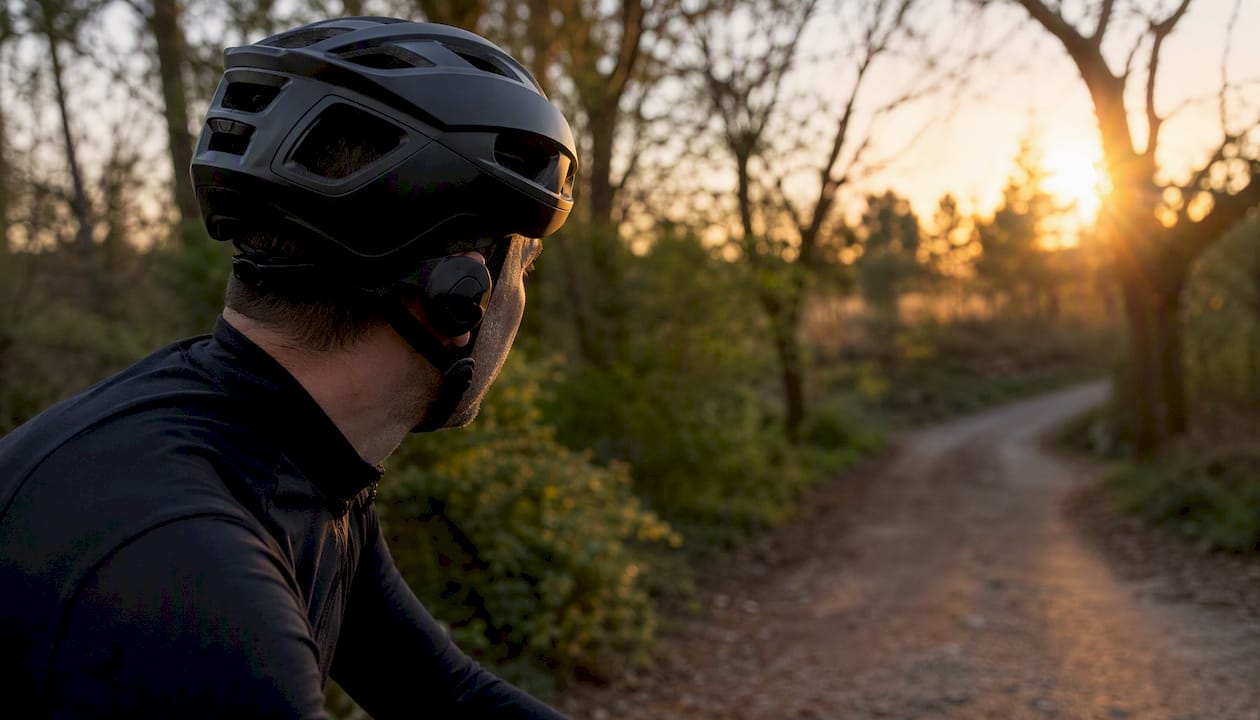
Vehicle ADAS features like automatic emergency braking have been linked to substantial reductions in rear-end collision risk. Connected cyclist devices work as a complementary layer to that, not a replacement for it. Electronics assist; defensive riding protects.
What should you check before buying connected safety gear?
Compatibility first. Before anything else, confirm whether a device uses BLE (Bluetooth Low Energy), ANT+, or both, and whether it requires a paired app or head unit. Most modern smart lights and helmet kits use BLE and pair directly to a smartphone. Some radar-linked lights require a compatible head unit.
Specs that actually matter:
- Lumens and flash modes: Look for a rear light with a brake-reactive or accelerometer mode. The BikeRadar smart lights buyer guide notes that many smart lights often incorporate sensors to automatically adjust brightness based on brake and ambient light detection.
- Camera resolution and EIS: Minimum 1080p at 30fps, with electronic image stabilization and loop recording. Incident-locking (automatic file protection on impact) is worth prioritizing.
- IP rating: IP65 or higher for rain resistance. IP67 for riders who commute in all weather.
- Battery life: Rear lights: 6–15 hours depending on mode. Cameras: 2–4 hours continuous, supplemented by loop recording. Helmet kits: 8–12 hours typical.
- Price bands: Entry-level smart lights run $30–$60. Mid-range camera setups $80–$150. Premium integrated helmet kits $150–$300+. Setup and pairing typically takes 10–20 minutes per device.
How does THE BEAM product family meet these criteria?
Thebeamofficial builds its product line around the same checklist above, with the advantage that the components are designed to work together.
- VIRGO integral helmet (MIPS): Full-face protection with MIPS technology for rotational impact management. Designed with integrated mounting points for the Bluetooth kit, so there’s no afterthought cabling. Available through THE BEAM’s helmet collection.
- Bluetooth helmet kit (audio + haptic modules): Pairs via BLE to your phone. Delivers audio alerts and haptic feedback for rear-approach warnings, consistent with the alert modalities favored in V2X prototype testing. No head unit required.
- Rear-view mirrors and handlebar options: Thebeamofficial offers both handlebar-mounted and glasses-mounted mirrors. The rear-view mirror setup guide covers mounting positions for road, gravel, and urban setups.
- FRAME FLASH reflectors: Minimalist high-visibility reflectors that attach to the frame. No charging, no pairing, no maintenance beyond a wipe-down. They work as a passive conspicuity layer that stays active even when your lights are off or dead.
Why choose THE BEAM: The VIRGO helmet and Bluetooth kit are designed as a single integrated system, not two separate products bolted together. FRAME FLASH reflectors add passive visibility at zero ongoing cost. All products ship to the U.S., come with manufacturer warranty and post-purchase support, and are available as a bundle or individually. If you’re building a safety stack from scratch, this is the configuration that covers every category in one purchase.
How do you mount and pair a THE BEAM setup in under 20 minutes?
Answer first: six steps, roughly 15–20 minutes total for a first-time setup.
- Mount the VIRGO helmet module (2 min): Attach the Bluetooth kit to the helmet’s integrated mount points. No tools needed for most configurations.
- Mount the rear camera to the seatpost (3 min): Use the included clamp. Angle the lens slightly downward to capture approaching vehicles at headlight height. Seatpost mounting gives more stable footage than a helmet mount.
- Pair BLE devices to your phone (5 min): Open the Thebeamofficial app, enable Bluetooth, and follow the in-app pairing sequence for the helmet kit. Most devices pair on first attempt.
- Check firmware (2 min): The app will prompt a firmware update if one is available. Do this at home, not on the road.
- Position the rear-view mirror (3 min): Adjust handlebar angle so you can see 50+ meters behind without moving your head. The mirror installation guide has angle diagrams for different bar widths.
- Test the alert flow (2 min): Simulate a rear approach in the app and confirm you can hear and feel the alert clearly with the helmet on.
Pro Tip: Use magnetic charging connectors wherever your kit supports them. The single biggest reason riders stop using connected gear is charging friction. Magnetic connections cut that barrier to near zero.
Which setup should you build for your riding scenario?
The right combination depends on where and when you ride. Here’s a scenario-based breakdown:
- Daily commuting: Smart rear light + seatpost camera + Bluetooth helmet kit. The camera documents incidents; the helmet kit handles rear-approach alerts hands-free.
- E-bike riding: Add FRAME FLASH reflectors to the frame. E-bikes travel faster than most drivers expect, so passive 360-degree visibility matters more, not less.
- Night riding: Prioritize a high-lumen front light with auto-dimming and the FRAME FLASH reflectors. The camera’s night-vision capability becomes a secondary priority.
- Family and cargo setups: For child seats or trailers, mount a rear light on the trailer itself, not just the bike. Add kids’ helmets with reflective elements for younger riders.
- Ultracycling and long-distance: Full stack: VIRGO + Bluetooth kit + FRAME FLASH + camera. Battery life becomes the constraint; carry a small power bank for the camera on rides over 4 hours.
| Scenario | Core devices | First purchase if budget-limited |
|---|---|---|
| Daily commute | Smart rear light, camera, helmet kit | Smart rear light |
| E-bike | Full stack + FRAME FLASH | FRAME FLASH reflectors |
| Night riding | Front light, FRAME FLASH, camera | High-lumen front light |
| Family/cargo | Trailer rear light, kids’ helmets | Trailer-mounted rear light |
| Ultracycling | Full stack + power bank | Rear camera |
How do you keep connected devices reliable long-term?
- Charging cadence: Charge rear lights and helmet kits after every 2–3 rides, not when they die. Lithium cells degrade faster from deep discharge cycles.
- Waterproofing checks: After heavy rain, inspect USB port covers and gaskets monthly. A cracked cover on an IP65 device turns it into an IP20 device overnight.
- Storage: Store devices at room temperature, away from direct sunlight. Avoid leaving them in a hot car, which accelerates battery degradation.
- Firmware routine: Check for updates monthly. Most manufacturers push safety-critical fixes and new flash-mode profiles through firmware. Takes two minutes in the app.
- Mount inspection: Every three months, check clamp torque on seatpost and handlebar mounts. Vibration loosens hardware gradually, and a camera that shifts angle mid-ride is useless for incident documentation.
These devices assist your visibility. They do not replace your obligation to follow state and local lighting requirements, signal your turns, and ride defensively. U.S. state laws on required lighting vary; check your state’s vehicle code for the minimum front and rear light specifications before relying solely on smart modes.
What I actually prioritize when choosing connected safety gear
Most riders spend too long comparing lumen specs and not enough time thinking about mount stability and automated intent signals. A 200-lumen light that falls off your seatpost at mile three is worse than a 100-lumen light that stays put for two years.
My go-to setup is the VIRGO helmet with the Bluetooth kit and FRAME FLASH reflectors. The integration is the point: the helmet and kit work as one system, and the reflectors cover the passive layer without adding any daily friction. The connected safety guide on THE BEAM site explains the conspicuity logic behind reactive lights well if you want to go deeper on the evidence.
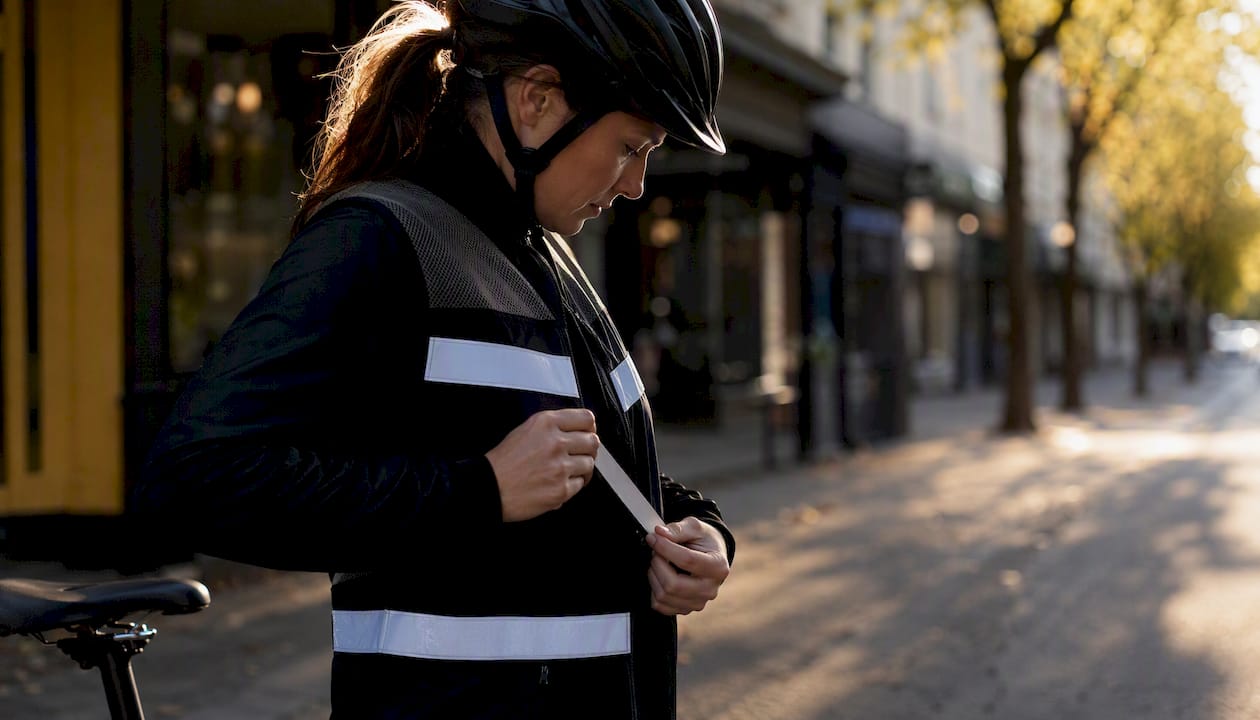
One thing worth saying plainly: test alert modalities in a quiet environment before riding in traffic. Ride a quiet street, trigger a simulated alert, and confirm you can actually hear it over road noise with the helmet on. Audio alerts that work in a quiet room often disappear at 20 mph on a busy street. Adjust volume, then ride.
THE BEAM’s safety bundle: what to buy and where
Thebeamofficial’s connected safety lineup covers every category in this guide. The core bundle includes the VIRGO integral helmet with MIPS protection, the Bluetooth helmet kit with audio and haptic alert modules, and FRAME FLASH reflectors for passive frame visibility. All products ship to the U.S. and come with manufacturer warranty and direct post-purchase support.
Start with the full bundle if you’re building a safety stack from scratch. The VIRGO and Bluetooth kit are designed as a matched system, and adding FRAME FLASH reflectors completes the passive layer at minimal cost. Browse the complete lineup at THE BEAM’s all-products collection, or go straight to the helmet collection to configure your VIRGO and kit. If you’re adding one item first, the rear light and FRAME FLASH reflectors give you the fastest visibility gain per dollar spent.
Sources
The following sources shaped the recommendations in this guide:
- The effect of rear bicycle light configurations on drivers’ perception of cyclists’ presence and proximity
- Frontiers in Public Health article on vehicle ADAS and collision reduction
- Sustainability 2024 — V2X prototype testing on electric cycles (HMI preferences reported)
- Advancing cycling safety: systematic review of cyclist warning technologies (2025)
- BikeRadar — Smart bike lights buyer guide


