

TL;DR:
- Properly fitting helmets match the shape and size of a rider’s head, ensuring maximum protection in a crash.
- Helmet fit depends on shell shape, internal padding, and retention system, not just head circumference.
Adaptive helmet sizing is the process of customizing a helmet’s fit to match your individual head shape and size precisely, and it directly determines how well your helmet protects you in a crash. A helmet that shifts, rocks, or creates pressure points fails at its core job, regardless of its price or certification. Traumatic brain injury risks occur at speeds as low as 5–10 mph, which means even a slow urban fall can cause permanent damage if your helmet isn’t seated correctly. Thebeamofficial designs every helmet in its lineup with this reality in mind, building adaptive features into helmets for road, gravel, urban, and e-bike cyclists who need protection they can count on every ride.
Why adaptive helmet sizing is the foundation of cycling safety
Standard helmet sizing gives you a starting point. It does not give you a safe fit. The difference matters because a helmet that doesn’t match your head architecture will shift during impact, exposing the temples, forehead, or base of the skull at the exact moment protection is most needed.
A properly fitted helmet stays level and snug, never rocking or sliding, with straps adjusted to allow some finger space under the chin for comfort and security.
That standard, cited by Loma Linda University Health, is the benchmark for adaptive fit. “Level and snug” means the helmet sits two finger-widths above your eyebrows, the rear retention system holds the shell firmly against your skull, and the chin strap allows only one to two fingers of clearance. When any of those three conditions fail, the helmet’s ability to absorb and redirect impact energy drops significantly.
Helmets that are too large shift forward on impact, driving the brim into your face and leaving the back of your skull unprotected. Helmets that are too small sit high on the head, creating the same rear exposure problem. Adaptive sizing solves both failure modes by matching shell geometry to your actual head shape, not just your head circumference measurement.

What factors shape helmet fit beyond head circumference?
Head circumference is the first measurement you take, but it is not the only one that matters. Pressure points and instability after fitting can come from mismatched internal shell shape and crown height, even when circumference measures correctly. This is the most common reason cyclists report that a helmet “feels wrong” despite choosing the right size on paper.
Human heads fall into two broad shape categories: round oval and long oval. A round oval head is roughly equal in width and length. A long oval head is noticeably longer front to back than it is wide. Most helmet manufacturers design their internal shell profiles around one of these shapes. Putting a long oval head into a round oval shell creates pressure on the temples and forehead. Putting a round oval head into a long oval shell creates a rocking sensation even when the circumference fits perfectly.
Shell size, padding, and crown height
These three elements work together, and confusing them leads to poor fit decisions. Shell size sets the outer structure. Internal padding adjusts the contact surface between the shell and your scalp. Crown height determines how deep the helmet sits on your head. A cyclist with a high crown needs a helmet with more vertical depth, not just a larger circumference. Changing padding thickness can compensate for minor gaps, but it cannot fix a crown height mismatch.
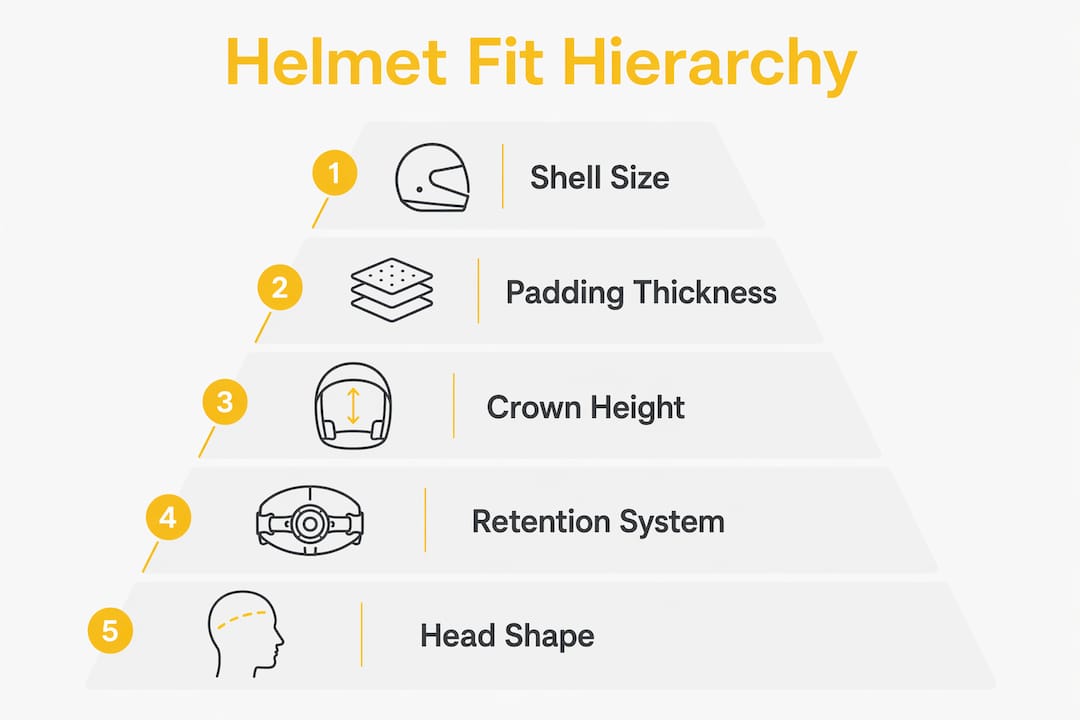
| Fit element | What it controls | Common mistake |
|---|---|---|
| Shell size | Outer structure and circumference | Choosing size from chart without trying on |
| Internal padding | Contact surface and pressure distribution | Adding padding to fix a shell size problem |
| Crown height | Vertical depth and forehead coverage | Ignoring depth when circumference fits |
| Head shape profile | Round oval vs. long oval alignment | Assuming all helmets of the same size fit the same |
Pro Tip: Measure your head circumference with a flexible tape measure placed 1 inch above your eyebrows and above your ears. Then note whether your head is visibly longer front to back than it is wide. Use both data points when selecting a shell, not just the circumference number.
Helmet manufacturers design different internal shell profiles to accommodate these variations. Knowing your head shape before you shop narrows your options and prevents the frustrating cycle of buying, returning, and buying again.
How can cyclists select and adjust helmets for a proper adaptive fit?
The only reliable way to confirm adaptive fit is to try the helmet on. Sizing charts are starting points. An ill-fitting helmet fails at protection if it doesn’t match your head architecture, regardless of what the chart says. If you buy online, prioritize brands with clear return policies so you can test fit at home.
Follow this sequence when evaluating any helmet:
- Place the helmet on your head without fastening anything. It should sit level, two finger-widths above your eyebrows, without you holding it.
- Shake your head side to side and front to back. The helmet should move with your head, not slide independently.
- Engage the retention system (the dial or ratchet at the back). Tighten until snug but not painful. You should feel even pressure around the full circumference.
- Adjust the side straps so they form a V-shape just below each ear. No slack, no pinching.
- Fasten the chin strap and check that only one to two fingers fit between the strap and your chin.
- Push up on the front brim. A properly fitted helmet should not rock back more than an inch.
- Pull down on the rear. The front should not drop over your eyes.
If the helmet fails any of these tests, the shell size or shape is wrong. Do not try to fix it with padding alone.
Pro Tip: Professional helmet fitting takes approximately 5 minutes per helmet when done correctly, covering pad placement, strap adjustment, and head shape assessment. If a bike shop offers fitting, take it. The time investment is worth it.
Professional fitting remains the gold standard for cyclists who want certainty. For those fitting at home, the seven-step sequence above replicates the core checks a trained fitter performs. Read the full step-by-step fitting guide from Thebeamofficial for a detailed walkthrough of each adjustment.
What misconceptions about helmet sizing actually reduce your safety?
The most dangerous misconception is that a larger helmet provides more protection. It does not. A helmet that is too large sits high on the head, rocks on impact, and leaves critical areas exposed. Size and coverage are not the same thing.
The second major myth is that retention dials can fix any fit problem. Adjustment systems should fine-tune the final 5–10% of helmet fit but cannot compensate for incorrect shell size or shape mismatches. Using a retention dial to shrink a helmet that is fundamentally too large creates uneven pressure and false confidence. The helmet feels tighter, but it is not seated correctly.
A third misconception is that helmets are only necessary for high-speed riding. Even low-speed falls can cause permanent brain injury without proper helmet fit. Urban commuters traveling at 10 mph face the same traumatic brain injury risk as riders going faster, because the critical factor is impact force at the skull, not riding speed.
Here is what cyclists most often get wrong about sizing:
- Trusting sizing charts as definitive rather than as a starting range
- Assuming pressure points mean the helmet is “breaking in” rather than signaling a shape mismatch
- Replacing padding instead of reconsidering shell size when fit feels off
- Skipping the stability shake test after adjusting the retention system
- Wearing a helmet that has been in a crash without replacing it, even if damage is invisible
Shell shape mismatches lead to pressure points on temples or forehead even when size matches on paper. Changing helmet size is not always the solution. Sometimes a different internal shape or padding layout is what you actually need. Understanding the difference between a size problem and a shape problem is the core skill of adaptive helmet fitting. For a deeper look at how padding technology contributes to fit, the Thebeamofficial guide on adaptive padding covers the mechanics in detail.
Key Takeaways
Adaptive helmet sizing works because matching shell geometry, internal shape, and retention systems to your specific head prevents the shifting and pressure failures that standard sizing cannot address.
| Point | Details |
|---|---|
| Fit beats size on paper | A helmet that matches your head shape protects better than one that matches only your circumference measurement. |
| Shape matters as much as size | Round oval and long oval heads need different internal shell profiles to avoid pressure points and instability. |
| Retention dials have limits | Adjustment systems fine-tune the last 5–10% of fit and cannot fix a fundamentally wrong shell size or shape. |
| Low-speed falls are dangerous | Brain injury risk starts at 5–10 mph, making proper fit critical for urban commuters, not just performance riders. |
| Test before you trust | The seven-step stability sequence confirms adaptive fit more reliably than any sizing chart. |
What I’ve learned after years of watching cyclists get this wrong
Cyclists spend hours researching frame geometry, drivetrain components, and tire pressure. Then they pick a helmet from a size chart in under two minutes. That gap in attention is where most helmet safety failures originate.
The detail most cyclists miss is the distinction between a size problem and a shape problem. I’ve watched riders return three helmets in a row, each one a different size, when the real issue was that every helmet they tried was designed for a round oval head and they had a long oval head. No size change was going to fix that. Only a different shell profile would.
Consistent helmet use with proper fit is the most important safety behavior a cyclist can develop. That means wearing it on every ride, including the short ones, and checking fit every season as padding compresses and retention systems wear. A helmet that fit perfectly two years ago may have drifted out of spec.
The technology is getting better. Retention systems now offer finer micro-adjustment. Padding materials recover their shape more reliably. Brands like Thebeamofficial are building adaptive features into helmets designed for real-world use across road, gravel, and urban riding. But the technology only works if you take the time to use it correctly. Fit is not a one-time task. It is a habit.
— Sophie
Thebeamofficial helmets built for adaptive fit
Thebeamofficial designs helmets for cyclists who treat safety as a non-negotiable, not an afterthought. Every helmet in the lineup is built with adaptive sizing in mind, combining shell geometry options, adjustable retention systems, and modular padding to match a wide range of head shapes and riding styles.

The VIRGO integral helmet with MIPS technology is the flagship product, engineered for riders who want full coverage and rotational impact protection in a single shell. Whether you ride road, gravel, urban, or e-bike, the full helmet collection includes options sized and shaped for real heads, not just average measurements. If you’re fitting a younger rider, the kids’ helmet range applies the same adaptive principles to growing cyclists who need consistent, reliable protection.
FAQ
What is adaptive helmet sizing?
Adaptive helmet sizing is the process of matching a helmet’s shell geometry, internal padding, and retention system to an individual cyclist’s head shape and size. It goes beyond selecting a size from a chart by accounting for head shape variations like round oval and long oval profiles.
Why does helmet fit matter more than helmet size?
A helmet that fits correctly stays stable during impact and covers all critical areas of the skull. A helmet that is the right size on paper but the wrong shape for your head will shift, create pressure points, and fail to protect you in a crash.
Can I fix a poor helmet fit by tightening the retention dial?
No. Retention dials fine-tune the final 5–10% of fit but cannot correct a shell that is the wrong size or shape. If you need to crank the dial to make a helmet feel secure, the base fit is wrong.
How do I know if my helmet fits correctly?
Place the helmet on your head and shake it side to side and front to back. It should move with your head, not independently. The front brim should not rock back more than an inch when pushed up, and the chin strap should allow only one to two fingers of clearance.
How often should I check my helmet fit?
Check fit at the start of every riding season. Padding compresses over time and retention systems wear, both of which can cause a previously well-fitted helmet to lose its adaptive contact. Replace any helmet that has absorbed a significant impact, even if no visible damage is present.


