

TL;DR:
- Impact absorption in helmets relies on foam crushing and shell deformation to extend stopping time and reduce brain forces during a crash. Materials like multi-density EPS foam, rotational management systems, and shell design work together to protect against linear and rotational impacts. Proper helmet fit and certification are essential, as damage from an impact cannot be seen externally and compromises future protection.
Impact absorption in helmets is defined as the process by which a helmet’s internal materials and outer shell convert collision energy into controlled deformation, reducing the peak force transmitted to the brain. This mechanism is the core of what is impact absorption in helmets and the reason a certified cycling helmet can mean the difference between a bruised ego and a traumatic brain injury. The Bicycle Helmet Safety Institute identifies the foam liner as the primary protective component, working alongside the outer shell to extend the time your head takes to stop during a crash. Understanding how this system works gives you a real advantage when choosing the best helmets for impact absorption.
What is impact absorption in helmets, and why does it matter?
Impact absorption is the conversion of kinetic energy into material deformation during a crash. When your head strikes a surface, the helmet’s foam liner crushes progressively, extending stopping time by about 6 ms. That fraction of a second matters enormously. Peak brain acceleration drops sharply when the stopping time increases, even by milliseconds, because force equals mass times acceleration. Less acceleration means less force on the brain.
The importance of impact absorption goes beyond physics. Skull fractures and severe brain trauma are the injuries helmets are engineered to prevent. A helmet that absorbs energy correctly keeps those forces below the threshold where catastrophic injury occurs. Without a functioning liner, the shell alone transfers nearly all crash energy directly to your skull.
Helmet impact protection is not a single material or feature. It is a system: foam liner, outer shell, retention system, and fit working together. Remove any one element and the system underperforms. That is why cyclists who understand the mechanics make better purchasing decisions than those who rely on marketing language alone.
How do helmets physically absorb impact forces during a crash?
The physics of helmet protection follow a clear sequence. When impact occurs, four things happen in rapid succession.
- The outer shell contacts the surface and begins distributing the force across a wider area. Research shows the shell absorbs roughly 50% of total impact energy through plastic deformation. That distribution prevents a concentrated point load from punching straight through to your head.
- The EPS foam liner begins to crush. Expanded polystyrene is a crushable structure that permanently deforms under load. This deformation converts kinetic energy into heat and structural change, slowing your head progressively rather than abruptly.
- Stopping time extends by approximately 6 milliseconds. Six milliseconds sounds trivial, but it is the window in which peak brain force drops to survivable levels. The Bicycle Helmet Safety Institute describes this as the fundamental mechanism of all certified cycling helmets.
- Residual energy dissipates through the retention system and padding, though comfort pads contribute nothing to this process.
The critical implication of EPS foam crushing is permanence. Once the foam deforms, it cannot recover. A helmet that has absorbed a significant impact is compromised internally even when the exterior looks fine. Bicycle helmets are single-impact devices by design.
Pro Tip: After any crash where your helmet contacted a hard surface, replace it immediately. Internal foam damage is invisible to the naked eye, and a compromised liner provides little protection in a second impact.
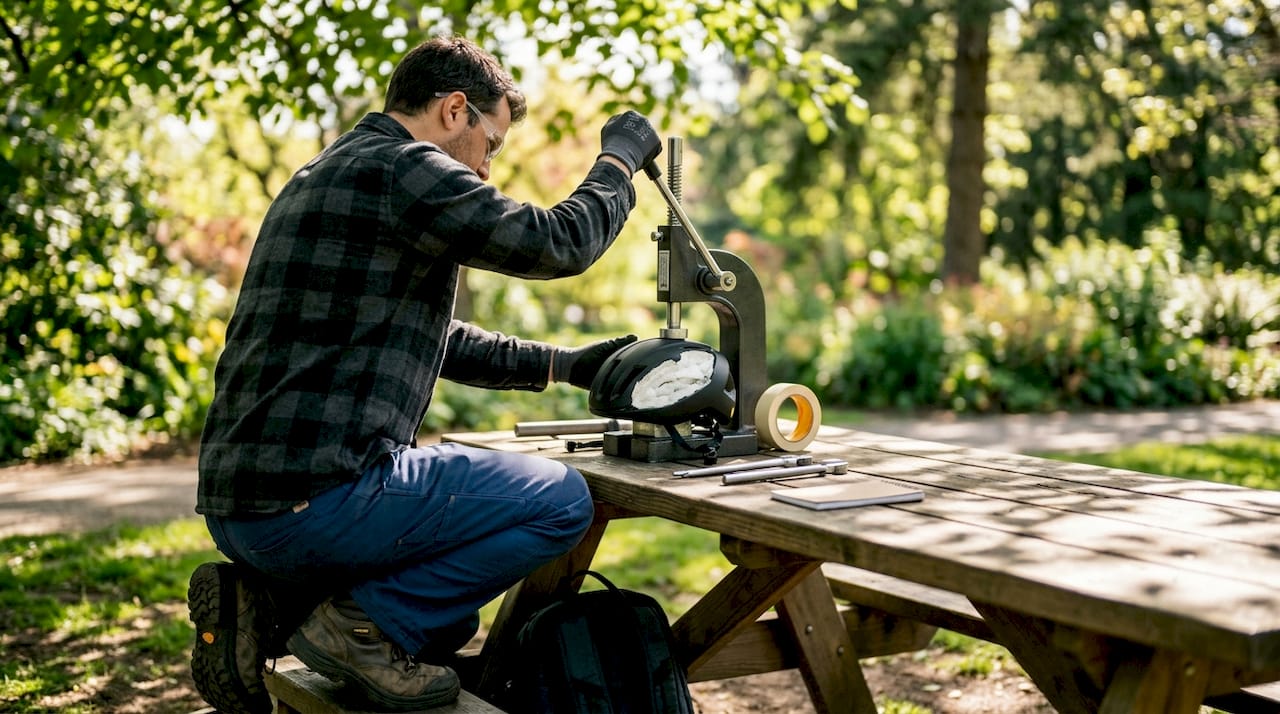
What materials and design features enhance impact absorption in modern helmets?
Modern helmet engineering goes well beyond a single block of foam. Several material and design choices determine how well a helmet protects across different crash types.
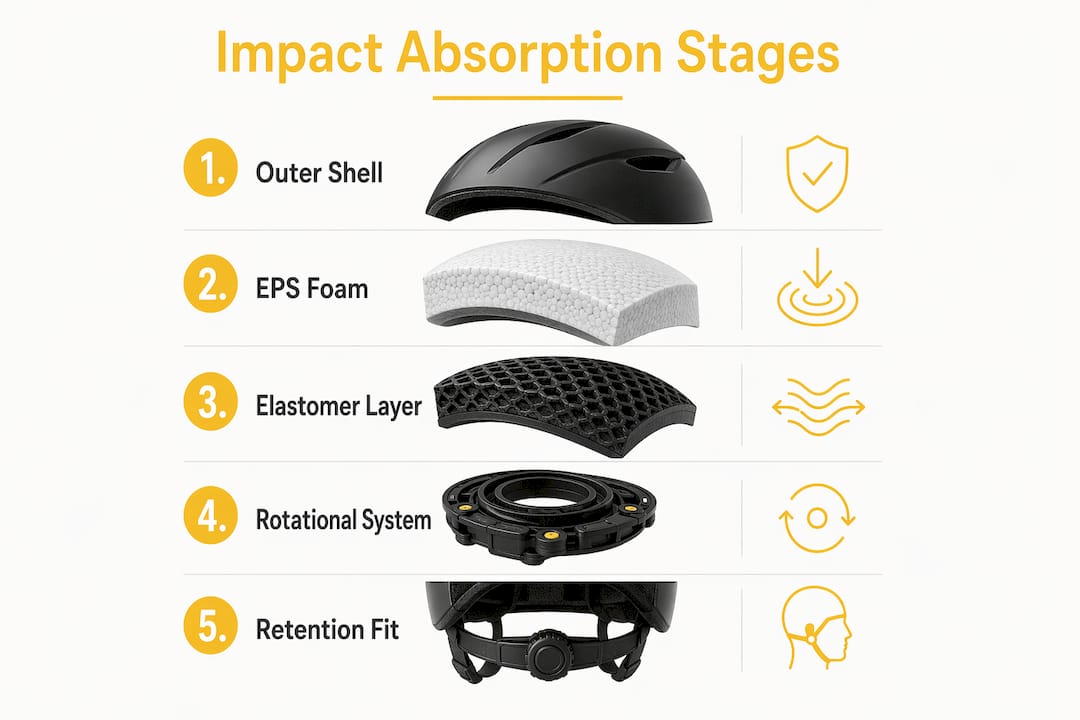
Multi-density EPS foam liners
Standard EPS foam is tuned to one density, which means it performs best within a narrow range of impact speeds. Multi-density liners solve this by combining a high-density outer layer that resists bottoming out on hard impacts with a lower-density inner layer that absorbs energy efficiently in moderate crashes. The result is broader protection across the range of real-world cycling accidents.
Polyurethane elastomers and viscoelastic materials
Some helmets incorporate polyurethane (PU) elastomer layers or viscoelastic foams alongside EPS. These materials deform under load and partially recover, making them useful for managing energy in impacts where EPS alone would bottom out. They are particularly effective in helmets designed for urban and e-bike use, where lower-speed impacts are more common.
Rotational management systems
Rotational force is the main cause of concussion, not linear impact. Traditional foam liners address linear deceleration well but cannot fully manage the rotational acceleration that twists the brain inside the skull. Systems like MIPS (Multi-directional Impact Protection System) and the Release Layer System (RLS) add a slip plane between the liner and the head. The Release Layer System claims up to a 4x reduction in concussion risk by allowing the helmet to rotate slightly on impact rather than transferring rotational force directly to the brain. Thebeamofficial’s VIRGO integral helmet incorporates MIPS technology for exactly this reason.
Shell design and surface finish
A smooth, rounded outer shell encourages the helmet to slide across impact surfaces rather than snag. Snagging transfers rotational energy directly to the head. A shell that slides reduces that rotational load before it ever reaches the foam liner. This is a design feature that works passively, requiring no additional components.
Here is a quick comparison of the key protective components and their roles:
| Component | Primary function | Impact type addressed |
|---|---|---|
| EPS foam liner | Energy absorption via crushing | Linear deceleration |
| Multi-density liner | Broad-range energy management | Low and high velocity impacts |
| Outer shell | Force distribution, sliding | Linear and rotational |
| MIPS or RLS layer | Rotational slip plane | Rotational acceleration |
| PU elastomer layer | Supplemental energy dissipation | Moderate, repeated low impacts |
Pro Tip: Comfort pads are not protective. They are for fit and sweat management only. Under high impact, comfort pads bottom out instantly and offer zero energy absorption. Never confuse a well-padded interior with a well-protected one.
Why helmet fit and standards compliance matter as much as the liner
A technically superior foam liner does nothing if the helmet shifts on impact. Fit and retention keep the helmet correctly positioned so the liner contacts the right area of the head during a crash. A helmet that rotates or slides off during impact fails regardless of its material quality.
Standards compliance is the only objective measure of helmet performance. Certifications like CPSC (Consumer Product Safety Commission) in the United States and Snell require helmets to pass:
- Impact attenuation tests at multiple drop heights and anvil shapes
- Strap strength tests verifying the retention system holds under load
- Environmental conditioning exposing helmets to heat, cold, and UV before retesting
- Coverage area requirements specifying which parts of the head must be protected
Choosing a helmet certified for your specific cycling activity matters. A road cycling helmet certified to CPSC standards is tested for the impact profiles common in road crashes. A helmet certified to a different standard may not cover the same scenarios. The evolution of helmet standards reflects decades of crash data and biomechanical research.
Marketing claims about proprietary technologies are not a substitute for certification. A helmet with an impressive-sounding liner material but no recognized certification has not been independently verified to protect you. Fit, coverage, and standards compliance remain the most reliable predictors of real-world performance.
What are common misconceptions about helmet impact absorption?
Several widely held beliefs about helmet protection are simply wrong. Correcting them leads to better decisions.
- “My helmet will prevent a concussion.” No helmet design has been definitively proven to prevent concussions. Helmets prevent skull fractures and severe trauma effectively. Concussions result primarily from rotational forces, which are harder to manage and require additional systems like MIPS or RLS to partially address.
- “The thick padding inside protects me.” Comfort pads are for fit and moisture management. They bottom out under impact and provide no meaningful energy absorption.
- “My helmet looks fine, so it’s still good.” EPS foam is a single-impact material. After one significant crash, the internal structure is permanently compromised. External appearance tells you nothing about liner integrity.
- “A heavier helmet means more protection.” Helmet weight reflects materials and construction, not necessarily protection level. A well-engineered multi-density liner in a lighter shell can outperform a heavier helmet with inferior foam.
- “Rotational systems are just marketing.” Rotational force is the primary mechanism of concussion. Systems that manage it address a real and documented injury pathway. The smooth shell design that promotes sliding is a passive version of the same principle and has been validated by the Bicycle Helmet Safety Institute.
Pro Tip: Check for certification labels inside the helmet before buying. If you cannot find a CPSC, Snell, or equivalent mark, the helmet has not been independently tested for your protection.
Key Takeaways
Impact absorption in helmets works through a system of foam crushing, shell deformation, and rotational management that together reduce peak brain force during a crash.
| Point | Details |
|---|---|
| Foam liner is the core protector | EPS foam crushes permanently to extend stopping time and reduce peak brain force. |
| Shell absorbs half the energy | The outer shell distributes and absorbs roughly 50% of impact energy before it reaches the liner. |
| Rotational force needs its own solution | MIPS, RLS, and smooth shell design address concussion risk that foam alone cannot manage. |
| Comfort pads offer zero protection | Only the EPS liner absorbs impact energy; comfort pads bottom out instantly under load. |
| Replace after any significant crash | Internal foam damage is invisible but real. A compromised liner cannot protect you in a second impact. |
What I’ve learned from years of watching cyclists choose helmets
Cyclists consistently overestimate the value of novel technologies and underestimate the basics. I have seen riders pay a premium for a helmet with a proprietary liner system, then wear it loose because the fit system was uncomfortable. That helmet provided less protection than a properly fitted entry-level certified option would have.
The rotational management conversation is genuinely important, and I am glad it has entered mainstream cycling. But the framing sometimes misleads people into thinking a MIPS or RLS layer compensates for poor fit or a missing certification. It does not. Those systems work best when the helmet is correctly positioned and stays there during impact.
Foam density trade-offs are also underappreciated. Thicker foam gives more stopping distance, which means more time to decelerate the head. But thicker helmets are heavier and bulkier, and cyclists resist wearing them. The balance between protection and wearability is a real engineering constraint, not a marketing excuse. A helmet you wear every ride beats a technically superior one sitting on your shelf.
My practical advice: start with certifications, then check fit, then evaluate rotational management features. Read about rotational force in helmets before deciding whether a slip-plane system matters for your riding style. Replace your helmet after any crash, even a minor one. And stop trusting comfort padding as a proxy for protection quality.
— Sophie
Thebeamofficial’s approach to cycling head protection
Thebeamofficial designs cycling safety equipment with the full protection system in mind, not just the liner. The VIRGO integral helmet incorporates MIPS technology to address rotational forces alongside its certified impact liner, meeting the standards that matter for road, gravel, and urban riders.

Beyond helmets, Thebeamofficial offers visibility accessories including the FRAME FLASH reflectors that keep you seen before a crash ever happens. For cyclists who want to put their gear to the test in a supported environment, the Thebeamofficial ultracycling event brings together safety-conscious riders in a community built around real-world endurance cycling. Safety starts with the right equipment and the right knowledge.
FAQ
What is the main material used for impact absorption in helmets?
Expanded polystyrene (EPS) foam is the primary impact-absorbing material in most certified cycling helmets. It crushes permanently during a crash to extend stopping time and reduce peak force on the brain.
Do helmets prevent concussions?
No helmet has been definitively proven to prevent concussions. Helmets reduce the risk of skull fractures and severe trauma, while rotational management systems like MIPS partially address the rotational forces that cause concussions.
How do I know if my helmet still works after a crash?
You cannot tell from the outside. EPS foam is a single-impact material that is permanently compromised after one significant crash, even when the shell looks undamaged. Replace your helmet after any impact.
What is the difference between comfort pads and the protective liner?
Comfort pads are soft foam inserts for fit and sweat management only. They bottom out instantly under impact and provide no energy absorption. The EPS liner is the structural component that actually protects your head.
How does MIPS improve helmet safety?
MIPS adds a slip plane between the helmet liner and your head, allowing the helmet to rotate slightly on impact. This reduces the rotational acceleration transferred to the brain, which is the primary mechanism behind concussions.


