

TL;DR:
- Head injuries cause 75% of cycling deaths, and helmets greatly reduce this risk.
- Properly fitting helmets with certification and safety features are essential for effective protection.
- Consistent helmet use, modeled by parents, is the most effective safety habit.
Head injuries account for 75% of cyclist deaths, yet most families underestimate the danger of a routine school run or grocery trip by bike. Urban roads are unpredictable in ways that catch even experienced riders off guard: a car door swings open, a child darts from a driveway, a wet patch appears at the worst moment. The good news is that helmets are one of the most well-researched safety tools available to cyclists of any age. This guide breaks down the science behind helmet protection, dismantles the myths that keep families from wearing them consistently, and gives you a clear, practical framework for choosing the right helmet for every member of your crew.
Table of Contents
- The real risks for family bike commuters
- How helmets actually protect you
- Debunking family helmet myths and concerns
- Choosing the safest (and most stylish) helmets for your family
- The missing truth: Why helmet habits beat perfect gear
- Ride safer and smarter: Find the right gear for your commute
- Frequently asked questions
Key Takeaways
| Point | Details |
|---|---|
| Helmets save lives | Wearing a certified helmet cuts head injury risk by over half, protecting every family member during city rides. |
| Urban commutes are risky | Even routine trips expose families to unpredictable dangers, making helmet use essential every time. |
| New technology increases protection | Helmets with MIPS and Wavecel shield against both linear and rotational impacts for better brain safety. |
| Consistency matters most | Setting a daily helmet habit for parents and kids is the best way to keep everyone safe—no excuses. |
The real risks for family bike commuters
Most cycling injuries do not happen on mountain trails or race circuits. They happen on the way to school, the farmers market, or the office. Urban and suburban roads combine fast-moving vehicles, inconsistent pavement, distracted pedestrians, and a constant stream of unpredictable events. For families riding together, these hazards multiply because you are managing your own bike while keeping an eye on younger riders.
Some of the most common accident scenarios for family commuters include:
- Driveway exits: Drivers reversing out of driveways often do not see low-profile cyclists or children on small bikes.
- Car door collisions: A parked car door opening suddenly can throw a rider off balance with almost no warning.
- Crosswalk conflicts: Intersections where cyclists and pedestrians share space create unpredictable stopping and swerving situations.
- Surface hazards: Wet leaves, loose gravel, and uneven pavement are especially dangerous for children still building bike-handling skills.
- Distracted drivers: Smartphone use behind the wheel remains a leading factor in urban cycling incidents.
These are not freak accidents. They are the everyday fabric of urban cycling risks that families encounter on nearly every commute.
“Head injuries cause 75% of cycling deaths, and helmets dramatically lower this risk for riders of all ages.”
Here is a look at how head injury risk varies across commuter age groups:
| Age group | Head injury rate in crashes | TBI risk (traumatic brain injury) | Fatality risk |
|---|---|---|---|
| Children (5 to 12) | High | Moderate to high | Lower but significant |
| Teens (13 to 17) | High | High | Moderate |
| Adults (18 to 50) | Moderate to high | High | Moderate to high |
| Older adults (50+) | High | Very high | High |
These numbers reinforce a simple truth: no age group is immune. Strategies for improving cycling security on everyday commutes always start with the helmet, because it is the single piece of gear that addresses the most lethal risk category directly.
With the risks clearly underestimated, let’s examine what makes a helmet truly protective and how it works.
How helmets actually protect you
A helmet is not just a hard hat for your head. It is an engineered system designed to manage the physics of a crash in a very specific way. Understanding how it works helps you appreciate why fit, certification, and technology choices actually matter.
Here is what happens in the seconds of a crash:
- Initial contact: The outer shell, usually made from polycarbonate or ABS plastic, distributes the impact force over a wider area, preventing a single concentrated point of pressure on your skull.
- Energy absorption: The expanded polystyrene (EPS) foam liner compresses on impact, converting kinetic energy into heat and deformation rather than transferring it to your brain.
- Rotational force management: Modern helmets with MIPS (Multi-directional Impact Protection System) include a low-friction layer that allows the helmet to rotate slightly on your head, reducing the rotational acceleration that causes the most serious brain injuries.
- Retention: The chin strap and fit system keep the helmet in place so it performs as designed rather than shifting or flying off on impact.
Research shows that helmets reduce head injury risk by 48 to 88%, depending on crash type and helmet quality. Studies on foam construction confirm that thicker EPS foam reduces both peak linear acceleration and rotational acceleration significantly, which directly translates to lower traumatic brain injury risk.
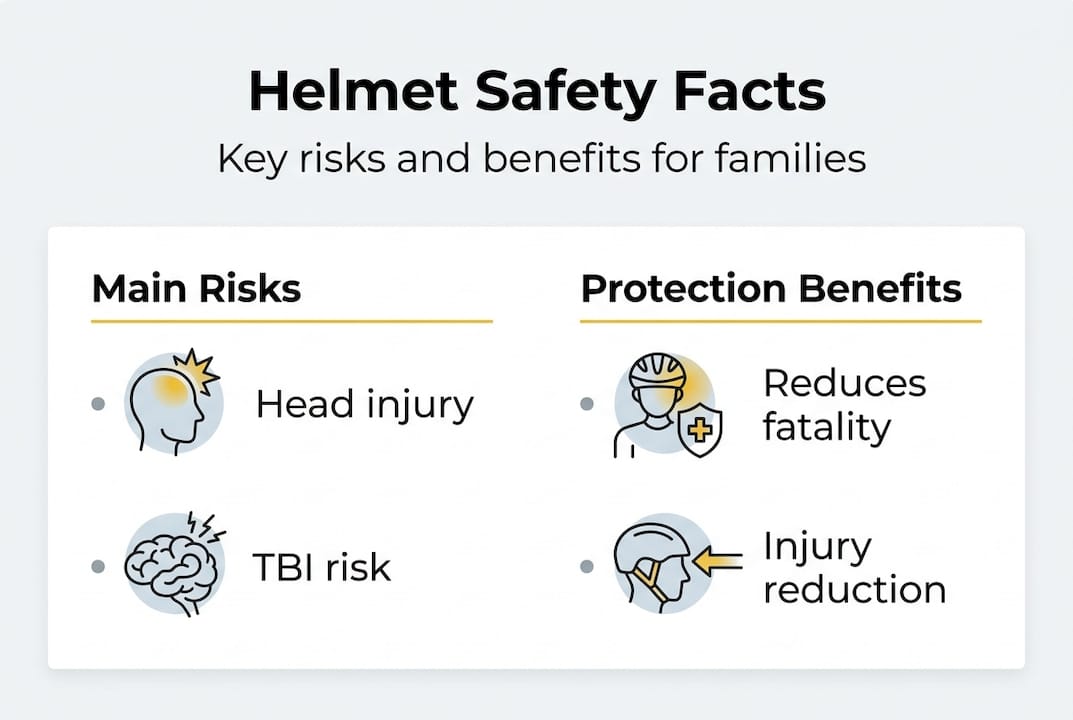
| Scenario | Helmeted head injury rate | Non-helmeted head injury rate |
|---|---|---|
| Low-speed fall (under 15 mph) | Low | Moderate to high |
| Collision with vehicle | Moderate | Very high |
| Child crash (any type) | Reduced by 60%+ | Baseline |
| Adult commuter crash | Reduced by 48 to 88% | Baseline |
For a deeper look at how helmet design and injury reduction are connected, the research is consistent and compelling across decades of data. If you are wondering whether upgrading to MIPS technology for helmets is worth it for family commuting, the answer from biomechanical research is a clear yes.
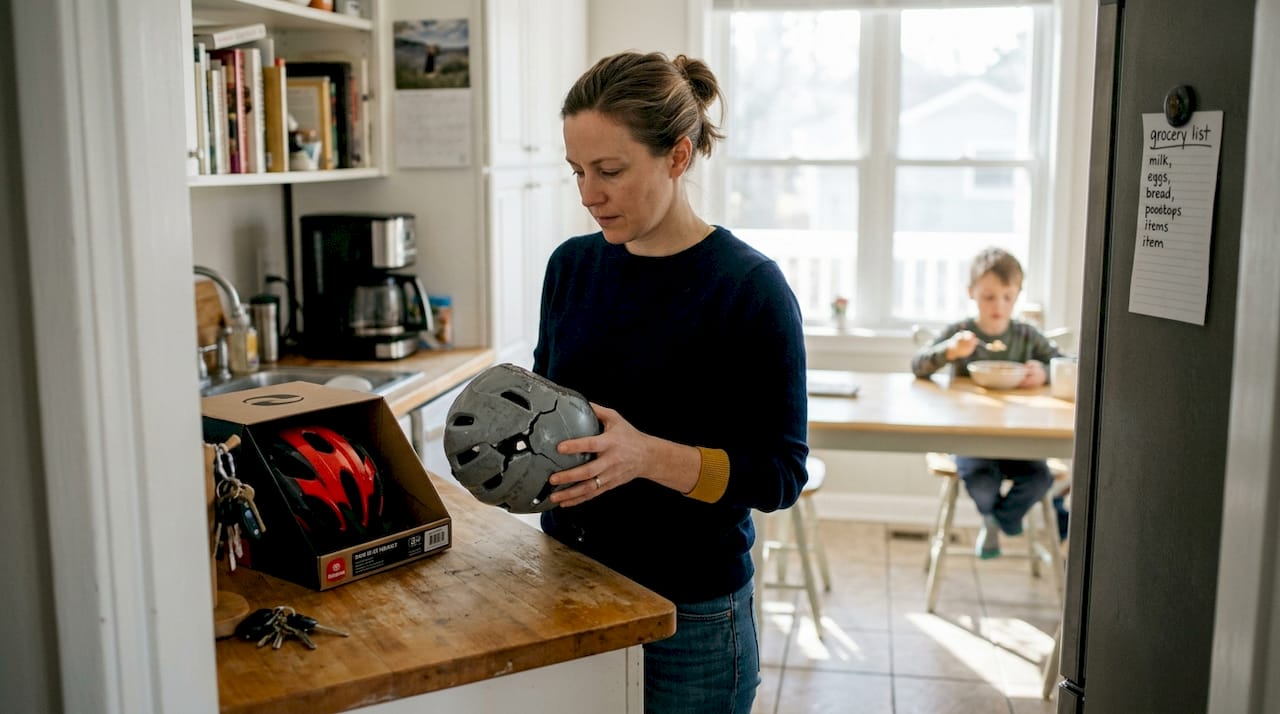
Pro Tip: Always replace a helmet after any significant impact, even if you see no visible cracks. The EPS foam compresses permanently during a crash and will not protect you the same way in a second impact.
Knowing how helmets minimize harm, let’s bust some persistent myths and clarify concerns about helmet use, especially for parents.
Debunking family helmet myths and concerns
Even safety-conscious parents sometimes hesitate. The myths around helmet use are surprisingly persistent, and some of them sound just plausible enough to create doubt. Let’s address the most common ones directly.
Myth: Helmets increase neck injury risk in children. This one circulates frequently, but the evidence does not support it. Research on pediatric cyclists shows no increased cervical spine risk from helmet use in children. The protection against head injury far outweighs any theoretical concern about neck loading.
Myth: Helmets are uncomfortable and kids will not wear them. Modern helmets are lighter, better ventilated, and more adjustable than the bulky options from a decade ago. Fit systems with dial adjusters mean a helmet can be tuned precisely for a child’s head shape, making it genuinely comfortable for a 30-minute school commute.
Myth: Helmets make no difference if you get hit by a car. Studies show that helmet benefits are clear for all ages and crash types, including vehicle collisions. The reduction in head injury severity is significant even in higher-speed impacts.
Here are quick answers to the concerns parents raise most often:
- “My child only rides short distances.” Most serious cycling injuries happen close to home, on familiar routes.
- “It messes up their hair.” A small inconvenience compared to a traumatic brain injury.
- “They say it feels weird.” Proper fit eliminates most discomfort. A poorly fitted helmet feels strange; a well-fitted one quickly becomes invisible.
- “I do not always wear mine.” Children model what they see. Parental helmet use is one of the strongest predictors of consistent child helmet use.
For a complete family cycling safety guide that covers more than just helmets, the principle is the same: habits formed early and modeled consistently are what stick.
Pro Tip: Let your kids help pick their helmet design, color, or graphics. When a child feels ownership over their gear, they are far more likely to wear it without a fight every single morning.
With misconceptions out of the way, let’s explore how to choose the best helmet for your family commute for maximum safety and style.
Choosing the safest (and most stylish) helmets for your family
Not all helmets are created equal, and the gap between a certified, well-fitted helmet and a cheap, loosely worn one is enormous in terms of real protection. Here is what to prioritize when shopping for your family.
Certification first. In the United States, look for CPSC (Consumer Product Safety Commission) certification. In Europe, EN1078 is the standard. These certifications mean the helmet has passed impact, retention, and coverage tests. Certification and proper fit are the two most critical factors in helmet effectiveness, more important than price or brand alone.
Fit is non-negotiable. A helmet that sits too high, tilts back, or wobbles side to side is not protecting your child the way it should. Measure head circumference before buying and use the size chart. For kids, look for helmets with easy-to-adjust dial retention systems that can be tweaked as they grow.
Technology matters for commuters. MIPS and similar rotational protection systems are worth the upgrade for everyday family commuting, where crashes are more likely to involve angled impacts than straight-on collisions. Reflective detailing and bright colorways also add visibility, which is a real safety benefit on morning and evening commutes.
Research confirms that helmets are effective against vehicle collisions and low-speed falls alike, and that parental modeling of helmet use directly increases compliance in children.
Use this five-point checklist when shopping for any family member:
- Fit: Sits level, two fingers above eyebrows, no wobble side to side
- Certification: CPSC (US) or EN1078 (Europe) label inside
- Comfort: Adequate ventilation for your typical commute conditions
- Visibility: Reflective elements or bright colors for low-light riding
- Kid approval: Your child actually likes how it looks and feels
For guidance on how to pick a family helmet that checks all these boxes, and for a closer look at MIPS and Wavecel helmets and how they compare, the research and product landscape in 2026 offers more genuinely good options than ever before.
The missing truth: Why helmet habits beat perfect gear
Here is something the gear industry rarely tells you: the most expensive helmet in the world does nothing sitting on a shelf. The single biggest predictor of whether a helmet will save your child’s life is whether they are wearing it on that particular ride.
We see families invest significant time researching MIPS ratings and ventilation scores, then skip the helmet on a “quick” two-block trip. That one unprotected ride is statistically where accidents happen, because familiarity breeds inattention on known routes.
The proven helmet benefits in the research literature are based on consistent use, not occasional use. Building a family routine where helmets go on before anyone touches a bike, every single time, is worth more than any technology upgrade.
“The best helmet is the one you and your child wear each ride. Science and parental modeling prove it.”
Make it automatic. Make it non-negotiable. Make it normal. That is the real safety strategy.
Ride safer and smarter: Find the right gear for your commute
At THE BEAM, we design helmets and safety gear specifically for cyclists who take real-world protection seriously. Every product in our lineup is built around the principle that great gear should make you want to ride more, not less.
From our VIRGO integral helmet with MIPS technology to the RS 1000 AI DashCam that gives you eyes on the road behind you, we have built a complete ecosystem for family commuters. Browse our full range of all cycling safety gear and find the combination that fits your family’s routes, riding style, and safety priorities. If you are part of the endurance community, check out our ultracycling event for more ways to connect with cyclists who take safety as seriously as you do.
Frequently asked questions
Do helmets really protect children during everyday short rides?
Yes, helmets reduce head injury risk for kids by over 60% in both low-speed and vehicle-involved crashes, making them essential even for the shortest neighborhood trips.
Is there any downside to young children wearing helmets?
Current research shows no increased cervical spine risk in children from helmet use, and no evidence that helmets discourage kids from cycling.
What type of helmet is best for family commuting?
Choose a CPSC or EN1078 certified helmet with a proper fit and rotational protection technology like MIPS for the best combination of safety and everyday comfort.
Do adults need helmets as much as kids when cycling with families?
Absolutely. Data shows that helmet benefits are similar for adults and children, and adult helmet use also directly increases the likelihood that children will wear theirs consistently.


