

TL;DR:
- E-bike injuries are rising but most incidents are preventable through awareness and proper safety measures.
- Knowing local laws, wearing essential gear, conducting pre-ride checks, and practicing defensive riding significantly reduce risks.
- Customized safety strategies based on rider age, experience, and environment lead to better outcomes than generic advice.
E-bike ridership in cities across the United States and Europe has surged in recent years, and so has the injury toll. In 2022, U.S. emergency rooms treated 31,000 e-bike injuries and recorded 97 fatalities, while Europe reported 184 e-bike deaths in 2021 alone. Those numbers are climbing. But here is the thing: most of those incidents were preventable. This guide cuts through the noise and walks you through a clear, step-by-step approach to urban e-bike safety, from understanding local laws to handling a crash. Follow it and you will ride with more confidence, not just more caution.
Table of Contents
- Know your e-bike and local laws
- Essential gear and bike checks before you ride
- Defensive riding techniques in traffic
- What to do during and after an incident
- Why most e-bike safety guides miss the mark
- Next-level safety: Gear up for confident rides
- Frequently asked questions
Key Takeaways
| Point | Details |
|---|---|
| Check laws first | Always know your e-bike class and local rules before riding in the city. |
| Gear up smartly | Wear a helmet and do a quick bike check every time you ride. |
| Ride defensively | Use predictable movements and stay visible to reduce accident risk. |
| React calmly to incidents | Respond safely to falls or collisions and learn from each experience. |
| Invest in safety gear | Quality helmets and accessories can make urban e-biking much safer. |
Know your e-bike and local laws
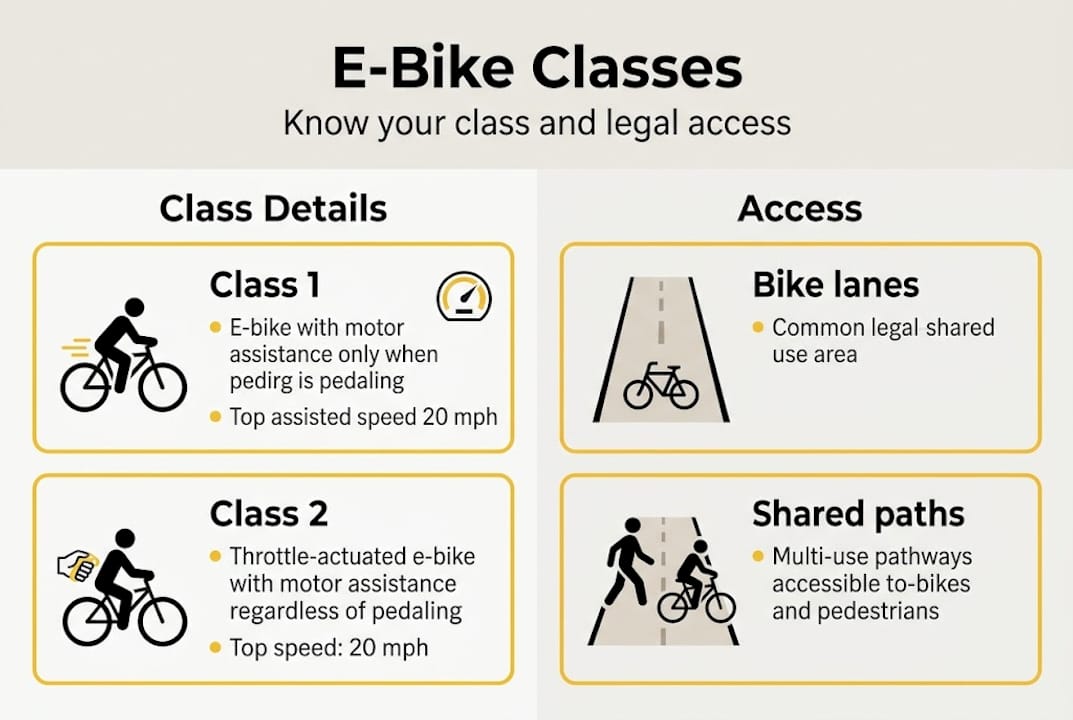
Before anything else, you need to know exactly what kind of e-bike you are riding. In the United States, e-bikes fall into three classes, each with its own rules. Class 1, 2, and 3 e-bikes differ in whether they have a throttle, how fast the motor assists, and where they are legally allowed to ride. A Class 3 bike, for example, can assist up to 28 mph, but that also means it may be banned from shared bike paths in many cities.
| Class | Max assisted speed | Throttle? | Typical access |
|---|---|---|---|
| Class 1 | 20 mph | No | Most bike lanes and paths |
| Class 2 | 20 mph | Yes | Most bike lanes and paths |
| Class 3 | 28 mph | No (usually) | Roads, some bike lanes only |
In Europe, the rules are different. Most countries follow the EU regulation capping motor assistance at 25 km/h (about 15.5 mph). Anything faster is legally classified as a moped, which requires registration, insurance, and sometimes a license. Knowing which side of that line your bike sits on is not just legal trivia. It determines where you can ride, how fast, and what protective equipment is expected of you.
Helmet laws are another area where the rules vary dramatically. New York City requires helmets for Class 3 riders and delivery workers, while states like Connecticut have broader helmet mandates. Across Europe, countries like Spain require helmets on the road but not in designated urban zones. The commuter cycling laws and essentials worth knowing go beyond helmets and include light requirements, lane rules, and phone use restrictions.
- Always check your city or state’s specific rules, not just the federal or national framework
- Know which paths are open to you: multi-use trails often have lower speed caps for e-bikes
- Riding outside your class’s legal zone can void your insurance and increase liability in a crash
Pro Tip: Take a photo of your e-bike’s classification label (usually on the frame or in the manual) and keep it on your phone. If you are ever stopped or need to report an incident, you will have the info immediately.
Understanding the law is the foundation. Everything else in this guide builds on it.
Essential gear and bike checks before you ride
Knowing your e-bike class is step one. Step two is making sure you and your bike are physically ready to handle city traffic. This part is non-negotiable.
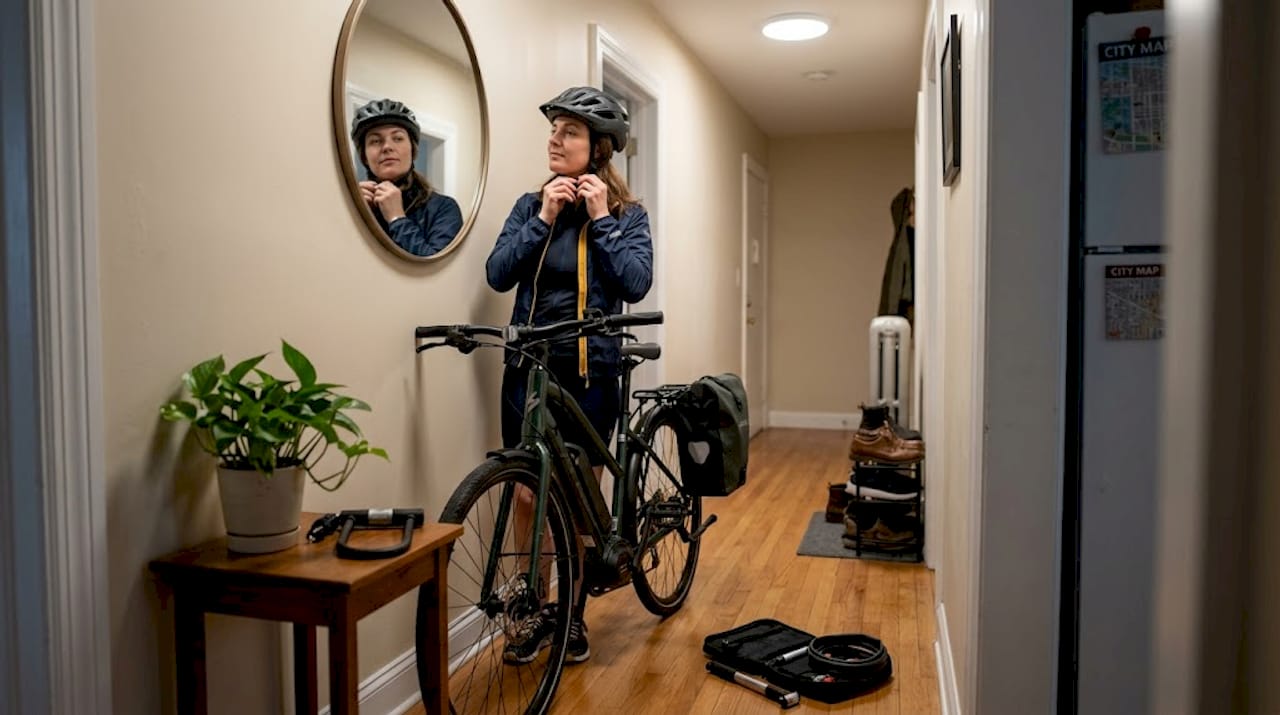
Start with your helmet. Low helmet use is one of the most consistently cited risk factors in e-bike injury and fatality studies. A certified helmet is your single most effective piece of protective equipment. For urban and e-bike riders, we recommend a full-face or urban integral helmet with MIPS technology, which reduces rotational forces on the brain during angled impacts. Beyond the helmet, reflective gear and front and rear lights are essential, especially if you ride at dawn, dusk, or in low-visibility conditions.
Next, run a quick pre-ride inspection. It takes less than three minutes and can prevent mechanical failures mid-ride.
- Brakes: Squeeze both levers firmly. They should engage before the lever reaches the handlebar. If not, adjust immediately.
- Tire pressure: Check the sidewall for the recommended PSI range and use a gauge. Under-inflated tires reduce control and increase puncture risk.
- Battery charge: Confirm your battery level before heading out. Running out mid-route can force you onto busy roads without motor assistance.
- Lights: Test both front and rear lights, especially if you use rechargeable units. Dim lights are nearly as dangerous as no lights.
- Chain and drivetrain: Give the pedals a few spins in a stationary position. Listen for grinding or skipping, which signals a maintenance issue.
| Item | What to check | Red flag |
|---|---|---|
| Helmet | Straps snug, no cracks | Loose fit or visible damage |
| Tires | Correct PSI, no visible wear | Bulging, cracking, or low pressure |
| Brakes | Full engagement before lever bottoms | Soft or spongy feel |
| Battery | Charged to intended route length | Below 20% for longer rides |
| Lights | Front white, rear red, both functional | Flickering or dead |
For a more detailed workflow, the bicycle safety checklist we put together walks you through each inspection point systematically. You can also browse ebike safety accessories to fill any gaps in your current setup.
Pro Tip: Keep a small saddle bag with a mini pump, a spare inner tube, and a basic multi-tool. It weighs almost nothing and can save a ride.
Defensive riding techniques in traffic
You are geared up and legally compliant. Now comes the part most riders underestimate: how you actually behave in traffic.
Collisions account for 33 to 50% of U.S. e-bike injuries, with rider error contributing to 45% of incidents. Those numbers tell a clear story. Most accidents are not random bad luck. They come from predictable mistakes, and they can be reduced with a deliberate riding strategy.
Here is a step-by-step approach to defensive riding:
- Make yourself visible: Wear bright or reflective gear, keep your lights on even in daylight, and avoid riding in a driver’s blind spot.
- Claim your lane: Riding too close to the curb is risky. Position yourself about one meter from parked cars to avoid getting doored.
- Make eye contact: At intersections, look directly at drivers before proceeding. If they see you, proceed. If you are not sure, wait.
- Signal every move: Use hand signals for turns and lane changes consistently. Predictability is your best protection.
- Match traffic speed where safe: E-bikes in protected lanes and those matching car speeds in low-speed zones see reduced collision rates.
- Scan ahead aggressively: Look 10 to 15 seconds ahead. Spot the opening car door, the pedestrian stepping off the curb, the truck pulling out before they become a problem.
“The best accident is the one you see coming and avoid entirely. Defensive riding is not about being timid. It is about processing your environment faster than the hazard develops.”
Some of the most dangerous situations urban e-bike riders face include:
- Right-hook turns from cars cutting across your path
- Sudden lane changes from vehicles that did not check their mirrors
- Dooring from parked car occupants swinging doors open
- Pedestrians stepping into bike lanes without looking
For city-specific strategies, the urban traffic safety tips we have compiled cover real-world scenarios across different urban layouts. Protected bike infrastructure helps, but defensive habits matter on every road type.
What to do during and after an incident
Even the most prepared riders can go down. How you respond in those first moments matters more than most people realize.
In Europe, up to 55% of e-bike incidents are single-vehicle falls, meaning no other vehicle is involved. Older adults are particularly vulnerable due to the higher speeds and weight of e-bikes compared to traditional bicycles. Knowing how to respond quickly and calmly can reduce secondary injury and make the recovery process smoother.
If you fall or collide, follow these steps:
- Stop moving and assess: Before standing up, take five seconds to check whether you are in a safe location. If you are in traffic, move to the curb immediately.
- Check for injuries: Run through a quick mental scan: head, neck, shoulders, wrists, hips, knees. Do not ignore pain or tingling. These can be signs of serious injury even without visible bleeding.
- Secure your bike: Move it off the road or path to prevent secondary incidents.
- Call for help if needed: Do not try to tough out serious symptoms. Head impact, chest pain, or loss of sensation always warrants a medical evaluation.
- Document everything: If another vehicle or person was involved, photograph the scene, the damage, road conditions, and any relevant signage. Collect witness contact details while you are still at the location.
After the incident, do not skip the follow-up:
- File a report with police if another party was involved, even for minor collisions
- Contact your insurer as soon as possible with your documentation
- Review what happened: Was it speed? Visibility? Distraction? Pinpoint the factor and adjust your habits accordingly
- Inspect your helmet: Any impact means the helmet may need replacement, even if there is no visible damage. MIPS helmets absorb energy on impact and the internal liner may be compromised
For a broader look at preparation before things go wrong, the advanced safety tips we share apply equally well to urban commuters.
Why most e-bike safety guides miss the mark
Most safety guides treat e-bike riders as a single group. That is where they go wrong. The reality, backed by research, is that risk profiles vary enormously depending on your age, experience level, city infrastructure, and the specific type of riding you do. Some studies show lower per-kilometer risk for e-bikes versus traditional bikes, while others document higher injury severity, particularly for novice and elderly riders.
Copying generic advice without filtering it through your own context is not just unhelpful. It can be actively misleading. A 65-year-old commuter in Amsterdam faces a very different risk landscape than a 30-year-old daily rider in Los Angeles. The former needs to focus on fall prevention and low-speed stability. The latter needs aggressive traffic visibility strategies.
At THE BEAM, we work with riders across France, Germany, and the United States, and one consistent finding stands out: riders who adapt their safety strategy to their local environment and personal vulnerabilities have far better outcomes than those who follow a one-size-fits-all checklist. Start with the core safety tips and then customize from there based on your city, your route, and your experience level. That personalized approach is what separates confident riders from cautious ones.
Next-level safety: Gear up for confident rides
You now have a clear, step-by-step framework for safer urban e-bike riding. The next logical move is making sure your gear matches the standard your riding deserves.

At THE BEAM, we design helmets and accessories specifically for riders who take urban and e-bike safety seriously. Our HELMETS collection includes the VIRGO integral helmet with MIPS technology, built for the demands of city traffic and higher e-bike speeds. Pair it with our accessories for e-bike riders, including rear-view mirrors, high-visibility reflectors, and connected safety tools that keep you seen and protected. Good gear is not optional. It is the physical backup to every smart decision you make on the road.
Frequently asked questions
Do I legally need to wear a helmet on my e-bike?
Helmet laws for e-bikes vary by location. Some states require helmets for all riders or specific e-bike classes, while others only mandate them for minors, so always verify the rules where you ride.
How fast can I go on an e-bike in the city?
Most U.S. cities cap e-bike motor assistance at 20 mph, though NYC sets its limit at 15 mph; in Europe, the standard legal maximum is 25 km/h (about 15.5 mph) for pedal-assist e-bikes.
What are the most common causes of e-bike crashes?
Collisions, rider error, and low helmet use are the leading factors in e-bike injuries, with single-rider falls being especially common in Europe among older adults.
Are e-bikes safer or riskier than regular bicycles?
The answer depends on the rider. Some research shows lower per-km risk for e-bikes in traffic, but injury severity tends to be higher for inexperienced or elderly riders due to greater speed and bike weight.


