

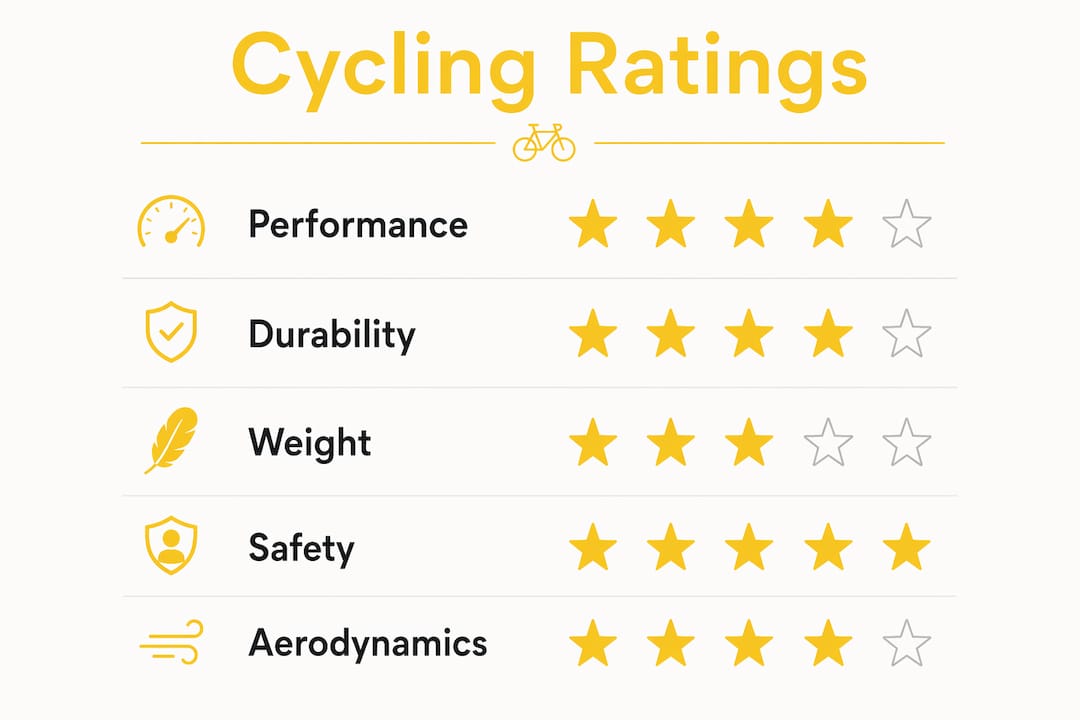
Cycling equipment ratings give you a fast, standardized way to compare gear before you spend a dollar. At their core, ratings translate raw performance data, safety test results, and durability assessments into a score you can act on. Most gear reviews use a 0–5-star scale that weighs performance against cost, durability, and desirability. Safety ratings like the Virginia Tech STAR system go further, predicting the actual percentage by which a helmet reduces concussion risk. Understanding cycling equipment ratings means knowing what each scale measures, what it leaves out, and how to match a score to your specific riding style.
What cycling equipment ratings typically measure:
- Performance: Speed, efficiency, power transfer, or aerodynamic drag reduction
- Safety: Impact protection levels, concussion risk reduction (Virginia Tech STAR), and legal certification compliance (CPSC, EN 1078)
- Durability: Component lifespan under real-world conditions, corrosion resistance, and maintenance intervals
- Ride feel: Subjective smoothness, shifting quality, and comfort under load
- Value: Performance delivered relative to price paid
No single rating captures all of these at once. A five-star drivetrain rating might reflect shifting precision but say nothing about how the component holds up in wet mud. That gap is exactly why reading ratings critically, rather than just chasing the highest number, produces better buying decisions.
How bike gearing and drivetrain components affect ratings
Gear ratio is the foundation of every drivetrain performance rating. It describes the relationship between how many times the rear wheel turns for each full pedal revolution, calculated by dividing the number of teeth on the front chainring by the number of teeth on the rear sprocket. A 50-tooth chainring paired with a 11-tooth sprocket produces a ratio of roughly 4.5:1, meaning the wheel turns 4.5 times per pedal stroke. High ratios push more speed; low ratios deliver more torque for climbing.
The main drivetrain components that ratings evaluate:
- Chainrings: The front gears attached to the crankset; tooth count determines the high end of your gear range
- Cassette: The cluster of rear sprockets; wider tooth-count spreads (like 10–51t) earn higher ratings for versatility
- Derailleurs: Front and rear mechanisms that move the chain; rated on shift speed, accuracy, and durability
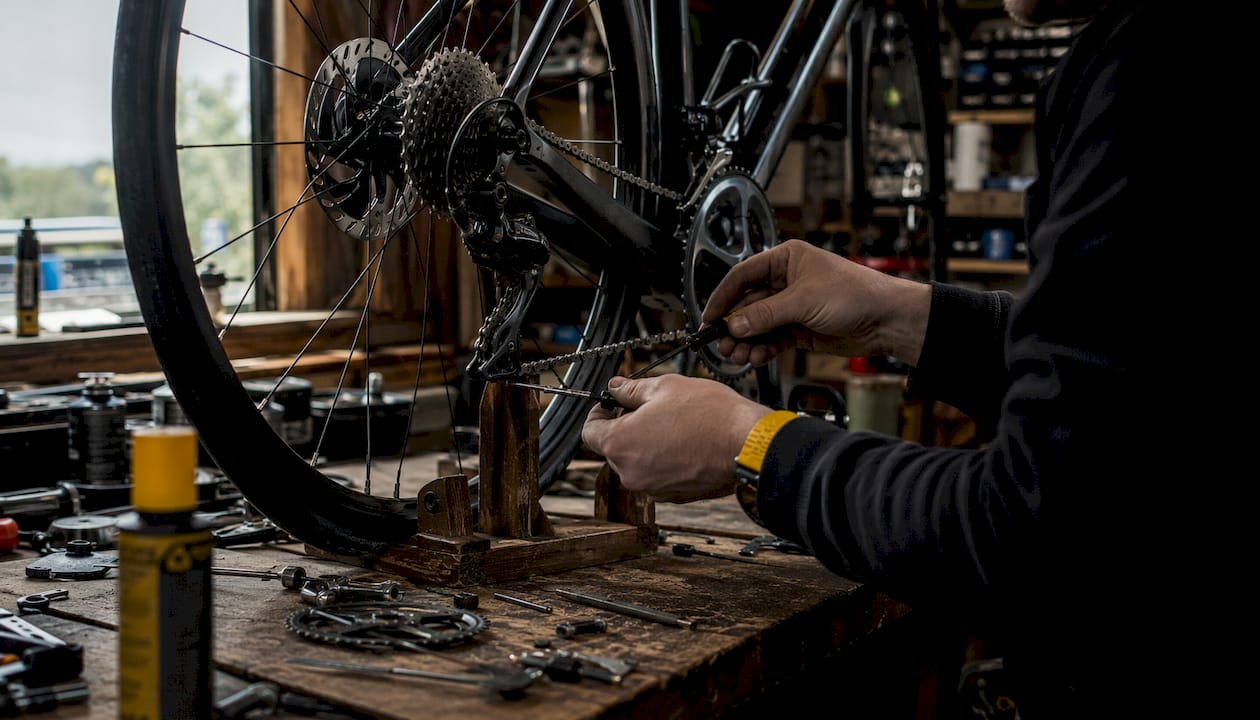
- Chain: Evaluated on wear rate, lubrication retention, and compatibility with cassette and chainring materials
- Crankset: The arm-and-chainring assembly; rated on stiffness-to-weight ratio and power transfer efficiency
| Component | Primary rating criteria | Why it matters |
|---|---|---|
| Cassette | Gear range, weight, material | Determines climbing and sprinting versatility |
| Derailleur | Shift speed, accuracy, durability | Affects reliability across terrain and conditions |
| Chain | Wear rate, compatibility | Drives long-term maintenance costs |
| Crankset | Stiffness, weight | Influences power transfer efficiency |
| Chainring | Tooth profile, material | Affects chain retention and shift quality |
Objective rating criteria for drivetrains typically measure shift accuracy under load, resistance to contamination, and component weight. Subjective criteria add ride feel and the quality of the shift “click.” Both matter, and the best ratings combine them rather than relying on specs alone.
Pro Tip: When comparing drivetrain ratings, check whether the tester weighted shift accuracy or durability more heavily. A component rated highly for race-day precision may score lower for commuter longevity, and vice versa.
How road bike gearing ratings work in practice
Road bike gearing ratings focus on three performance scenarios: flat-speed sprinting, sustained climbing, and time trial efficiency. A compact double crankset (50/34t) paired with an 11–32t cassette covers most road terrain and earns strong versatility ratings. A standard double (53/39t) with an 11–25t cassette rates higher for flat-course speed but lower for steep grades.
Key rating factors for road gearing:
- Gear range: Wider ranges score better for mixed terrain; narrow ranges score better for pure speed
- Shift quality under load: Rated on how cleanly the chain moves when the rider is pedaling hard
- Weight: Lighter components earn higher ratings in performance-focused reviews, though the gains are often marginal
- Aerodynamic interaction: Frame and wheel aerodynamics compound drivetrain efficiency; aerodynamic frames can save 1.5–2.5 minutes over 40 km compared to standard round-tube frames
Road bike ratings also reflect the aerodynamic contribution of wheels. Aerodynamic wheelsets can improve time trial performance by 60–82 seconds over 40 km compared to conventional box-section rims. That kind of measurable gain is why wheel ratings carry significant weight in road cycling gear comparisons.
One nuance worth knowing: a top-tier drivetrain rating does not automatically mean better road performance for most riders. The core shifting technology in a mid-tier group is often identical to the flagship version. Spending on wheels and tires typically yields more tangible improvement per dollar than upgrading to the most expensive drivetrain available.
What mountain bike gear ratings actually tell you
Mountain bike gearing ratings prioritize a different set of values than road ratings. Terrain adaptability, mud clearance, and component toughness matter far more than aerodynamics or marginal weight savings. Most modern trail and enduro setups run a 1x drivetrain (single chainring up front) with a wide-range cassette, often spanning 10–51 teeth or wider. That range earns high versatility ratings for mixed singletrack but would score poorly on a road-focused scale that rewards tight gear spacing.
Mountain bike rating criteria that differ from road:
- Mud clearance: Derailleur cage geometry and chain guide compatibility; rated on performance in wet, packed, and loose conditions
- Shifting reliability under stress: Tested with lateral chain tension and impact loads that simulate rock strikes
- Clutch mechanism quality: Rear derailleurs with clutch systems earn higher ratings for chain retention on rough terrain
- Cassette material: Steel cassettes rate higher for durability; aluminum cassettes rate higher for weight but lower for longevity
- Chainring retention: Narrow-wide tooth profiles score well for chain security without a guide
A high mountain bike drivetrain rating reflects how the component performs when the trail gets technical, not how fast it shifts on a smooth road. Riders who cross-reference road and mountain ratings without accounting for this difference often end up with gear that excels in the wrong environment. Always check what terrain the tester used when assigning the score.
Pro Tip: For mountain bike gear, prioritize ratings from testers who specify their trail type. A rating earned on hardpack singletrack tells you little about how a derailleur handles deep mud or creek crossings.
Gravel and cyclocross gearing: reading ratings for mixed terrain
Gravel and cyclocross riders sit between road and mountain disciplines, and their gear ratings reflect that compromise. A typical gravel setup uses a 1x drivetrain with a 40t or 42t chainring and a 10–42t or 10–50t cassette, balancing enough top-end speed for paved sections with low enough gearing for steep dirt climbs. Cyclocross setups often favor a 2x drivetrain for tighter gear spacing on courses that mix pavement, grass, and barriers.
Gravel and cyclocross rating considerations:
- Versatility score: Ratings that evaluate a component across multiple surface types are more useful than single-surface tests
- Mud shedding: Cyclocross-specific ratings test how quickly a drivetrain clears mud between obstacles
- Tire clearance interaction: Frame and fork ratings for gravel bikes include clearance measurements, since wider tires affect handling ratings
- Durability under mixed conditions: Components rated for gravel use are tested for both road vibration and offroad shock loads
- Shift quality at varied cadences: Gravel riders frequently change pace; ratings that test shifting at both low and high cadence are more predictive
The most common misreading of gravel ratings is treating a high road score as a proxy for gravel suitability. A derailleur rated excellent for road use may lack the clutch mechanism needed to prevent chain drop on rough gravel. Check whether the rating explicitly covers mixed-surface use before applying it to a gravel build.
How to interpret ratings with safety and performance in context
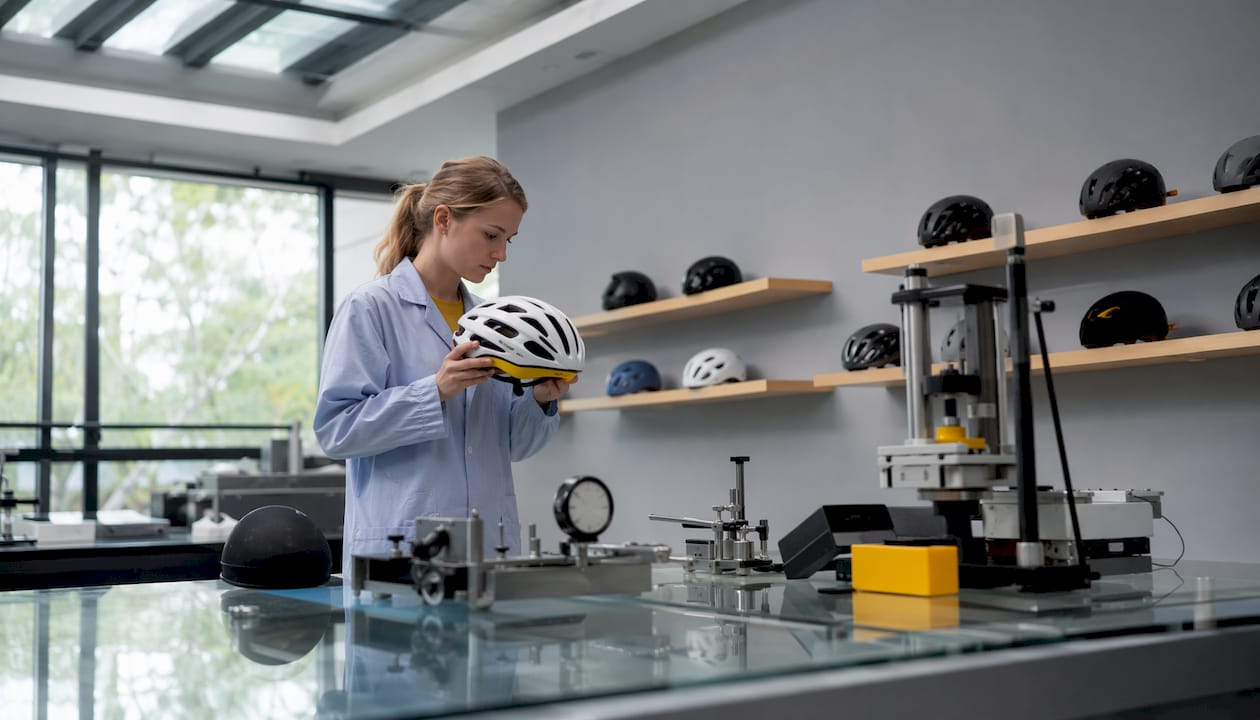
The Virginia Tech STAR rating is the most rigorous independent safety rating system available for cycling helmets in the United States. It uses 24 laboratory drop tests per helmet, targeting six specific impact locations at both high and medium force levels that replicate real crash velocities. The result is a STAR score on a one-to-five scale that directly predicts concussion risk reduction: a one-star helmet reduces concussion risk by less than 40%, while a five-star helmet cuts that risk by significantly more than 70%.
Safety callout: A CPSC certification sticker on a helmet confirms it meets the legal minimum to be sold in the U.S. It does not tell you how well the helmet actually protects you. The Virginia Tech STAR rating does.
The distinction between legal certification and independent performance rating is one of the most misunderstood areas in cycling gear. CPSC certification sets a floor, not a ceiling. A helmet can pass CPSC testing and still earn only a two-star STAR rating, meaning it offers meaningfully less protection than a five-star alternative at the same price point. The Virginia Tech database currently ranks many cycling helmets, and a large portion of the top tier earned five stars, including several models priced well under $100.
Thebeamofficial applies this same principle across its product line. The VIRGO integral helmet carries MIPS technology, which addresses the rotational acceleration component that standard certifications ignore but Virginia Tech explicitly tests. Understanding helmet safety ratings means recognizing that MIPS and high STAR scores address the same underlying physics: rotational forces on the brain during an oblique impact.
Common pitfalls when reading cycling equipment ratings:
- Treating star ratings as absolute rather than relative to the test conditions used
- Ignoring whether a rating was earned under objective or subjective criteria
- Assuming a higher price always correlates with a higher rating
- Applying a road-specific rating to mountain or gravel use without checking the test context
- Confusing legal safety certifications with independent performance ratings
Pro Tip: Cross-reference at least two independent rating sources before buying. A 1–5 grading scale from one tester weighted for power accuracy will score the same product differently than a scale weighted for ride feel. Neither is wrong; they just answer different questions.
Thebeamofficial’s approach to safety gear reflects what the best rating systems demand: real-world testing, transparent criteria, and products built to exceed the legal minimum rather than merely meet it. The FRAME FLASH reflectors and CORKY rearview mirror, for example, address visibility, a factor that no drivetrain rating covers but that directly affects rider safety on every ride. Ratings for cycling equipment durability also matter here: a safety accessory that fails after one season offers no protection at all.
The rider’s own fitness and technique remain the largest performance variables. Gear ratings are decision tools, not guarantees. A five-star helmet protects better than a two-star one regardless of who wears it, but a perfectly rated drivetrain won’t close the gap between a trained and untrained rider on a climb.
Ride safer with gear that earns its rating
Thebeamofficial designs helmets and safety accessories built to perform where ratings are tested: in real crashes, at real speeds, in real conditions. The VIRGO helmet with MIPS technology targets the rotational impact forces that Virginia Tech measures and that standard certifications ignore.
Browse the full helmet collection to find five-star-level protection that fits your riding style, whether you’re on road, gravel, or urban streets.
Key Takeaways
Gear ratings combine objective measurements and subjective criteria, but no single score covers every riding context, so always match the rating’s test conditions to your actual use case.
| Point | Details |
|---|---|
| STAR ratings predict real protection | Virginia Tech’s five-star helmets reduce concussion risk by significantly more than 70%; one-star helmets reduce it by less than 40%. |
| Certifications set a floor, not a ceiling | CPSC approval means a helmet is legal to sell, not that it protects well; independent ratings differentiate actual performance. |
| Gear ratio drives drivetrain ratings | Chainring and cassette tooth counts determine speed and climbing range, the core variables in any drivetrain performance score. |
| Aerodynamic wheels move the needle | Aerodynamic wheelsets can improve 40 km time trial performance by 60–82 seconds compared to conventional box-section rims. |
| Match the rating to your terrain | Road, mountain, and gravel ratings use different test criteria; a high score in one discipline does not transfer automatically to another. |


