

TL;DR:
- Helmet ventilation depends on internal airflow design, not just the number of vents.
- Modern helmets balance safety and breathability through engineered channel systems and impact-absorbing materials.
- Testing helmets in real conditions provides the best assessment of their cooling performance for your riding environment.
Most cyclists assume that counting vents on a helmet tells you everything you need to know about how well it breathes. Count the holes, pick the winner. Simple. Except that logic falls apart the moment you compare two helmets side by side on a long summer climb and realize the one with fewer vents keeps your head noticeably cooler. Ventilation is one of the most misunderstood features in cycling gear, and getting it wrong costs you comfort, focus, and potentially safety. This guide breaks down what helmet ventilation actually means, how airflow design interacts with impact protection, and what to look for when choosing your next helmet.
Table of Contents
- Understanding helmet ventilation: What it really means
- How helmet ventilation and safety work together
- Key ventilation concepts and airflow designs
- How to choose the right helmet ventilation for your rides
- The surprising truth: Why more vents aren’t always better
- Explore advanced helmet options at The Beam
- Frequently asked questions
Key Takeaways
| Point | Details |
|---|---|
| Vent count isn’t everything | Number of holes matters less than smart airflow paths and overall helmet design for cooling and comfort. |
| Safety and ventilation can coexist | Innovative liner technologies let cyclists enjoy both robust protection and breathability in modern helmets. |
| Choose for your ride | Match helmet ventilation features to your typical climate, speed, ride duration, and comfort needs. |
| Test in real conditions | Trying helmets in your usual environment is the best way to tell if ventilation concepts will actually work for you. |
Understanding helmet ventilation: What it really means
Helmet ventilation is not simply the number of holes cut into a shell. At its core, ventilation describes the entire system that moves air across your scalp, including the size and shape of openings, the internal channels that guide airflow from front to back, the liner material that either traps or releases heat, and the fit that determines how close the helmet sits to your head.
The primary goals of a well-ventilated helmet are:
- Cooling: Moving warm air away from your scalp to prevent overheating during sustained effort
- Sweat management: Encouraging evaporation rather than letting moisture accumulate at contact points
- Reducing fogging: Particularly relevant for cyclists wearing integrated visors or glasses
- Sustained comfort: Keeping your core temperature in check so you can maintain focus and power output over long rides
One persistent myth is that adding more vents automatically improves airflow. In reality, a helmet with 30 shallow, poorly positioned vents can perform worse than one with 18 deep vents connected by a continuous internal channel. The shell geometry, vent angle relative to your riding position, and how air exits the back of the helmet all determine real-world performance.
“A helmet that looks airy on a shelf may trap heat on the road. True ventilation is an engineered system, not a count.”
Another misconception is that ventilation and safety exist on opposite ends of a spectrum, meaning the more open the helmet, the less protective it is. While there is a real engineering tradeoff between material coverage and airflow, modern design has narrowed that gap considerably. As helmet safety research explores non-traditional liner technologies, it becomes clear that protection and breathability can be pursued together rather than traded off against each other. Understanding why helmet ventilation matters for both daily commuters and performance riders is the first step toward making a smarter buying decision.
How helmet ventilation and safety work together
For decades, the cycling industry relied almost exclusively on EPS foam (expanded polystyrene) as the primary liner material. EPS absorbs impact energy effectively, but it is dense, it does not breathe, and it compresses permanently on impact, meaning a helmet that takes a serious hit should be replaced. Ventilation was achieved by cutting channels into the foam and aligning them with shell openings. This worked, but it always involved removing foam material, which reduced the protective coverage area.
Recent research has started to challenge that compromise directly. Air-filled helmets reduce linear brain injury risk by 44.1% compared to the best-performing EPS helmet under oblique impacts. This is a significant finding because oblique impacts, the kind where your head hits the ground at an angle, are far more common in real crashes than straight-on linear impacts. Air-filled chambers can absorb and redirect energy in ways rigid foam cannot.
Here is a quick comparison of the three main liner approaches:
| Liner type | Impact absorption | Ventilation potential | Weight | Replaceability |
|---|---|---|---|---|
| EPS foam | Good (linear) | Moderate (channel-dependent) | Light | No |
| Air-filled chambers | Excellent (oblique) | High potential | Variable | Some designs allow it |
| Hybrid (foam + air) | Very good | Good | Moderate | Partial |
Tracking helmet technology trends shows a clear direction: the industry is moving toward materials that serve double duty. Helmets with non-traditional liners can potentially allow more airflow through the structure itself, not just around it, while also improving the type of protection that matters most in real crashes.
Crucially, the number of vents does not determine how safe a helmet is. A helmet with many vents but a compromised liner or poor fit offers far less protection than one with fewer vents and a well-engineered shell. When evaluating integrated helmet design, the question to ask is whether every element works together as a system, not whether any single feature looks impressive on its own.
Pro Tip: When comparing helmets, look for certifications and test data specific to oblique impact performance, not just standard drop tests. A helmet that scores well under both linear and oblique impact scenarios offers the most complete protection.
Key ventilation concepts and airflow designs
Understanding the vocabulary of helmet airflow helps you cut through marketing language and evaluate helmets on their actual merits. There are two broad categories of ventilation: active and passive.

Passive ventilation relies entirely on your forward motion to push air through the helmet. The faster you ride, the more air moves through the system. Most road and recreational helmets use passive ventilation. It works well at speed but can feel stuffy at low speeds or during stop-and-go urban riding.
Active ventilation involves adjustable elements, such as closeable vents or internal baffles, that let you control airflow based on conditions. Some mountain bike helmets and commuter models offer this feature, allowing you to seal vents in cold or wet weather while opening them fully in summer heat.
Within those two categories, three structural elements define how well any ventilation system performs:
- Intake vents: Located at the front of the helmet, these capture oncoming air and direct it into internal channels. Their size, angle, and number determine how much air enters the system. Deep, wide intake vents angled toward a cyclist’s typical head position (slightly forward, chin down) outperform shallow decorative openings.
- Exhaust ports: Positioned at the rear of the helmet, exhaust ports allow warm air to escape. Without effective exhaust, air stagnates inside the helmet regardless of how open the front is. Helmets with a pronounced rear spoiler or raised trailing edge often use this geometry to create a low-pressure zone that pulls hot air out.
- Air channels: These are the internal pathways cut through the liner that connect intake vents to exhaust ports. Channel depth, continuity, and alignment with your scalp determine whether air actually moves across your head or simply enters and exits without making contact.
Helmet aerodynamics and speed are closely linked to vent placement. Helmets designed for high-speed road riding often use fewer, narrower vents to reduce drag while maintaining airflow through well-placed channels. In contrast, endurance and gravel helmets prioritize maximum cooling, sometimes accepting slightly more drag in exchange for comfort on long, slower days in the saddle.
Athletes in other endurance sports face similar tradeoffs, and cooling innovations for athletes continue to confirm that effective heat management is less about surface area and more about directing flow precisely where it matters most. The same principle applies to your helmet.
As helmet safety tests evolve to examine ventilation features alongside impact scenarios, manufacturers face pressure to prove their airflow claims rather than simply marketing them. This is good news for cyclists because it pushes the industry toward designs that actually deliver on both fronts.
How to choose the right helmet ventilation for your rides
Choosing a helmet based on ventilation starts with understanding your own riding conditions, not the conditions shown in a product photo shoot. A well-ventilated helmet for a criterium racer in southern France performs very differently for a daily commuter in a humid coastal city.
Here is a practical checklist to guide your decision:
- Environment: Hot and dry climates benefit from maximum airflow. Humid environments require sweat management at contact points as much as raw cooling.
- Speed: If you ride fast, passive ventilation works well. Slower, urban riding means you need either active vents or a design optimized for low-speed airflow.
- Ride duration: Short commutes tolerate some heat buildup. Multi-hour rides demand consistent temperature regulation throughout.
- Fit: A helmet that sits too high or too low on your head disrupts the alignment between vents and your scalp. Even the best ventilation system underperforms if the helmet does not fit correctly.
- Weight: Highly ventilated helmets sometimes carry more weight because deeper channels require additional structural support. Decide whether cooling or total weight matters more for your riding style.
When to prioritize maximum cooling: If you ride more than two hours in temperatures above 75°F (24°C), or if you climb regularly and spend extended time at low speed, maximal ventilation should rank very high on your list. Heat stress degrades both physical performance and cognitive function, and your helmet is the one piece of gear that sits directly on your head for the entire ride.
As manufacturers explore liner technologies with both impact and airflow benefits, the options available to cyclists are expanding. It is worth looking at how to choose a cycling helmet using a structured approach, and pairing that with a proper step-by-step helmet fitting to make sure the ventilation channels actually align with your head geometry.
Pro Tip: If possible, test a helmet in-store by holding it near a fan or riding briefly in warm conditions. The difference between two helmets can be dramatic, and no spec sheet captures that as clearly as five minutes of real airflow on your scalp.
The surprising truth: Why more vents aren’t always better
Here is something the cycling industry rarely says out loud: the vent count printed in a product description is one of the least useful numbers in cycling gear. We have seen cyclists choose helmets based purely on that figure, the way you might pick a computer based on core count without looking at how those cores actually perform together. It rarely ends well.
What actually distinguishes a high-performing helmet comes down to three things that are harder to photograph: channel continuity, liner technology, and fit-to-ventilation alignment. A helmet can have 28 vents, but if those vents feed into shallow channels that dead-end before reaching the back of your head, you get very little real cooling. Meanwhile, a helmet with 16 deep, well-placed vents connected by a continuous channel system moves more air across more of your scalp.
The liner research makes this even more interesting. As noted, air-filled chambers protect against the kinds of impacts that foam struggles with, and they may also open new possibilities for airflow through the structure of the helmet itself, not just around it. But the primary point of that research is protection mechanisms, not thermal ventilation efficiency. That distinction matters because it tells us where the real innovation is happening: not in cutting more holes, but in rethinking what sits between your head and the road.
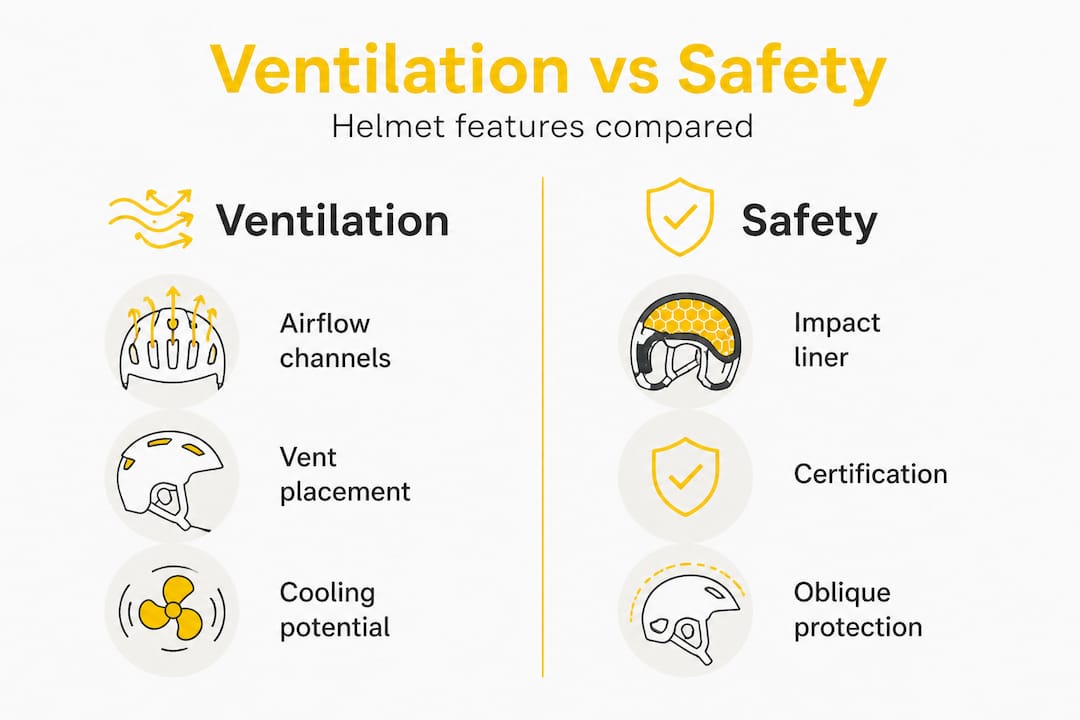
The marketing around helmet ventilation often conflates aesthetics with engineering. A helmet that looks open and airy signals cooling to a consumer, even if the airflow paths are poorly designed. At THE BEAM, we find that cyclists who understand helmet design and urban cyclist safety at a deeper level make much better purchasing decisions and ultimately wear their helmets more consistently because the fit and comfort actually work for them. The best helmet is not the one with the most vents. It is the one engineered to move air effectively across your specific head, in your specific riding conditions, while providing the protection level the situation demands.
Explore advanced helmet options at The Beam
You now know what separates a well-ventilated helmet from one that just looks the part. That knowledge changes how you shop.

At THE BEAM, we design helmets that treat ventilation as an integrated system, not a feature added after the fact. Our helmet range covers road, gravel, urban, and e-bike riding, with each model engineered around real airflow paths, tested protection standards, and the kind of fit that keeps ventilation channels aligned where they belong on your head. If you are looking for something built for longer rides and warmer conditions, our adults’ helmets offer a strong starting point. Explore the collection, compare the liner technologies, and use what you have learned here to ask the right questions before you buy.
Frequently asked questions
Do more helmet vents always mean better airflow?
No. Vent placement and airflow channel design play a far bigger role in real-world cooling than simply having more openings, and a poorly channeled helmet with many vents can underperform a well-engineered helmet with fewer.
Can advanced helmet liners improve both ventilation and safety?
Emerging designs like air-filled chamber helmets reduce injury risk under oblique impacts and are being explored for impact mitigation, but their primary benefit is superior protection rather than cooling.
How can I test if a helmet’s ventilation works for me?
The most reliable method is trying helmets on in-store or during a short test ride in your typical conditions, since actual airflow across your scalp tells you more than any specification sheet.
What factors should influence my helmet ventilation choice?
Your riding environment, average speed, climate, ride duration, and head fit all directly affect how well any ventilation system performs, so prioritize those variables over vent count when comparing options.


