

TL;DR:
- Crash detection relies on analyzing both linear and rotational motion data to identify impacts accurately.
- System performance varies, with best accuracy around 93.7% in controlled conditions but lower in real-world riding.
- Effective helmets balance sensitivity with false alarm reduction, using multi-stage alerts and user adjustments.
Your helmet can call for help when you can’t. That’s the quiet promise behind crash detection technology, and it’s more sophisticated than most cyclists realize. A single unexpected fall can leave you unconscious, disoriented, or unable to reach your phone. Smart helmets with built-in crash detection can automatically alert your emergency contacts within seconds of an impact. But not all systems work the same way, and the gap between a well-designed detection algorithm and a basic motion sensor is enormous. This article breaks down exactly how crash detection works, what the real-world performance numbers look like, and how to choose a helmet that genuinely delivers on its promise.
Table of Contents
- What helmet crash detection actually means
- How smart helmets detect and interpret crashes
- Performance metrics: accuracy, false alarms, and alert speed
- Minimizing false alarms while staying protected
- How to pick the right crash detection helmet
- Why smart helmet crash detection is only part of true cycling safety
- Explore next-level protection: Find your ideal crash detection helmet
- Frequently asked questions
Key Takeaways
| Point | Details |
|---|---|
| Crash detection basics | Modern helmets use multiple sensors and algorithms to tell real crashes from normal jolts. |
| Accuracy varies widely | Detection rates and false alarms depend on tech choices, speed, and how well the system is tuned. |
| Design minimizes false alarms | Timeouts and multi-stage alerts help avoid unnecessary panic when the helmet is bumped or dropped. |
| Choosing the right helmet | Look at real-world data, alert speed, and contact features when shopping for smart helmets. |
What helmet crash detection actually means
To understand why crash detection isn’t foolproof, let’s start with the basic science behind these systems.
At its core, crash detection is an event-classification problem. The helmet’s onboard system must constantly analyze motion data and decide: is what just happened a crash, or something else entirely? As Quin’s smart helmet research explains, the detection problem is framed as distinguishing crash and impact signatures, including rotational motion, from normal riding dynamics like braking, potholes, jumps, and helmet drops.
This distinction is harder than it sounds. A pothole hit can generate sharp acceleration spikes. A mountain biker landing a jump produces forces that look alarming on paper. Dropping your helmet on a tile floor before a ride creates a sudden impact. The system has to get this right every time, under real conditions, on real roads.
The sensors doing the heavy lifting
The primary tool inside a crash-detection helmet is the Inertial Measurement Unit, or IMU. An IMU typically combines:
- Accelerometers: measure linear acceleration across three axes (forward/back, side to side, up/down)
- Gyroscopes: measure rotational velocity around those same axes
- Sometimes magnetometers: add orientation data relative to Earth’s magnetic field
What makes rotational data so important? Brain injuries, particularly concussions and diffuse axonal injuries, are strongly linked to rotational forces acting on the brain, not just straight-line impacts. A helmet that only measures linear acceleration misses a critical piece of the puzzle. Systems that fuse both linear and rotational data are significantly more capable of identifying genuinely dangerous events.
| Sensor type | What it measures | Why it matters |
|---|---|---|
| Accelerometer | Linear G-forces | Detects impact magnitude |
| Gyroscope | Rotational velocity | Identifies dangerous head rotation |
| IMU (fused) | Combined motion data | Enables event classification |
Pro Tip: When comparing smart helmets, ask specifically whether the system uses both accelerometer and gyroscope data. A helmet that only advertises “impact detection” without mentioning rotational sensing may be working with incomplete information.
The sensing window matters too. Most systems analyze motion data in short bursts, often around 500 milliseconds, to determine whether an event crosses the threshold for a crash. That half-second window captures the full signature of a real impact without being overwhelmed by continuous background noise from normal riding.
For riders already familiar with MIPS impact protection, it’s worth knowing that MIPS addresses the physical rotational forces on your head during impact, while crash detection addresses the electronic recognition of that event. They solve related but distinct problems.
How smart helmets detect and interpret crashes
So what actually happens inside your helmet during a crash? Here’s how the technology converts raw data into life-saving alerts.
The process from sensor reading to emergency alert happens in a matter of seconds, but involves several distinct steps. Understanding this chain helps you evaluate whether a given system is genuinely sophisticated or just marketing.
- Continuous sensing: The IMU samples motion data dozens or hundreds of times per second while you ride. This stream of data is fed into the onboard processor in real time.
- Feature extraction: The processor identifies key characteristics in the data, such as peak linear acceleration, rotational velocity, and the combination of both occurring simultaneously.
- Event classification: The algorithm compares these features against trained models of what crashes look like versus what normal riding looks like. This is where algorithm choice matters most: systems that emphasize both linear acceleration and rotational motion outperform those relying on a single axis.
- Threshold decision: If the event matches the crash signature with sufficient confidence, the system flags it as a potential accident.
- Alert initiation: The helmet triggers a countdown, typically 30 seconds, during which you can cancel the alert if you’re fine.
- Emergency notification: If not canceled, the system sends your GPS location and an alert message to pre-configured emergency contacts.
“Algorithm choice matters: many systems lean on IMU-based fusion that emphasizes both linear acceleration and rotational motion, because rotational dynamics are strongly tied to head impacts and can help separate a tumble or crash from simpler jolts.”
The sophistication of step three is what separates premium systems from basic ones. A simple threshold trigger, where any impact above X Gs fires an alert, will produce constant false alarms on rough gravel or cobblestones. A well-trained classification model understands context. It knows that a sharp deceleration followed by sudden stillness looks very different from a pothole jolt followed by continued normal pedaling.
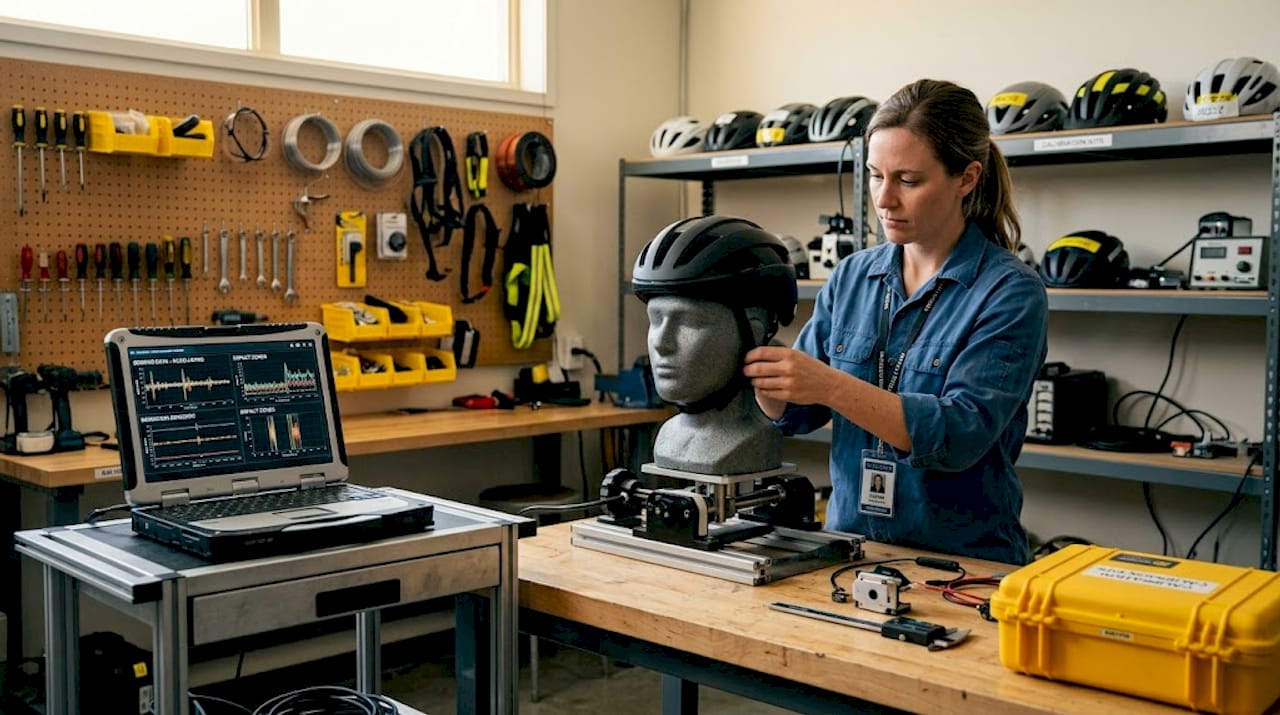
This is also why helmet design safety matters beyond just the electronics. The physical placement of sensors within the helmet affects the quality of data they capture. Sensors positioned close to the head, with minimal vibration interference from the outer shell, produce cleaner readings and more reliable classifications.
Performance metrics: accuracy, false alarms, and alert speed
Understanding the inner mechanics sets the stage for evaluating if the tech really works, so what does the evidence show?
Real-world performance data on crash detection helmets is still emerging, but published research gives us useful benchmarks. Empirical performance metrics for these systems are typically reported across three dimensions: detection accuracy (also called sensitivity), false positive rate, and alert latency. These numbers vary widely depending on system design and the conditions being tested.
What the numbers look like
In best-case lab scenarios, some systems achieve detection accuracy as high as 93.7%. That sounds reassuring, but it’s important to understand what “best-case” means. Controlled tests use standardized impact scenarios at moderate speeds, with known crash signatures. Real-world riding introduces variables that degrade performance: high speeds, complex terrain, unusual fall angles, and sensor noise from vibration.
| Metric | Best-case scenario | Real-world variability |
|---|---|---|
| Detection accuracy | Up to 93.7% | Drops at higher speeds |
| False positive rate | Low in controlled tests | Higher on rough terrain |
| Alert latency | Under 5 seconds | Varies by connectivity |
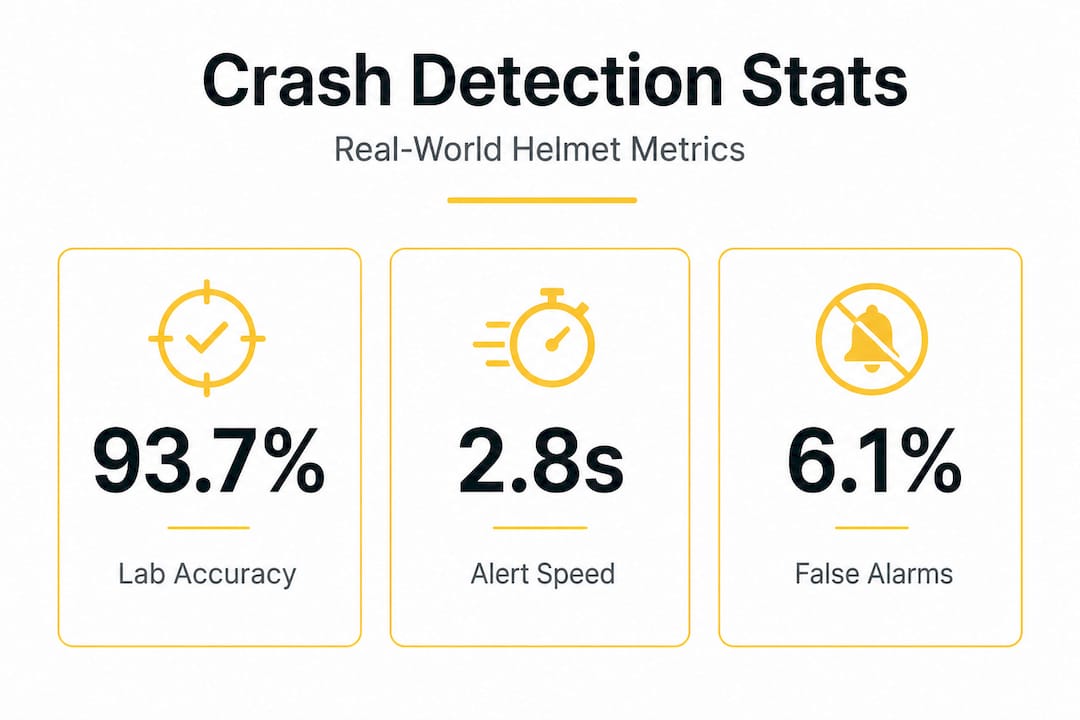
The false positive rate deserves serious attention. A false alarm doesn’t just cause inconvenience. It can trigger unnecessary emergency responses, erode trust in the system, and cause riders to disable the feature entirely. A helmet that cries wolf too often becomes a helmet that nobody uses correctly.
Alert latency is the third critical metric. This is the time between the crash event and the moment your emergency contacts receive the notification. Latency directly affects how quickly help can be dispatched. A 30-second cancellation window plus a 10-second transmission delay means emergency contacts might not know about your crash for nearly a minute. In serious accidents, that time gap matters enormously.
Factors that affect all three metrics include:
- Riding speed at impact: Higher-speed crashes can produce sensor saturation, where forces exceed the sensor’s measurement range
- Terrain type: Cobblestones, gravel, and off-road surfaces create constant background noise
- Helmet fit: A poorly fitting helmet moves independently of your head, generating misleading data
- Battery and connectivity: Low battery or weak Bluetooth/cellular connection can delay or prevent alerts
Staying current with cycling technology trends helps you track which systems are publishing real performance data versus relying on marketing claims. For a deeper look at how current systems compare in practice, connected helmet reviews offer side-by-side evaluations based on real riding conditions.
Minimizing false alarms while staying protected
With system accuracy in mind, it’s just as important to avoid unneeded alerts. Here’s how modern helmets find the right balance.
The engineering challenge of crash detection isn’t just detecting crashes. It’s avoiding false alarms without missing real ones. These two goals are in direct tension. A more sensitive system catches more crashes but also generates more false alerts. A more conservative system produces fewer false alarms but risks missing genuine accidents.
Modern systems address this through several design strategies:
- Multi-stage alerting: Rather than immediately sending an emergency message, the system first alerts the rider (via vibration or audio) and waits for a response. This cancellation window, often 30 seconds, filters out false positives without delaying real emergency notifications significantly.
- Explicit drop classification: Advanced algorithms specifically model the signature of a dropped helmet, which tends to show a single sharp impact without the preceding motion patterns of a real crash, and exclude these from triggering alerts.
- Contextual motion analysis: Systems that track your motion before and after an impact can distinguish a crash (sudden stop, no subsequent normal movement) from a pothole (brief spike, immediate return to normal riding).
- User-configurable sensitivity: Some helmets allow riders to adjust detection thresholds based on their riding style, with mountain bikers setting higher thresholds than urban commuters.
Pro Tip: When testing a new crash-detection helmet, intentionally drop it (carefully) on a padded surface to see whether the system triggers an alert. A well-designed system should recognize this as a drop event, not a crash. If it fires an alert, that’s a red flag for false positive performance.
The practical benefit of getting this balance right goes beyond convenience. Riders who trust their helmet’s detection system ride with more confidence, knowing that a genuine emergency will trigger a real response. Riders who don’t trust it tend to disable the feature or ignore alerts, which defeats the entire purpose.
How to pick the right crash detection helmet
So, how can you make sure you’re getting a crash-detection helmet that’s actually effective?
Alert latency is a key metric that many buyers overlook when shopping for connected helmets. Emergency response depends on how quickly the alert reaches contacts or services, so this number should be part of your evaluation alongside detection accuracy.
Here’s a practical checklist for evaluating crash-detection helmets:
- Sensor quality: Does the system use a full IMU (accelerometer plus gyroscope) or just a basic accelerometer? Rotational sensing is non-negotiable for serious protection.
- Algorithm transparency: Does the manufacturer publish detection accuracy, false positive rates, and alert latency? If they don’t share performance data, be skeptical.
- Alert response speed: How quickly does the system notify emergency contacts after a confirmed crash? Under 60 seconds total (including cancellation window) is a reasonable target.
- Emergency contact features: Can you configure multiple contacts? Does the alert include GPS coordinates? Does it work without cellular connectivity through a paired phone?
- User-controlled cancellation: Is the cancellation window long enough to avoid accidental alerts but short enough to be useful in a real emergency?
- Real-world test results: Look for independent reviews and peer-tested performance data, not just manufacturer claims.
- Battery life impact: Crash detection requires constant sensor activity. Understand how it affects your helmet’s battery life and whether it can run all day on a single charge.
When choosing a cycling helmet, crash detection is one feature among several. It should complement, not replace, attention to fit, ventilation, certification standards, and overall construction quality.
Why smart helmet crash detection is only part of true cycling safety
Before you click “buy” on the latest smart helmet, here’s a candid view about what this technology can and can’t do.
We’ve spent considerable time thinking about this at THE BEAM, and our honest take is this: crash detection is genuinely valuable, but it’s a backup system, not a safety strategy. The riders who benefit most from it are those who already practice good fundamentals. Proper helmet fit. Consistent use on every ride. Awareness of traffic and road conditions. Route planning that accounts for risk.
No crash detection system reaches 100% reliability. The best published results hover around 93% in controlled conditions, and real-world performance is lower. That means roughly one in ten real crashes might not trigger an alert, and false alarms will occur. Rider judgment, situational awareness, and defensive cycling habits remain your primary protection. The helmet’s algorithm is your last line of defense, not your first.
There’s also a subtler risk worth naming: over-reliance. A rider who feels “covered” by smart technology may unconsciously take more risks, ride in higher-traffic areas without adequate preparation, or skip the basics of route safety because they feel the helmet has them protected. That’s a dangerous trade-off.
The future of this technology is genuinely exciting. Algorithms will improve as more real-world crash data becomes available for training. Sensor integration will become tighter, with better placement and less noise interference. We expect to see systems that can distinguish between crash types and calibrate alert urgency accordingly. Some research points toward AI-driven models that adapt to individual rider patterns over time, reducing false positives dramatically.
But that future isn’t fully here yet. Today’s smart helmets are impressive tools with real limitations. Pair them with urban cyclist safety strategies that address the full picture of riding safety, and you have something genuinely powerful. Rely on the technology alone, and you’re leaving gaps.
Explore next-level protection: Find your ideal crash detection helmet
Ready to experience the benefits of smarter protection for yourself?
At THE BEAM, we’ve built our entire product line around the idea that protection and real-world usability should never be in conflict. Our helmets are engineered for riders who want serious safety features without sacrificing comfort, aerodynamics, or style.
Explore our full helmets collection to find options that combine advanced protection standards with the connected features that matter on real roads. And if you’re looking to upgrade your existing setup, our helmet add-ons include visibility and connectivity accessories designed to work seamlessly with your current gear. Whether you’re commuting through city traffic or pushing limits on a gravel route, we have solutions built for how you actually ride.
Frequently asked questions
How does helmet crash detection know the difference between a real crash and a simple drop?
Crash detection uses sensors to analyze both rotational and impact force patterns, with smart algorithms trained to recognize the distinct signatures of real accidents versus everyday bumps, drops, or riding vibrations.
What happens after my helmet detects a crash?
Most systems initiate a countdown alert giving you time to cancel, then automatically send your GPS location to emergency contacts. Multi-stage cancellation windows, typically around 30 seconds, help filter out false alarms before the alert goes out.
Are all helmet crash detection systems equally accurate?
No. Accuracy varies widely by sensor quality, algorithm design, and riding conditions, with top systems exceeding 90% in controlled tests but performing less reliably at higher speeds or on complex terrain.
Does alert latency really matter?
Yes, significantly. Faster alert delivery means emergency contacts can act sooner, making latency one of the most practically important performance metrics when evaluating crash detection systems.


