

Cycling safety terminology can feel overwhelming, yet many riders misunderstand basic terms that could save their lives. Over 1,100 bicyclists died in the U.S. in 2023 alone, with many crashes preventable through proper knowledge of key safety terms. This guide clarifies essential cycling terminology, recent regulatory updates in Europe and the U.S., and practical applications to boost your safety and confidence on the road.
Table of Contents
- Why Understanding Cycling Safety Terminology Matters
- Key Cycling Safety Terms Every Cyclist Should Know
- Helmets and Protective Gear Terminology
- Cyclist Behavior Terminology: Assertive Vs Aggressive Cycling
- Common Misconceptions About Cycling Safety Terminology
- Conceptual Framework for Cycling Safety Terminology
- Applying Safety Terminology Knowledge to Improve Your Riding Experience
- Summary and Next Steps for Safer Cycling
- Explore The Beam’s Safety Gear for Confident Riding
Key Takeaways
| Point | Details |
|---|---|
| Understanding crash terms like ‘right hook’ and ‘door zone’ prevents common urban cycling collisions. | These terms describe specific scenarios where cyclists are most vulnerable to vehicle interactions. |
| Helmets reduce head injury risk by up to 70%, but legal requirements vary widely across regions. | Helmet laws differ significantly between European countries and U.S. states, with many applying only to minors. |
| Assertive cycling enhances safety through predictability; aggressive cycling increases risk for all road users. | Confident, legal lane positioning improves visibility while reckless behavior creates dangerous situations. |
| ‘Taking the lane’ is both legal and essential for visibility in many traffic situations. | This widely misunderstood practice is a legitimate safety tactic, not aggressive or illegal behavior. |
Why Understanding Cycling Safety Terminology Matters
Urban and road cycling injuries remain a major public safety concern across developed nations. In the U.S., thousands of cyclists are injured annually, while 8% of EU road deaths involve cyclists, prompting regulatory frameworks that mandate basic safety features.
Terminology forms the foundation for legal compliance and safer riding practices. Cyclists wearing properly fitted bicycle helmets reduce their risk of head injury by 50% to 70%, yet helmet laws vary dramatically by region. Understanding why cycling safety matters starts with grasping the language that defines safe practices.
Increasing urban traffic and evolving regulatory changes in 2026 require cyclist awareness of safety language. Proper terminology enables effective communication with drivers and other cyclists, directly reducing collision risk. Consider these essential reasons:
- Clear terminology helps you recognize dangerous road configurations before entering them
- Legal terms protect your rights when interacting with law enforcement or insurance after incidents
- Safety language allows precise communication with fellow cyclists about hazards
- Understanding equipment terminology ensures you purchase gear that meets recognized safety standards
“Mastering cycling safety terminology is not academic exercise; it’s practical knowledge that transforms how you navigate traffic and assess risk in real time.”
The CDC bicycle safety statistics demonstrate that educated cyclists make safer decisions. As urban cycling infrastructure expands in 2026, terminology keeps pace with new road designs, technologies, and legal frameworks.
Key Cycling Safety Terms Every Cyclist Should Know
Every cyclist must understand fundamental terms that describe dangerous scenarios and protective actions. The ‘right hook’ stands as a leading cause of urban cycling collisions, occurring when right turning vehicles fail to yield to cyclists traveling straight.
Here are critical terms that directly impact your survival:
- Right hook: A crash where a motorist turns right across a cyclist’s path, cutting them off
- Door zone: The area adjacent to parked cars where opening doors can strike passing cyclists
- Take the lane: Positioning your bicycle in the center of a travel lane to increase visibility and avoid hazards
- Bike box: A designated area at intersections where cyclists wait ahead of motor vehicle traffic
- Sharrow: Shared lane markings indicating that cyclists and vehicles share the same roadway space
- Blind spot: Areas around vehicles where drivers cannot see cyclists through mirrors or direct vision
The ‘take the lane’ concept deserves special attention because it contradicts many cyclists’ instincts. When you position yourself in the center of a narrow lane, you force following vehicles to change lanes completely to pass, preventing dangerous squeeze situations. This road cycling safety concept applies whenever lanes are too narrow for safe side by side travel.

The Portland bike safety glossary defines these terms with crash prevention in mind. Door zone awareness alone prevents countless injuries, as cyclists learn to position themselves outside the swing radius of car doors.
Pro Tip: Scan vehicle blind spots constantly by making eye contact with drivers through their mirrors before assuming they see you, and always signal your intentions three seconds before turning or changing position.
Helmets and Protective Gear Terminology
Protective equipment terminology intersects directly with legal requirements and proven safety outcomes. Understanding helmet types helps you select appropriate protection for your riding style.
Helmets fall into several categories:
- Road helmets: Lightweight designs optimized for aerodynamics and ventilation during high speed riding
- Urban commuter helmets: Durable designs often featuring integrated lights and extended rear coverage
- MIPS technology helmets: Advanced designs using Multi directional Impact Protection System to reduce rotational forces during crashes
Helmet effectiveness is not debatable. Studies show helmet use reduces head injury risk by approximately 50% to 70%. Yet legal requirements vary dramatically:
| Region | Helmet Requirement | Age Restrictions | Enforcement |
|---|---|---|---|
| France | Mandatory for children under 12 (riders and passengers) | Under 12 years | Fines for non compliance |
| Allemagne | No legal requirement | None | Voluntary use |
| California, USA | Mandatory for all riders under 18 | Under 18 years | Citations possible |
| Pays-Bas | No legal requirement | None | High voluntary adoption |
Helmet laws vary widely in Europe and the U.S., with EU directives mandating basic bike safety features while leaving helmet requirements to individual countries. Understanding cycling helmet certifications ensures your gear meets recognized safety standards.
Visibility gear terminology matters equally:
- Certified reflectors: Reflective materials meeting legal standards for visibility distance and angle
- Active lighting: Battery powered front white and rear red lights required in most jurisdictions during low light conditions
- High visibility clothing: Garments using fluorescent materials and reflective strips to increase daytime and nighttime conspicuity
Many jurisdictions now mandate front and rear lights during darkness, with specific lumen requirements. EU cyclist safety regulations continue evolving in 2026, emphasizing integrated lighting systems.
Pro Tip: Choose helmets certified to CPSC (USA), EN 1078 (Europe), or equivalent standards, and look for integrated reflective elements or light attachment points that enhance your visibility without requiring separate accessories.
Cyclist Behavior Terminology: Assertive vs Aggressive Cycling
Behavior terminology shapes how you interact with other road users and directly impacts crash risk. Assertive cycling means confidently claiming your right of way to increase predictability and safety, while aggressive behavior creates dangerous situations.
Assertive cycling includes:
- Taking the lane when necessary for safety or visibility
- Signaling turns and stops clearly and in advance
- Making eye contact with drivers at intersections
- Maintaining steady, predictable speed and trajectory
- Claiming sufficient space to maneuver safely around obstacles
Aggressive cycling behaviors to avoid:
- Weaving unpredictably between lanes or through traffic
- Running red lights or stop signs
- Passing other cyclists or vehicles without adequate clearance
- Riding against traffic flow
- Engaging in confrontational behavior with motorists
The distinction centers on predictability. Assertive riders behave as legitimate traffic with legal rights, following traffic laws while claiming necessary space. This road cycling behavior concept improves safety for everyone because motorists can anticipate your actions.
Aggressive behavior, conversely, creates uncertainty. When you weave through traffic or ignore signals, drivers cannot predict your next move, leading to defensive overreactions or dangerous gaps in awareness.
Practical tips for assertive, safe cycling:
- Ride at least three feet from parked cars to avoid the door zone
- Position yourself where you want vehicles to pass you, not where you hope they will
- Communicate intentions through hand signals, eye contact, and predictable positioning
- Follow traffic laws as you would when driving a motor vehicle
The balance between assertive and aggressive riding determines how other road users respond to your presence. Confident, legal behavior earns respect and space. Reckless actions trigger hostility and increase everyone’s risk.
Common Misconceptions about Cycling Safety Terminology
Misunderstandings about cycling terminology create unnecessary risk and legal complications. Correcting these misconceptions improves your safety and legal standing.
-
Misconception: Helmets are legally required everywhere. Reality: Helmet laws vary dramatically by country, state, and even municipality, with many jurisdictions requiring helmets only for minors. Always verify local requirements, but wear a helmet regardless of legal mandates.
-
Misconception: Taking the lane is aggressive or illegal. Reality: ‘Taking the lane’ is legal and often essential for safe cycling in the U.S. and Europe. Traffic codes in most jurisdictions explicitly permit cyclists to use the full lane when necessary for safety.
-
Misconception: Cyclists can use mobile phones like pedestrians. Reality: Many jurisdictions prohibit mobile phone use while cycling, with violations resulting in fines comparable to motorist citations. European countries enforce these bans strictly.
The mobile phone ban deserves emphasis:
“Fines for mobile phone use while cycling reach €200 in several European countries, reflecting the serious safety risks of distracted riding.”
Headphone use faces similar restrictions in many areas. While not universally banned, wearing headphones that block ambient sound impairs your ability to hear approaching vehicles, warning shouts, or emergency sirens. Some jurisdictions allow single ear use while prohibiting both ears covered.
Common cycling safety misconceptions persist because cycling occupies an ambiguous space between pedestrian and vehicle traffic. Understanding actual legal requirements protects you from citations and, more importantly, from the crashes these laws aim to prevent.
The helmet misconception proves particularly dangerous. Cyclists in regions without helmet laws may assume helmets provide minimal benefit, when data clearly shows dramatic injury reduction. Legal requirements reflect political and cultural factors, not safety science.
Conceptual Framework for Cycling Safety Terminology
Organizing cycling terms into categories enhances comprehension and practical application. Understanding terminology through frameworks improves knowledge retention and helps you retrieve relevant information during actual riding.
Four core categories encompass most cycling safety terminology:
| Category | Definition | Key Examples |
|---|---|---|
| Legal Requirements | Terms describing laws, regulations, and compliance obligations | Helmet laws, lighting requirements, traffic law applicability |
| Cyclist Behavior | Terms describing riding techniques and interaction approaches | Assertive cycling, taking the lane, signaling, lane positioning |
| Equipment & Visibility | Terms related to safety gear and conspicuity enhancement | MIPS technology, certified reflectors, active lighting, high visibility gear |
| Crash Scenarios | Terms describing common collision types and danger zones | Right hook, left cross, door zone, blind spot |
This cycling safety terminology framework provides mental scaffolding. When you encounter a new term, categorizing it immediately connects it to existing knowledge.
Practical applications of this framework:
- Before each ride, mentally review the legal requirements category to ensure compliance
- When entering complex traffic, recall crash scenario terms to identify specific risks
- During equipment purchases, reference the equipment category to verify you understand specifications
- In challenging traffic situations, draw on behavior category knowledge to choose appropriate responses
The framework also reveals relationships between categories. For example, understanding the ‘right hook’ crash scenario (crash category) informs your decision to ‘take the lane’ (behavior category) before intersections, which may be explicitly permitted (legal category) and enhanced by wearing high visibility gear (equipment category).
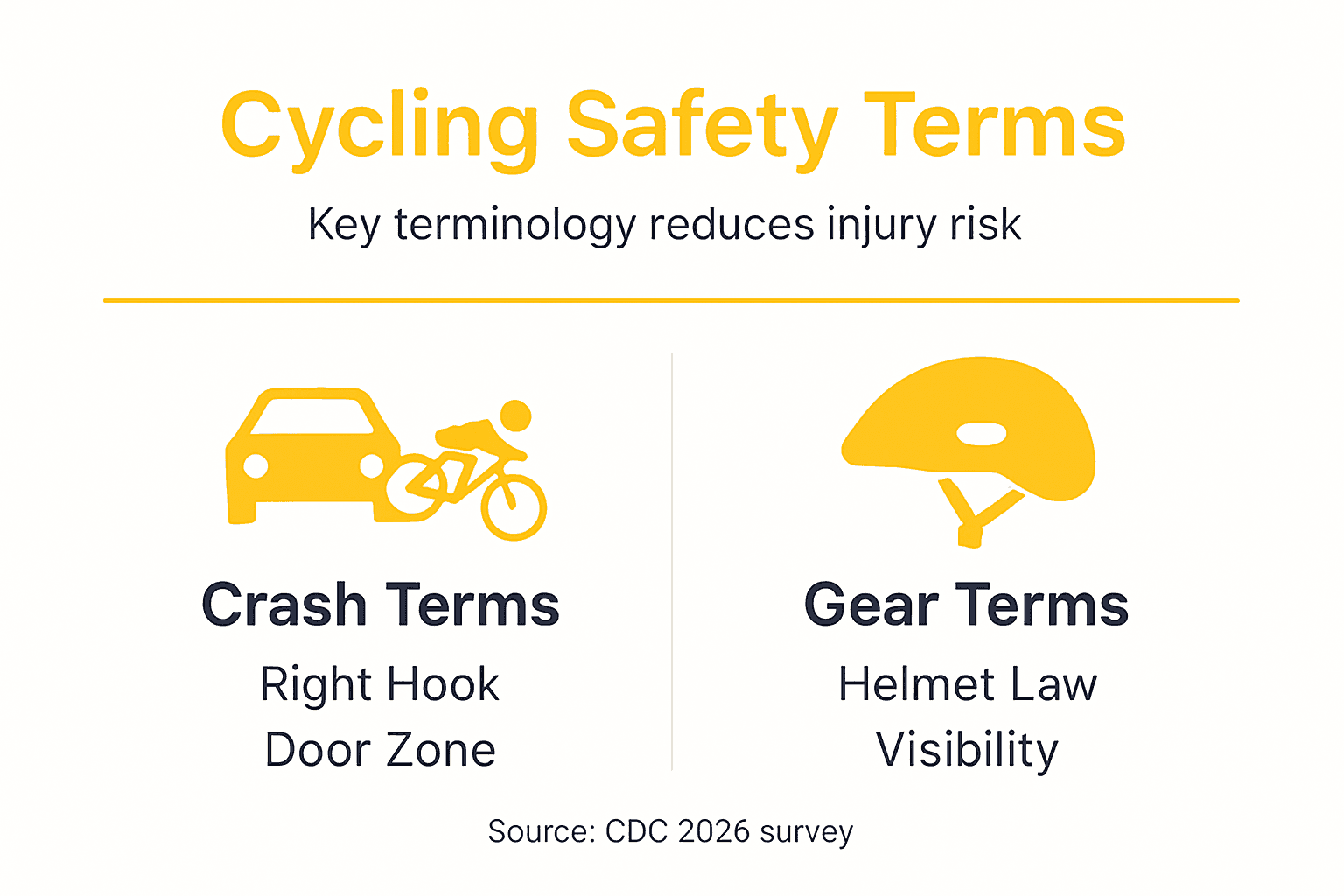
Grouping terms this way transforms isolated definitions into a comprehensive safety system. Each category reinforces the others, building complete situational awareness rather than fragmented facts.
Applying Safety Terminology Knowledge to Improve Your Riding Experience
Terminology knowledge means nothing without application. Translate your understanding into concrete actions that enhance safety, legal compliance, and communication.
Use terminology for clearer communication with motorists and other cyclists. When you understand terms like ‘taking the lane’ or ‘blind spot’, you can briefly explain your positioning to confused or frustrated drivers, defusing potential conflicts. Fellow cyclists immediately understand when you reference specific hazards using correct terminology.
Adapt your behavior and gear choices to regional laws. Research local regulations using the proper terminology:
- Verify helmet requirements for your age group and riding context (commuting vs recreation)
- Confirm lighting and reflector specifications mandated in your jurisdiction
- Understand local traffic laws regarding lane usage, signaling, and right of way
- Check for specific restrictions on headphone or mobile device use while cycling
- Learn whether your area requires bells, horns, or other warning devices
These cycling safety concepts apply differently across regions. A technique legal and common in Amsterdam may violate laws in California.
Pro Tip: Review local cycling regulations annually, as laws change frequently in response to infrastructure updates, injury data, and advocacy efforts. Subscribe to local cycling advocacy newsletters for regulatory updates in your area.
Consistent application of terminology knowledge builds safer habits:
- Scan for door zones automatically when passing parked cars
- Position yourself to avoid blind spots at intersections
- Signal every turn, even when you believe no one is watching
- Wear your helmet and visibility gear on every ride, regardless of distance or conditions
- Practice assertive lane positioning during low traffic conditions to build confidence
Your helmet and visibility equipment represent your first line of defense. Understanding why these tools work motivates consistent use even when inconvenient.
Summary and Next Steps for Safer Cycling
Mastering cycling safety terminology transforms abstract concepts into life saving knowledge. You now understand critical terms describing crash scenarios, protective behaviors, legal requirements, and equipment standards that directly impact your safety on every ride.
Key insights for ongoing safety vigilance:
- Apply crash scenario awareness (right hook, door zone, blind spot) during every ride to anticipate dangers before they materialize
- Practice assertive cycling techniques that increase your predictability and visibility without crossing into aggressive behavior
- Stay current on evolving laws in your region, particularly regarding helmets, lighting, and device use while riding
- Invest in proper safety equipment meeting recognized certification standards, including helmets with MIPS technology and integrated visibility features
- Communicate using precise terminology when discussing safety with fellow cyclists, motorists, or authorities
Safety standards and regulations continue evolving in 2026. Infrastructure improvements, new technologies, and changing traffic patterns require ongoing learning. Commit to reviewing updated cycling safety guidance at least annually.
Your knowledge now includes the terminology, framework, and practical applications needed for safer riding. The final step involves consistent application. Every ride offers opportunities to practice these concepts, building habits that become automatic responses in critical moments.
Explore The Beam’s Safety Gear for Confident Riding
Now that you understand essential cycling safety terminology, equip yourself with gear that embodies these concepts. The Beam specializes in innovative helmets integrating MIPS technology, offering the head injury protection discussed throughout this guide. Our designs serve urban commuters and road cyclists who prioritize both safety and style.

Explore our range of cycling helmets engineered for maximum protection and real world usability. Discover the comprehensive benefits of cycling helmets and how proper equipment reduces injury risk. Browse our complete collection of safety gear including high visibility accessories and connected products that transform terminology knowledge into tangible protection.
FAQ
What does the term ‘right hook’ mean in cycling safety?
A ‘right hook’ describes a crash where a right turning vehicle cuts off a cyclist traveling straight through an intersection. This collision type ranks among the most common urban cycling crashes because drivers often fail to check for cyclists before turning. Positioning yourself visibly and anticipating right turning vehicles prevents most right hook incidents.
Are helmets legally required for cyclists in all European countries?
No, helmet laws vary widely across Europe, with many countries mandating helmets only for children or specific rider categories while others have no requirements. France requires helmets for children under 12, while Germany and the Netherlands have no legal mandates despite high cycling rates. Always verify regulations in your specific country and region, but wear a helmet regardless of legal requirements given the proven 50% to 70% reduction in head injury risk.
Is ‘taking the lane’ an illegal cycling behavior?
No, ‘taking the lane’ is legal and often essential for safe cycling in both the U.S. and Europe. Traffic laws in most jurisdictions explicitly permit cyclists to use the full lane when necessary for safety, such as when lanes are too narrow for side by side travel or when avoiding road hazards. This practice increases your visibility and prevents dangerous squeeze situations where motorists attempt unsafe passing in insufficient space.
Are cyclists allowed to use mobile phones or headphones while riding?
Many jurisdictions prohibit mobile phone use while cycling, treating it similarly to distracted driving with fines reaching €200 in several European countries. Headphone restrictions vary more widely, with some areas banning them completely while others allow single ear use. These laws recognize that distracted or hearing impaired cyclists cannot effectively monitor traffic, hear warning signals, or respond to hazards. Check your local regulations and prioritize attentive riding over device use regardless of legal status.


