

The fastest way to see behind on a bike is combining a properly angled mirror with a quick, practiced shoulder glance, backed by a bright rear light or reflector so drivers see you before you even need to look. Skip the mirror and you’re twisting your torso every time, which drifts your line. Skip the light and drivers approaching from behind have less time to react to you at all. On your next ride, test your mirror angle at a stoplight and check that your rear light is charged before you clip in.
TL;DR:
- Properly angled mirrors paired with shoulder checks are the quickest, most reliable way to monitor traffic behind you during a ride.
- Handlebar and bar-end mirrors can blur at high speeds if not securely mounted, while helmet mirrors tend to stay steadier but require a head turn to see behind.
- A bright rear light set to flash, combined with reflective gear, significantly improves visibility and safety, especially in low-light conditions.
- Regularly test, recheck, and clean your mirror setup and lights to ensure they remain effective, and replace reflective coatings or mirrors after years of use.
- Practicing shoulder checks in a controlled environment improves safety and prevents lane drifting, even when using mirrors or cameras for rear visibility.
Table of Contents
- What Are Your Options for Seeing What’s Behind You?
- Which Bike Mirror Actually Works, and How Do You Set It Up?
- Do Rear-View Cameras Actually Help You See Traffic Behind?
- How Do Lights and Reflectors Make You Easier to See?
- How Do You Check Behind You Without Swerving?
- How Does the Beam Approach Rear Visibility?
- A Straight Answer on What Actually Keeps You Safer
- Where to Find the Right Gear on The Beam
- Sources
- FAQ
What Are Your Options for Seeing What’s Behind You?
Four categories cover almost every rear-visibility need on a bike, and picking the right one depends on where and how you ride.
- Mirrors (handlebar, bar end, or helmet/sunglass mounted) give a constant, glanceable view without turning your head far.
- Cameras and live-view systems stream a rear feed to a handlebar display or your phone, and some record footage as you ride.
- Rear lights and reflectors don’t show you what’s behind, but they make sure what’s behind sees you.
- Riding technique, specifically the shoulder check, is the fallback every cyclist needs regardless of what gear they run.
City commuters weaving through stop-and-go traffic often prefer a compact mirror they can glance at without breaking cadence. Riders on fast, open roads or descents lean toward wider-field helmet mirrors or a camera feed, since a mirror on shaky handlebars can blur at speed. Night riders need lights and reflectors most of all, because a mirror is useless if the car behind you has no time to register your position.
When comparing products, weigh field of view against mounting stability. A wide mirror that vibrates into a blur is worse than a smaller one that holds steady. Check weatherproofing if you commute year round, and confirm compatibility with your handlebar diameter or helmet vents before you buy.
Which Bike Mirror Actually Works, and How Do You Set It Up?
Handlebar mirrors mount at the end of your bar or clamp near the brake lever, giving a stable base but a narrower field unless you angle them carefully. Bar-end mirrors slide into the handlebar itself, keeping a low profile with less vibration than clip-on styles, though they sit lower and can catch less of the lane behind you. Helmet or sunglass mirrors move with your head, not your bike, which means potholes and road buzz affect them less, but you do need a slight head turn to bring the mirror into your sightline.
Here’s the setup sequence that actually gets you a usable reflection instead of a view of your own elbow:
- Mount the bracket first without fully tightening, so you can rotate the mirror freely.
- Sit in your normal riding position, hands on the bars, back at your usual angle.
- Adjust the mirror until you see the lane behind you without ducking or straining your neck.
- Tighten the mount fully, then check the angle again since tightening can shift it slightly.
- Test at low speed on a quiet street before trusting it in traffic.
Pro Tip: Do the angle test twice, once seated normally and once in your sprint or climbing position. Riders who only check the mirror while relaxed on the bars often find it useless the moment they stand up.
Recheck the tightness every few rides, since road vibration loosens clamps faster than most riders expect. Wipe the mirror surface with a cloth, not your glove, and swap it out once the reflective coating starts to cloud or scratch, usually after a season or two of regular commuting. The Beam’s own mirror setup guide walks through this same angle-testing process with photos if you want a visual reference.
Do Rear-View Cameras Actually Help You See Traffic Behind?
A live-view camera system gives you a continuous feed instead of a quick glance, which matters most on fast descents or busy roads where a half-second mirror check isn’t enough. You get a wider, more stable picture than a handlebar mirror bouncing over cracked pavement, and some units record footage that’s useful after a close call or a crash.
The trade-offs are real, though. Screen glare in bright sun can wash out the display, night performance drops off unless the sensor is rated for low light, and any wireless feed carries a hint of latency, small, but enough that you shouldn’t treat it as instant.
- Mount the camera low and centered on the seat post or saddle rail for the steadiest feed.
- Choose a weatherproof housing rated for rain if you commute year round.
- Battery-powered units are simpler to install; wired setups last longer per charge but need more routing work.
- Recharge or swap the battery on a fixed schedule so it’s never dead on a ride that matters.
One more thing worth knowing: recording other road users raises privacy considerations that vary by location, so check local rules before posting footage publicly, especially if faces or license plates are visible.
How Do Lights and Reflectors Make You Easier to See?
A rear light with a daytime flashing mode, not just steady, cuts through sun glare far better than a dim constant beam, and reflectors add a passive backup that works even if your battery dies mid ride. MedlinePlus recommends a red rear reflector visible from about 500 feet and a white front lamp visible from about 300 feet for night riding, figures worth treating as a minimum, not a target.
- Mount your main rear light at seat post height, angled slightly up, not straight down at the road.
- Add a second reflector on a wheel or pedal, since moving reflectors catch a driver’s eye differently than a static one on the frame.
- Check the beam angle isn’t blocked by a saddlebag or fender before every ride, not just once at setup.
- Swap batteries or recharge on the same schedule as your camera, so nothing goes dark at once.
Better conspicuity buys you time. A driver who spots you three seconds earlier has three more seconds to adjust. That gap is often the whole difference between a close pass and a real problem.
How Do You Check Behind You Without Swerving?
The shoulder check only works if you do it in the right order, and rushing the sequence is exactly what causes riders to drift into the lane they were trying to check.
- Scan the road ahead first, so you know what’s coming before you take your eyes off it.
- Glance over your shoulder quickly, keeping your hips and handlebars pointed straight ahead.
- Signal your intention with a clear hand gesture.
- Glance back a second time to confirm the gap is still clear.
- Move only once you’ve confirmed it, not the instant you finish signaling.
NHTSA’s cycling safety guidance frames this as core to riding predictably: minimize blind spots, look before you move, and keep your line steady while you do it. Mirrors and cameras support that discipline, they don’t replace it.
Practice matters more than most riders assume. Find an empty parking lot and ride in a straight line while doing shoulder checks every few seconds, first with two hands loosely on the bars, then progressing to a brief one-hand hold while you signal. The most common mistakes are glancing too late (after you’ve already started drifting), over-rotating your shoulders so your front wheel wanders, and scanning without a clear purpose, meaning you look but don’t actually register what’s there.
Pro Tip: Practice your shoulder check at the same speed you’d ride in traffic, not slower. A glance that works at walking pace often falls apart at 15 miles per hour because your balance margin shrinks.
How Does the Beam Approach Rear Visibility?
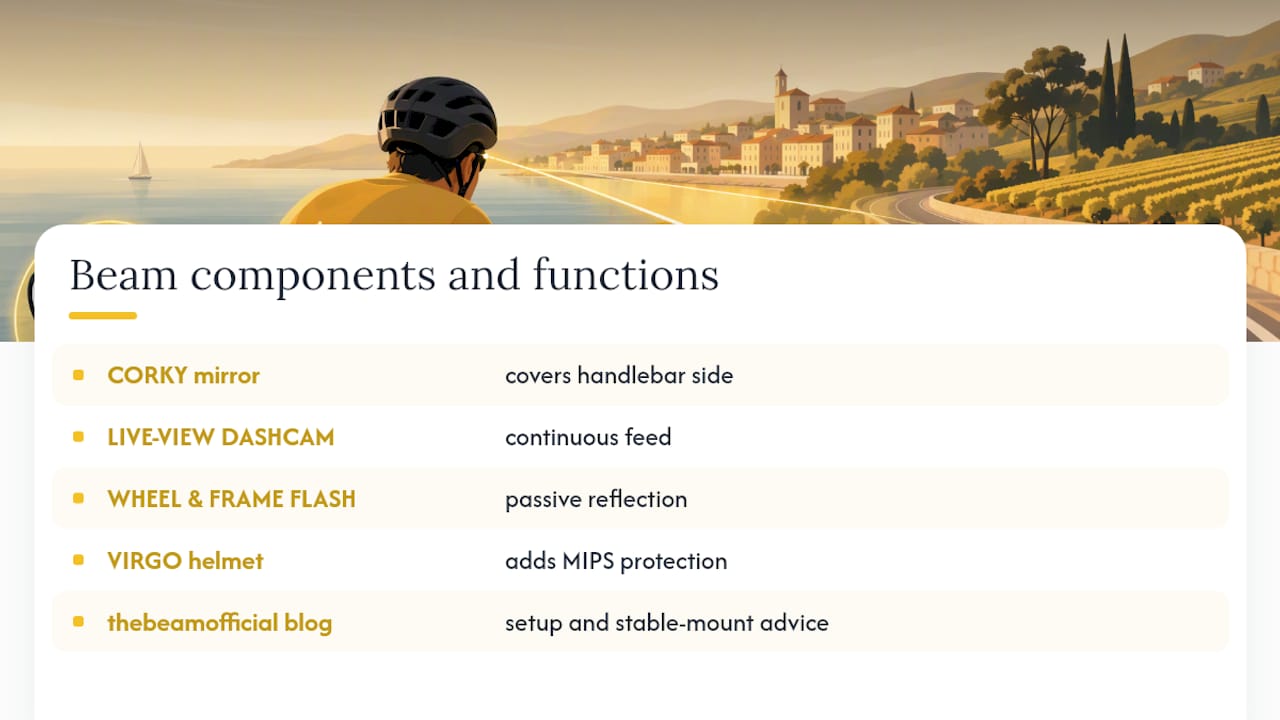
There are brands that offer a mix of mirrors, cameras, and lighting tailored for cycling safety under one roof. The CORKY mirror covers the handlebar side of the equation, the LIVE-VIEW DASHCAM covers continuous feed, and WHEEL FLASH and FRAME FLASH handle passive reflection. The VIRGO helmet adds MIPS protection on top. Thebeamofficial’s blog walks through setup for each, since a stable mount beats an expensive gadget mounted wrong.
A Straight Answer on What Actually Keeps You Safer
The riders who avoid close calls aren’t the ones with the most expensive gadget strapped to their bars. They’re the ones who checked their mirror angle before leaving the driveway and practiced the shoulder glance until it stopped throwing off their line. Gear helps, but it only works when it’s set up right and paired with the habit of actually looking. Here’s the pre-ride checklist worth taping to your handlebar bag: mirror angle checked in riding position, rear light charged and set to flash, helmet buckled, and one shoulder-check drill planned for the first quiet stretch of road.
— Sophie
Where to Find the Right Gear on The Beam
Some brands provide mirror, light, and camera options from one source, offering an alternative to assembling gear from multiple brands. Compatibility between different cycling safety accessories can be an issue, which may be avoided when products are designed to fit well together.
Start with the helmet collection if you’re building out a full safety setup, or head straight to accessories if a mirror is the one thing missing from your bike right now. For night riders, the rear-lighting collection covers the brightness and mounting options this guide recommends. Browse the setup guides linked throughout this article before you buy, so you know exactly how each piece mounts on your specific bike.
Sources
This guide draws on NHTSA’s bicycle safety guidelines for scanning and predictability, the League of American Bicyclists’ Rules of the Road for conspicuity standards, and MedlinePlus for night-visibility specs. Thebeamofficial’s own mirror setup guide supplements these with hands-on installation detail.
- Bicycle Safety: Bike Safety Tips for Kids and Adults | NHTSA
- Bicycle safety: MedlinePlus Medical Encyclopedia
FAQ
What’s the Fastest Way to See Behind on a Bike?
A properly angled mirror combined with a quick shoulder glance is the fastest reliable method, since the mirror gives you a constant reference and the glance confirms what you can’t see in the mirror’s blind spot. Pairing both with a bright rear light means drivers also see you sooner, cutting your reaction risk from both directions.
Are Bike Mirrors Actually Reliable at Speed?
Handlebar and bar-end mirrors can blur at higher speeds if the mount isn’t tightened correctly, while helmet mirrors move with your head and tend to stay steadier. Testing your mirror in both a relaxed and a sprint position, as Thebeamofficial’s setup guide recommends, catches this before you rely on it in traffic.
Do I Still Need to Shoulder Check if I Have a Mirror?
Yes. A mirror narrows your blind spot but doesn’t eliminate it, and NHTSA’s guidance treats the shoulder check as core technique regardless of what gear you’re running. Use the mirror for a constant read and the glance to confirm before any lane change or turn.
How Bright Should My Rear Light Be at Night?
MedlinePlus recommends a rear reflector visible from about 500 feet, and a daytime-flashing mode helps your light cut through sun glare during the day too. A steady beam alone often isn’t enough in low light, so pairing a light with a passive reflector gives you backup if the battery dies.
Does The Beam Sell Rear-View Mirrors and Dashcams?
Yes. Thebeamofficial’s product lineup includes the CORKY mirror, a LIVE-VIEW DASHCAM, and reflector options like WHEEL FLASH and FRAME FLASH, alongside the VIRGO helmet with MIPS technology. Current pricing for each is listed on the product pages, since prices aren’t published elsewhere.


