

TL;DR:
- Helmets significantly reduce skull fractures and neurological injuries, but protection varies widely among models.
- Advanced rotational management technologies like RLS and MIPS effectively lower brain injury risks in oblique impacts.
- Choosing helmets based on independent ratings, coverage, and proper fit is crucial for optimal safety.
Most cyclists assume that putting on any helmet dramatically cuts their injury risk. That assumption is wrong. Research shows that among 32 helmet models tested, the likelihood of a moderate neurological injury from the same crash varied between 21% and 74%, depending on the helmet worn. That’s not a small margin. The forces that cause the most serious brain injuries aren’t the ones most helmets were historically designed to stop. Understanding the science behind impact forces, materials, and rotational technology isn’t just interesting. It’s the difference between making a genuinely protective choice and a false sense of security.
Table of Contents
- Understanding impact forces and helmet failures
- How helmets protect: materials, tech, and limitations
- Comparing helmet safety: top models and innovations
- Choosing the right helmet for your ride
- Our take: why real helmet safety is about more than buying the top model
- Find the perfect helmet for your safety needs
- Frequently asked questions
Key Takeaways
| Point | Details |
|---|---|
| Impact type matters | Linear and oblique impacts affect injury risk differently, so helmets must protect against both. |
| New tech improves safety | Helmets with RLS or MIPS layers greatly reduce brain injury risk compared to foam-only models. |
| Fit for your ride | Choosing a helmet based on your cycling style and real crash data offers the best protection. |
| Lab ratings aren’t enough | Practical fit, comfort, and coverage play a critical role in real-world helmet safety. |
Understanding impact forces and helmet failures
When cyclists crash, the forces acting on the skull and brain are rarely simple and direct. Most impacts happen at an angle, where the head strikes a surface obliquely and then rotates. That rotation is the real danger. Rotational acceleration strains the brain tissue in ways that straight-line impacts don’t, and it’s directly linked to concussions, diffuse axonal injury, and other serious neurological damage.
Research makes this starkly clear. Oblique impacts are most common in real cycling crashes, with critical conditions including linear-lateral impacts and ZRot (rotation around the vertical axis), leading to roughly 50% risk of moderate neurological injuries. The same study, which tested 32 different helmets, found a wide variation in protection, with risk outcomes ranging from 21% to 74% across models. That gap is enormous, and it means that two cyclists wearing different helmets in an identical crash could have dramatically different outcomes.
Here’s what makes oblique impacts so difficult to address:
- The head doesn’t just absorb a direct punch. It twists, rolls, and shears at the brain stem and across cerebral tissues.
- Traditional helmet foam (EPS) is excellent at crushing to absorb direct linear energy, but largely ineffective at managing rotational forces.
- Rear and side impacts, which are common in traffic crashes, expose parts of the helmet with less coverage and often thinner foam.
- Edge impacts, where the helmet rim rather than the dome takes the hit, can transfer force directly to the skull.
“A helmet that scores well in flat-drop tests may fail badly in the oblique scenarios that real crashes actually produce. The test type matters as much as the result.”
Meanwhile, helmets still offer substantial protection. When comparing helmeted versus unhelmeted falls, helmets reduce skull fracture risk by approximately 65% and neurological injury risk by approximately 75%, though edge impacts remain a high-risk scenario even with a helmet.
This is exactly why choosing a cycling helmet based on test data rather than marketing claims matters so much. And if you’re riding in urban or commuting environments, integral helmet safety offers expanded coverage that addresses some of the edge and rear-impact weaknesses found in more open road helmet designs.
How helmets protect: materials, tech, and limitations
Every helmet starts with the same basic architecture. A hard outer shell distributes force across a wider surface area. An inner EPS (expanded polystyrene) foam layer crushes on impact, converting kinetic energy into deformation. A retention system keeps it on your head. That structure works well for direct, linear impacts like a flat fall onto a smooth surface. Real crashes, unfortunately, rarely look like that.
EPS foam is energy-efficient, lightweight, and cheap to produce. But it has a significant limitation: it crushes in a straight line. When a head hits a surface at an angle, the foam resists that crushing motion while the surface simultaneously grips the helmet exterior. The skull keeps rotating underneath. The brain, which is suspended in cerebrospinal fluid, lags behind and then snaps back. That lag and snap is what causes the most damaging injuries.
This is where rotational management technology changes the equation. Systems like MIPS (Multi-directional Impact Protection System) and RLS (Release Layer System) add a low-friction or mechanically decoupled layer between the foam and the wearer’s head. When the helmet strikes a surface obliquely, this layer allows the helmet to rotate slightly relative to the skull, reducing the amount of rotational energy transferred to the brain.
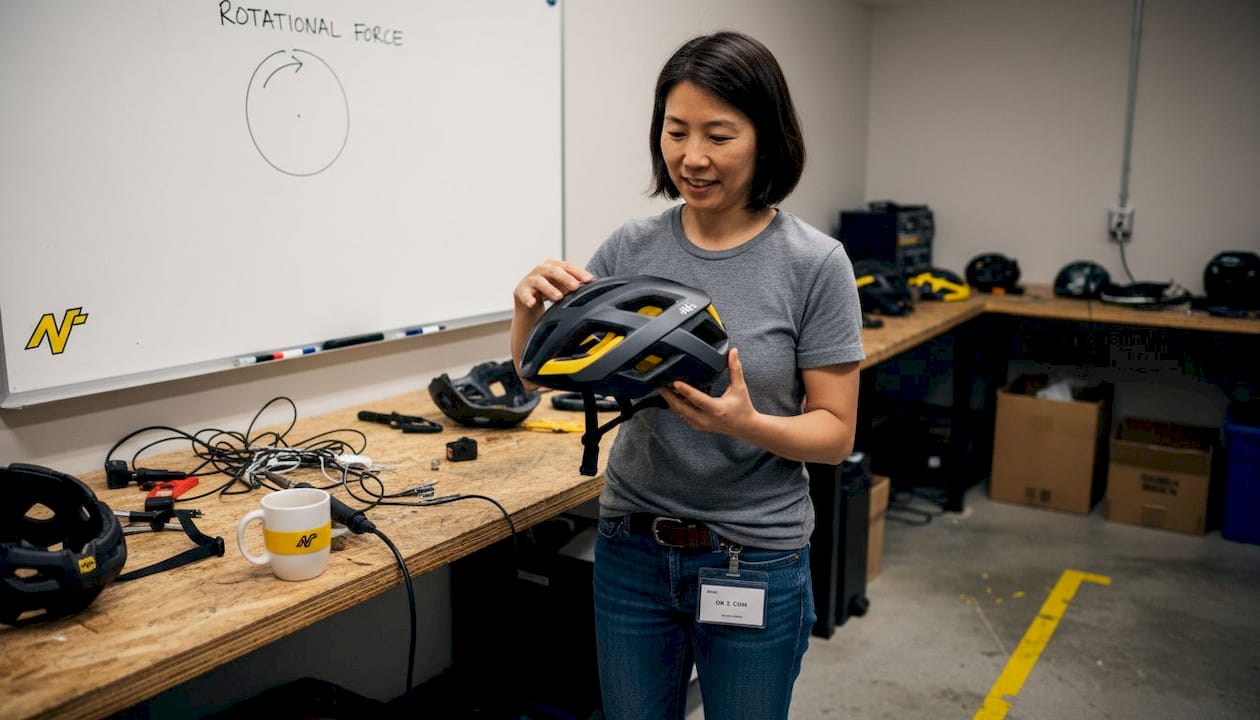
The numbers are significant. Helmets with rotational technology reduce peak rotational acceleration by 34%, peak linear acceleration by 7%, peak rotational velocity by 24%, and brain injury criterion (BrIC) by 22%, compared to standard EPS-only helmets at e-bike-relevant impact speeds of 8 m/s. That same data shows AIS2 injury risk (moderate brain injury) drops by 29%, and AIS5 risk (critical injury) drops by 45%.
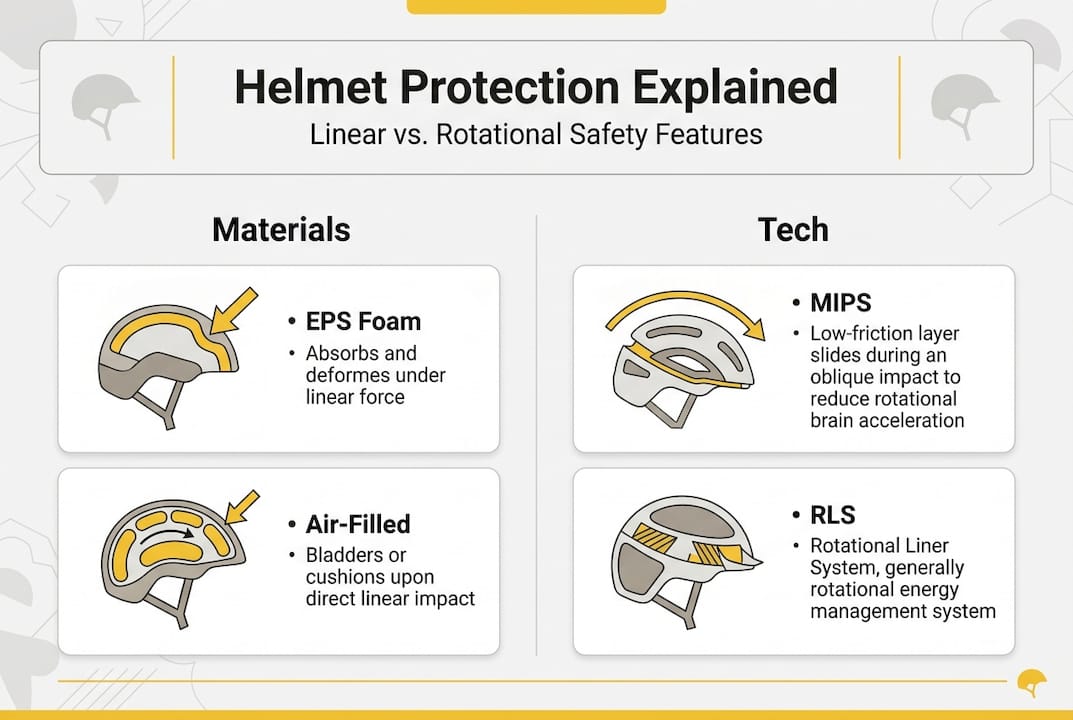
Here’s a simplified comparison of helmet protection technologies:
| Technology | Linear protection | Rotational protection | Key mechanism |
|---|---|---|---|
| EPS only | Good | Minimal | Foam crush |
| EPS with MIPS | Good | Significant | Slip layer |
| EPS with RLS | Good | Very significant | Release mechanism |
| Air-filled (e.g., Ventete aH-1) | Excellent | Comparable to top EPS | Extended impact duration |
No helmet eliminates risk entirely. Rear impacts, in particular, produce the highest rotational forces and remain the most difficult scenario for any design to fully address. High-speed crashes, where kinetic energy exceeds what any foam can absorb, are another hard limit of current technology.
Pro Tip: Look for helmets where the rotational technology is integrated into the certification process, not just added as a marketing feature. Check independently tested scores, not manufacturer claims.
Understanding MIPS helmet technology in depth helps you appreciate what you’re paying for. And integrated helmet design that combines materials, geometry, and rotational management into a unified structure tends to outperform helmets where these elements were added independently.
Comparing helmet safety: top models and innovations
Test data from independent labs is the clearest way to separate genuine performance from branding. Virginia Tech’s STAR rating system is one of the most rigorous, using multiple impact types and locations to generate a composite concussion risk score. Lower STAR scores equal better protection.
The latest data produces some surprising results. The Canyon Deflectr RLS ranks first in the Virginia Tech STAR ratings with a score of 6.82, followed by the HEXR Miden RLS in second place. Both use the Release Layer System. Compared to conventional helmets without rotational management, RLS models reduce concussion risk approximately 4 times over, with a 68% to 84% brain injury probability reduction across multiple impact scenarios.
Key takeaways from the latest comparative testing:
- RLS helmets currently lead the Virginia Tech STAR ratings by a meaningful margin over MIPS-equipped models
- MIPS helmets still significantly outperform EPS-only helmets in rotational scenarios
- Air-filled designs offer a genuinely different approach, with longer impact duration reducing peak forces more effectively than foam alone
That last point deserves more attention. Air-filled helmets like the Ventete aH-1 reduce linear brain injury risk by 44% compared to conventional EPS helmets, while providing comparable rotational protection in oblique impacts at 6.5 m/s on a 45-degree anvil. The mechanism is different: rather than crushing foam, the air chambers deform more slowly and over a longer contact time, spreading the force peak across a wider window. That longer impact duration means lower peak forces, even if the total energy absorbed is similar.
This innovation matters because it suggests the EPS model isn’t the only valid path. Helmets designed around fundamentally different physics can perform equally well or better, which is good news for design evolution. WaveCel, another alternative to MIPS developed by Trek, uses a collapsible cellular structure to manage both linear and rotational forces simultaneously. Early test results show strong performance, though fewer independent studies exist compared to MIPS or RLS at this stage.
What you shouldn’t do is pick a helmet based on brand popularity or price alone. A $300 helmet with EPS-only construction can be outperformed by a $150 helmet with RLS technology. The MIPS vs RLS differences are real and quantifiable, and the gap between top-performing and average helmets in the same price bracket can be wider than the gap between price brackets.
Choosing the right helmet for your ride
All of this research only helps if you translate it into a decision. Here’s how to use what you now know to pick the right helmet for your specific situation.
-
Identify your primary risk environment. High-speed road riding, urban commuting, trail riding, and e-bike use all have different crash profiles. Urban riders face more oblique, low-speed collisions with cars and curbs. Road cyclists face higher-speed impacts with pavement. Trail riders face irregular surfaces and vegetation strikes. Each scenario loads different parts of the helmet differently.
-
Check independent ratings, not brand marketing. Virginia Tech STAR ratings and similar databases give you a composite score that accounts for multiple impact types. Look for helmets that perform well across all categories, not just one.
-
Prioritize rotational management technology. Whether it’s MIPS, RLS, WaveCel, or another system, the evidence for rotational tech reducing serious injury risk is strong and consistent. For urban cyclists especially, where oblique low-speed impacts are common, this is not optional.
-
Pay attention to coverage area. More coverage around the rear and sides of the skull reduces the exposed surface area where edge impacts can occur. Rear and side impacts carry the highest rotational risk, and helmets that leave these zones exposed are a genuine trade-off between ventilation and protection.
-
Make sure it fits, and fits correctly. A premium helmet that sits too far forward or shifts during use can expose the rear skull entirely in a crash, or fail to transmit rotational slip technology properly. Fit is not aesthetic. It’s mechanical.
-
Replace after any significant impact. EPS foam compresses once. After a crash, the foam may look intact while its internal structure is compromised. Rotational slip layers can also be disrupted. A damaged helmet that looks fine provides far less protection than its ratings suggest.
Pro Tip: If you commute daily through urban traffic, consider an integral or full-face design. The additional coverage around rear and temporal zones addresses exactly the high-risk areas that standard open helmets leave vulnerable.
When you’re ready to make a choice, choosing the right helmet for your riding environment is one of the highest-impact safety decisions you can make.
Our take: why real helmet safety is about more than buying the top model
Here’s a perspective that doesn’t get enough attention: the safest helmet in the world becomes significantly less effective if it doesn’t match your actual risk environment, doesn’t fit your head correctly, and isn’t replaced after it’s done its job once.
Lab ratings test specific scenarios at specific speeds and angles. They’re valuable, but they’re not a guarantee that a #1-rated helmet performs better for your particular crash profile than a #3-rated one does. A cyclist who regularly rides rear-facing in traffic with a helmet that has minimal rear coverage is exposed in exactly the scenario the test suite doesn’t fully penalize.
We also see a pattern in how people use helmet research. They find the top-rated model, buy it, and then assume the safety work is done. But real-life helmet fit and daily usage habits matter just as much as the technology inside the shell. A helmet worn at the wrong angle, with straps adjusted poorly, or retained past its service life is a false assurance.
The future of helmet safety isn’t only in better foams or more sophisticated slip systems. It’s in better rider education, more real-world crash data feeding back into design, and smarter matching of protection levels to actual riding scenarios. The technology is advancing fast. The gap between rider knowledge and that technology is still wide.
Find the perfect helmet for your safety needs
Ready to put these insights into action for safer cycling?
At THE BEAM, we design helmets and safety accessories with exactly this kind of research behind them. Our flagship VIRGO integral helmet integrates MIPS technology into a full-coverage design built for urban cyclists, commuters, and e-bike riders who need protection across all the high-risk impact zones this article covers.
Whether you’re looking for a road helmet with rotational management, a commuter design with full rear coverage, or accessories that increase your visibility before a crash ever happens, our range is built on evidence, not aesthetics alone. Explore our full selection of modern helmets designed to match real riding risks, and browse our helmet add-ons to complete your protection setup with mirrors, reflectors, and connected safety tools.
Frequently asked questions
Do all helmets reduce both skull fracture and brain injury risk equally?
No, helmet models vary widely in reducing brain injury risk. Testing 32 helmets showed protection ranged from 21% to 74% risk of moderate neurological injury, depending on the model, especially for oblique impacts.
What helmet technology most reduces risk for urban cyclists?
Helmets with advanced rotational management like RLS or MIPS offer the strongest protection against the rotational forces most common in city crashes. RLS helmets reduce concussion risk approximately 4 times compared to conventional helmets with no rotational system.
Do air-filled helmets outperform traditional foam helmets?
Air-filled designs like the Ventete aH-1 reduce linear brain injury risk by 44% compared to EPS-only helmets, while matching top EPS helmets in rotational protection, making them a genuinely competitive alternative in real crash conditions.
Is it true that helmets can increase neck injury risk?
Some research data notes that neck injuries may be higher with helmets during certain impact types, particularly rear and side strikes, but there is no confirmed evidence that this effect applies to cyclists in real-world crash conditions.


