

TL;DR:
- A modular helmet features a hinged chin bar, offering full-face protection with open-face convenience without removal. Certified to meet safety standards like ECE 22.06 and P/J homologation, they are ideal for urban and touring riders who value versatility and ease of communication. However, they are heavier and slightly less robust at high speeds compared to full-face helmets.
A modular helmet is a hybrid helmet design featuring a hinged chin bar that flips up, letting you switch between full-face protection and open-face convenience without removing the helmet. Also called a flip-up helmet in the industry, this style is built from fiberglass, polycarbonate, or carbon fiber and must meet safety certifications like ECE 22.06 and P/J homologation to be ridden safely in both positions. For urban commuters, touring cyclists, and everyday riders, the modular format solves a real problem: you get serious protection when you need it and easy face access when you don’t.
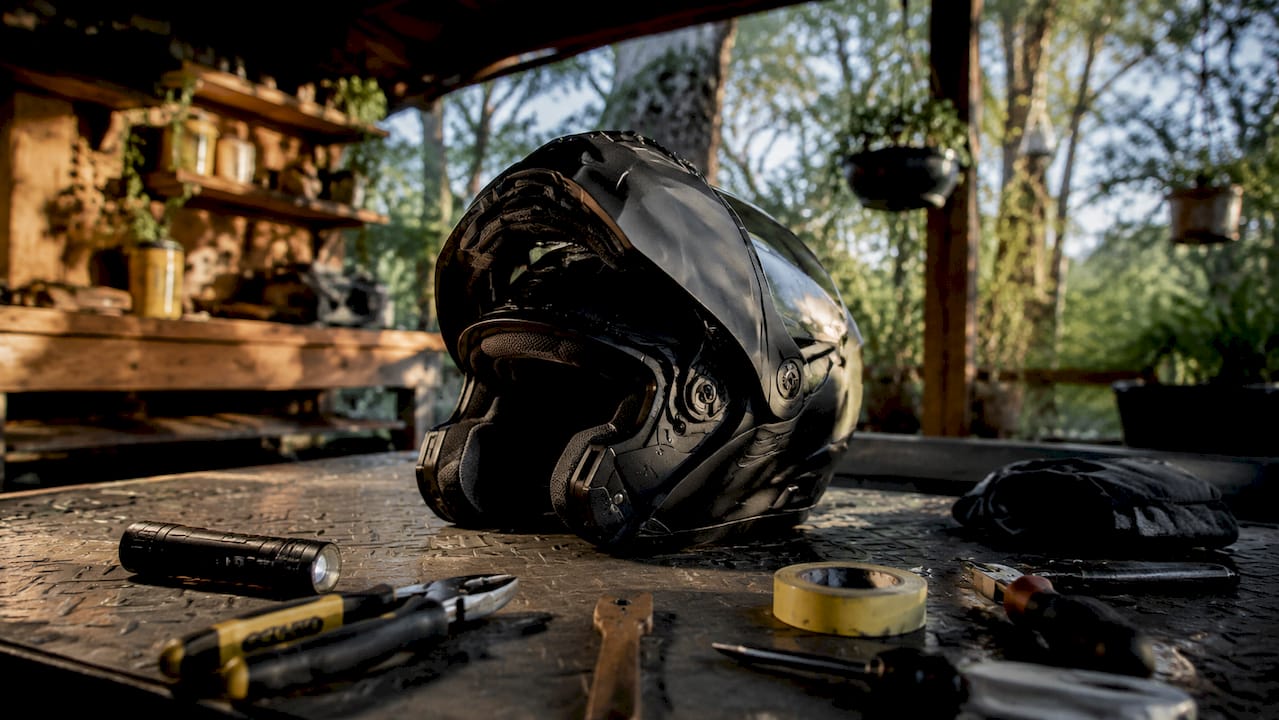
What is a modular helmet and how is it constructed?
A modular helmet, or flip-up helmet, is defined by its hinged chin bar mechanism mounted on the lower sides of the shell. That hinge is the feature that separates it from every other helmet category. Pull the release, and the chin bar rotates up and over the top of the helmet, converting a full-face design into an open-face one in under two seconds.
The shell itself uses the same core materials as full-face helmets: fiberglass composites, polycarbonate, or carbon fiber. What changes is the structural engineering around the hinge points. The shell must absorb and distribute impact forces even with a mechanical joint running through it. That requires reinforced side panels and additional structural parts that a standard full-face helmet simply does not need.
Key construction features that define modular helmet design include:
- Hinged chin bar: Rotates upward on a locking mechanism, secured in both open and closed positions
- Reinforced shell sides: Extra material around the hinge to maintain structural integrity
- Adapted interior padding: Interior padding is specially engineered to accommodate the hinge, which changes the fit around your jaw and cheeks compared to a full-face helmet
- Dual locking positions: A quality modular helmet locks firmly in both open and closed positions, preventing accidental movement at speed
- Integrated visor system: Most models include a drop-down sun visor built into the shell, a feature rarely found on standard full-face designs
Pro Tip: When trying on a modular helmet, open and close the chin bar several times in the store. A quality hinge should feel solid with no play or rattle. A loose hinge is a red flag for long-term durability.
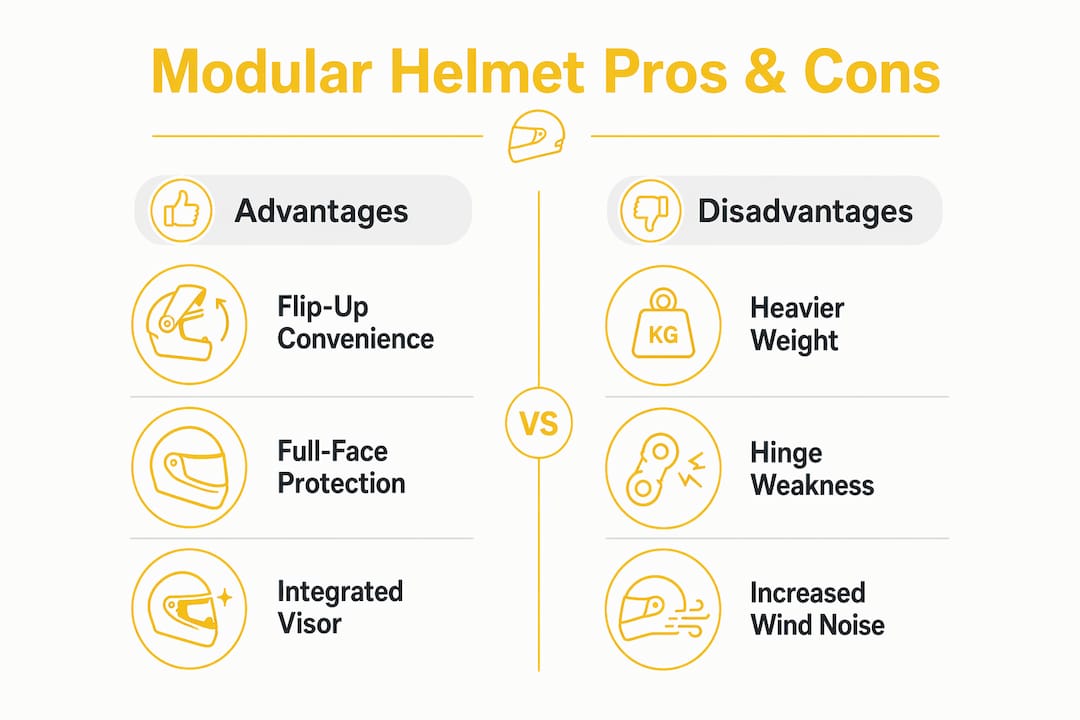
One tradeoff you should know upfront: modular helmets are heavier by about 200–300 grams than equivalent full-face helmets. That weight difference comes directly from the hinge mechanism and the reinforced structural parts around it. On a short commute, you won’t notice it. On a four-hour touring ride, your neck will.
Are modular helmets safe? what the tests show
Modular helmet safety is governed by ECE 22.06, the current European standard that most international markets recognize. The standard requires modular helmets to pass impact tests in both the open and closed chin bar positions. The chin bar must withstand an impact of 5 ± 0.2 kg at 3.5 ± 0.2 m/s. That test replicates the kind of chin-first impact that causes serious facial injuries in real crashes.
The certification that matters most for open-position riding is P/J homologation. Only helmets with P/J certification are approved for safe riding with the chin bar flipped up. A helmet marked only with “P” is certified for closed-position use only. This distinction is one of the most overlooked details when cyclists shop for a modular helmet.
“Safety experts regard full-face helmets as the gold standard for protection, but recognize modular helmets provide nearly equivalent safety for typical urban riding.” — Snowmobile Review
Here is how the three main helmet types compare on key safety and usability metrics:
| Category | Modular (Flip-Up) | Full-Face | Open-Face |
|---|---|---|---|
| Chin bar protection | Yes (closed position) | Yes (always) | No |
| Open-position certification | P/J models only | N/A | Standard |
| ECE 22.06 compliance | Required | Required | Required |
| Shell integrity | Reinforced at hinge | Unified shell | Unified shell |
| Best use case | Commuting, touring | Track, high-speed | Urban, low-speed |
The hinge is the structural weak point in any modular helmet. A unified shell, like the one on a full-face helmet, distributes impact forces across the entire surface. A modular shell must do the same job with a mechanical joint running through it. Modern modular helmets have achieved protection levels nearly comparable to full-face helmets, but full-face designs remain superior for high-speed and track use. For urban cycling speeds and commuting distances, a certified modular helmet delivers protection that is more than adequate.
What are the real advantages and disadvantages?
The case for choosing a modular helmet comes down to one core benefit: you get full-face protection without the full-face inconvenience. Modular helmets allow riders to eat, drink, talk, or ventilate without removing the helmet. For urban commuters stopping at lights, touring cyclists pulling into a café, or e-bike riders navigating city traffic, that convenience is genuinely useful.
Advantages of a modular helmet:
- Face access without removal: Flip the chin bar up to talk to someone, take a sip of water, or catch a breath of air at a stop
- Glasses-friendly fit: Modular helmets are notably glasses-friendly, letting you put on and remove the helmet while wearing eyeglasses without the struggle that full-face helmets create
- Versatility across conditions: Ride with full protection in traffic, then flip open on a quiet country road for fresh air
- Built-in sun visor: Most modular models include a drop-down internal visor, reducing the need for tinted visors or sunglasses
- Communication ease: Talking to a passenger, a parking attendant, or a fellow rider requires no helmet removal
Disadvantages you should weigh:
- Extra weight: The 200–300 gram weight penalty from the hinge mechanism creates real neck fatigue on long rides
- Wind noise: Hinge seams increase wind noise penetration compared to full-face helmets with unified shells. This is a known engineering limitation that has not been fully solved
- Higher cost: The mechanical complexity of a quality hinge and dual-position locking system pushes prices above comparable full-face models
- Fit differences: The adapted padding around the hinge area means the jaw and cheek fit feels different from a full-face helmet. Some riders find it less snug
Pro Tip: If wind noise is a concern, look for modular helmets with aerodynamic chin bar designs and dense neck roll padding. These two features reduce noise more than any other design element.
For urban commuters and touring riders, the advantages consistently outweigh the downsides. For sport riders or anyone spending time at higher speeds, the noise and weight penalties become harder to ignore.
Modular vs. full-face vs. open-face: which one fits your ride?
Choosing between helmet types is a decision about your specific riding conditions, not about which helmet is objectively best. Each type solves a different problem. Understanding the differences between cycling helmet types helps you match the helmet to your actual riding life.
A full-face helmet offers the highest protection level. The unified shell covers your chin, jaw, and face without any mechanical joints. It is quieter at speed, lighter than a modular equivalent, and the preferred choice for track riding, mountain biking at speed, and any situation where maximum impact protection is the priority. The tradeoff is convenience. You cannot flip it open. Putting it on while wearing glasses is awkward. Talking to someone at a stop means either shouting or removing the helmet.
An open-face helmet, sometimes called a three-quarter helmet, covers the top, sides, and back of your head but leaves your face exposed. It is the lightest option, the most comfortable in warm weather, and the easiest to put on and take off. The protection gap is significant. Without a chin bar, your face and jaw are unprotected in a forward impact. Open-face helmets suit low-speed urban riding and casual use where comfort is the priority.
The modular helmet sits between these two. It delivers full-face protection when closed and open-face convenience when flipped up. The integral helmet advantages of a full-face design are largely preserved in a quality modular model, with the added flexibility that urban and touring riders actually use. The cost is weight, noise, and a slightly higher price point.
For commuters who stop frequently, wear glasses, or ride in varied conditions, the modular format is the most practical choice. For sport-focused cyclists or anyone prioritizing pure protection over convenience, a full-face helmet is the stronger call. For casual, low-speed urban riders who prioritize airflow and comfort, an open-face design makes sense. Check out the top commuter helmet features to see how these priorities translate into specific design choices.
Key takeaways
A modular helmet delivers full-face protection and open-face convenience in one design, making it the most practical choice for urban commuters and touring cyclists who prioritize versatility without sacrificing certified safety.
| Point | Details |
|---|---|
| Core definition | A flip-up helmet with a hinged chin bar that converts between full-face and open-face positions. |
| Safety certification | Look for ECE 22.06 approval and P/J homologation to ride safely with the chin bar open. |
| Weight tradeoff | Modular helmets weigh 200–300 grams more than full-face equivalents, which matters on long rides. |
| Best rider profile | Urban commuters, touring cyclists, and eyeglass wearers benefit most from modular helmet design. |
| Full-face comparison | Full-face helmets remain superior for high-speed and track use due to their unified shell structure. |
Why i think most cyclists overlook the right details when buying a modular helmet
After spending years looking at cycling safety gear and talking to riders across commuting and touring contexts, I’ve noticed a consistent pattern: most people buying a modular helmet focus on the wrong things. They compare visor tint options and color choices before they check whether the helmet carries P/J homologation. That is backwards.
The P/J certification question should be the first thing you ask. If you plan to ride with the chin bar flipped up at any point, a helmet without P/J approval is not certified for that use. The helmet may feel fine. The hinge may feel solid. But it has not been tested for open-position impact. That gap matters.
The second thing most buyers underestimate is the weight. A 250-gram difference sounds trivial on paper. After two hours on a bike, your neck disagrees. I’d recommend anyone considering a modular helmet for touring to try it on and hold the position for five minutes before buying. That test tells you more than any spec sheet.
My honest recommendation: modular helmets are the right choice for the majority of urban and touring cyclists. The convenience is real, the protection is certified, and the versatility is genuinely useful in daily riding. Just buy one with P/J homologation, check the fit around your jaw carefully, and accept that you will pay a bit more for a quality hinge. The riders who get the most out of modular helmets are the ones who understood what they were buying before they bought it.
— Sophie
Find the right helmet for your ride at Thebeamofficial
Thebeamofficial designs high-end cycling helmets built for real-world riders, from daily urban commuters to long-distance touring cyclists. Every helmet in the collection is developed with protection, fit, and usability as the core priorities, not as afterthoughts.
Whether you are looking for a versatile helmet that handles city stops and open-road stretches, or you want to explore the full range of certified options, the Thebeamofficial adults’ helmet collection covers the full spectrum. You will also find helmet accessories and add-ons that complement your setup, from visibility gear to connected safety products. Protection that fits your ride starts with the right choice.
FAQ
What is a modular helmet used for?
A modular helmet is used for cycling and motorcycling where riders want full-face protection with the option to flip the chin bar open for convenience at stops, during communication, or for ventilation without removing the helmet.
Can you ride with a modular helmet chin bar open?
Only if the helmet carries P/J homologation. Standard modular helmets are certified for closed-position use only. A P/J certified helmet has passed impact tests in both open and closed positions and is approved for riding in either configuration.
How does a modular helmet differ from a full-face helmet?
A modular helmet has a hinged chin bar that flips up, while a full-face helmet has a unified shell with no moving parts. Full-face helmets are lighter, quieter, and structurally superior at high speeds. Modular helmets offer more convenience for urban and touring use.
Are modular helmets heavier than full-face helmets?
Yes. Modular helmets are typically 200–300 grams heavier than equivalent full-face helmets due to the hinge mechanism and reinforced structural components required to maintain shell integrity around the joint.
Are modular helmets good for cyclists who wear glasses?
Modular helmets are one of the best options for eyeglass wearers. Flipping the chin bar up before putting on or removing the helmet eliminates the awkward struggle that full-face helmets create for riders who wear glasses.


