

TL;DR:
- Eco-friendly helmets use sustainable materials like expanded cork, bio-based PLA, recycled polycarbonate, and bamboo fiber padding to protect cyclists while minimizing environmental impact.
- Safety standards are met by these materials, with design principles like disassembly and mono-material construction enhancing recyclability.
Eco-friendly helmet materials are sustainable substances designed to protect cyclists while minimizing environmental impact through recycled plastics, natural fibers, and bio-based components. Understanding what is eco-friendly helmet material means looking beyond the outer shell at every layer: the liner, the padding, the fasteners, and the finish. The cycling industry is shifting toward materials like expanded cork, Polylactic Acid (PLA), recycled polycarbonate, and bamboo fiber padding. Each of these meets or approaches the CPSC and EN1078 safety standards that govern helmet certification in the United States and Europe. Thebeamofficial tracks these developments closely, because the next generation of protective gear must perform on both the road and the environmental scorecard.

What are the primary sustainable materials used in eco-friendly helmets?
Eco-friendly helmet construction relies on four core material categories: bio-based liners, recycled shells, natural fiber padding, and low-impact surface coatings. Each category solves a different part of the sustainability problem.
Expanded cork is the most discussed bio-based liner alternative right now. It is a carbon-negative liner that absorbs carbon during the growth of the cork oak tree, making it one of the few helmet materials with a net positive environmental profile. Research confirms its stress-strain response is on par with standard EPS foam densities, meaning it absorbs impact energy comparably to the petroleum-based foam found in most helmets today.
Bio-based PLA (Polylactic Acid) is a plant-derived plastic made from corn starch or sugarcane. Switching to PLA can reduce material footprint by up to 8 times compared to petroleum-based plastics. That is a significant reduction, and it comes with the added benefit that PLA helmets can be processed through conventional recycling streams rather than sent to incineration.
Recycled polycarbonate shells use reground post-consumer plastic to form the hard outer layer. Leading sustainable helmets have achieved up to 90% recycled or renewable material construction, with only about 10% of components coming from non-renewable sources. That benchmark shows what is achievable with current manufacturing technology.
Bamboo fiber padding rounds out the picture. Bamboo fiber is durable, flexible, and temperature-regulating, making it a natural fit for interior padding that sits against your skin on long rides.
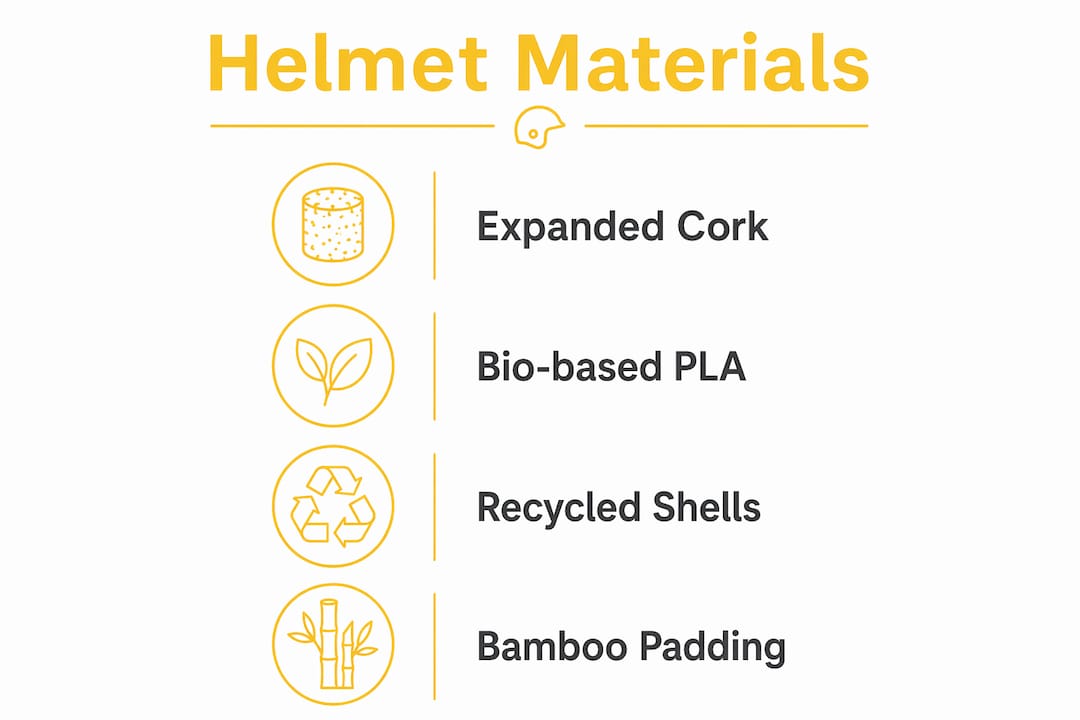
Here is a quick comparison of the four primary material types:
| Material | Source | Key benefit | Recyclability |
|---|---|---|---|
| Expanded cork | Cork oak bark | Carbon-negative, impact-absorbing | High |
| PLA plastic | Corn starch or sugarcane | Up to 8x lower material footprint | High (single-material) |
| Recycled polycarbonate | Post-consumer plastic | Reduces virgin plastic demand | Medium |
| Bamboo fiber | Bamboo grass | Moisture-wicking, thermal comfort | Medium |
Pro Tip: When evaluating a helmet’s sustainability claims, ask whether the liner, shell, and padding are each addressed. A recycled shell with a petroleum EPS liner is only a partial solution.
How do eco-friendly helmet materials meet safety and performance standards?
Sustainable materials only matter if they protect your head. The good news is that the gap between eco-friendly and conventional materials is closing fast.
The two primary standards governing helmet safety are the CPSC standard (required in the United States) and EN1078 (required in Europe). The 2026 updated helmet standards add rotational impact requirements, which means helmets must now manage both linear and angular forces during a crash. Sustainable materials must meet these updated benchmarks, not the older ones.
Expanded cork performs well under these conditions. Bio-based liners like expanded cork match or exceed EPS foam in shock absorption, though they require patented surface treatments for abrasion resistance and environmental durability. That last point matters: untreated cork can degrade faster than EPS when exposed to moisture and UV light, so surface engineering is part of the material solution.
Energy Reduction Technology (ERT) padding addresses the rotational impact requirement directly. ERT padding uses advanced polymers that absorb both rotational and linear impact energy during falls. It can be integrated with eco-friendly shells and liners without compromising the recyclability of the overall helmet.
The manufacturing process also contributes to safety. Water-based paints and UV-cured inks lower volatile organic compound emissions compared to solvent-based alternatives. This matters for the workers making the helmet and for the air quality around manufacturing facilities.
Pro Tip: Check whether a helmet lists its specific safety certification on the product page. “Eco-friendly” is a design choice; CPSC or EN1078 certification is a legal requirement. You need both.
What design innovations support sustainability and comfort in eco-friendly helmets?
Material choice is only half the story. How a helmet is designed determines whether it can actually be recycled at the end of its life.
The most important design principle is design-for-disassembly. Traditional helmets bond their components with permanent adhesives, which makes separating the shell, liner, and padding at end of life nearly impossible. Mechanical fasteners enable easier component separation and recycling compared to glue-bonded parts. A helmet built with screws and clips instead of glue can be taken apart by a recycler, or even by you, before disposal.
Single-material architecture takes this further. A helmet made entirely from one material type, such as a fully PLA construction, can enter a single recycling stream without sorting. Single-material helmets like those made entirely from PLA enable true recyclability and support a circular economy model. The challenge is that single-material designs require more engineering to meet multi-zone impact requirements.
Natural fabric covers add comfort and reduce synthetic material use. The Flexcork concept, developed by researchers studying electric micromobility helmets, pairs a cork liner with a burel wool cover. The cork liner helmet with burel wool cover weighs approximately 340g total, which is competitive with many conventional helmets on the market.
Bamboo padding contributes to comfort in a measurable way. Unlike synthetic foam, bamboo fiber actively wicks moisture away from your scalp and regulates temperature during effort. For cyclists who ride in heat or on long gravel routes, this is a real performance difference, not a marketing claim.
What are the environmental impacts and lifecycle considerations of eco-friendly helmet materials?
A helmet’s environmental impact does not begin when you buy it or end when you throw it away. The full lifecycle covers raw material extraction, manufacturing, your years of use, and final disposal.
Expanded cork starts with a carbon-negative extraction process. Cork oak bark is harvested without cutting the tree, and the tree continues to absorb CO2 throughout its life. This gives cork a lifecycle profile that no petroleum-based material can match at the extraction stage.
PLA reduces the carbon burden at the manufacturing stage. Lifecycle assessments show PLA helmets reduce carbon footprint significantly compared to conventional helmets, though PLA must still overcome material stability and certification hurdles before full market adoption. The certification gap is the current bottleneck, not the material performance.
The disposal stage is where most helmets fail. Traditional helmets have glued mixed materials that hinder recyclability, and most are incinerated after 3–5 years of use. Incineration recovers some energy but destroys the material value entirely. A helmet designed for disassembly, using mechanical fasteners and mono-materials, avoids this outcome.
Pro Tip: When your helmet reaches the end of its life, contact the manufacturer before throwing it away. Some brands offer take-back programs or can direct you to a specialist recycler for composite materials.
Key Takeaways
Eco-friendly helmet materials reduce environmental impact across the full lifecycle only when combined with design-for-disassembly principles, certified safety performance, and mono-material or bio-based construction.
| Point | Details |
|---|---|
| Expanded cork is carbon-negative | Cork absorbs CO2 during growth and matches EPS foam in impact absorption. |
| PLA cuts material footprint | Bio-based PLA can reduce a helmet’s material footprint by up to 8 times versus petroleum plastics. |
| Design-for-disassembly matters | Mechanical fasteners instead of adhesives make helmets recyclable at end of life. |
| Safety standards still apply | CPSC and EN1078 certification is required regardless of material choice. |
| Bamboo padding delivers real comfort | Bamboo fiber wicks moisture and regulates temperature, improving performance on long rides. |
Why I think most “eco” helmet claims miss the point
The conversation around sustainable helmet materials tends to focus on what a helmet is made of. That is the wrong starting point. The right question is: what happens to this helmet in five years?
I have reviewed enough helmet lifecycle data to know that a recycled polycarbonate shell bonded to a petroleum EPS liner with industrial adhesive is not an eco-friendly helmet. It is a conventional helmet with a marketing upgrade. The recycled content is real, but the end-of-life outcome is identical: incineration.
The helmets that actually move the needle are the ones built around disassembly. When a design team chooses mechanical fasteners over glue, they are making a decision that costs more at the manufacturing stage and pays off only when the product is retired. That is a genuine sustainability commitment, not a label.
Natural materials like expanded cork and bamboo padding also deserve more credit than they get. Cork is not a novelty. It is a material with centuries of use in demanding applications, and its impact absorption data is solid. Bamboo padding genuinely improves comfort on hot days. These are not compromises you make for the planet. They are upgrades you make for yourself.
My recommendation: look for helmets that list their helmet liner materials explicitly, specify their fastening method, and carry a current safety certification. If a brand cannot answer those three questions clearly, the sustainability claim is surface level.
The future of cycling safety gear runs through the circular economy. Brands that design for disassembly today will be the ones with compliant, competitive products when regulations catch up to the science.
— Sophie
Thebeamofficial’s approach to helmets built for the long ride
Thebeamofficial designs helmets for cyclists who refuse to choose between protection and responsibility. Every helmet in the collection is built around real safety certification, with materials and construction methods selected for performance across road, gravel, urban, and e-bike riding.

If you are ready to upgrade to a helmet that takes both your safety and your environmental impact seriously, the Thebeamofficial helmet collection covers every riding style. From commuting to long-distance gravel, you will find options built with the same attention to protection that defines every product the brand makes. Pair your helmet with safety accessories designed to make you more visible on every ride.
FAQ
What is eco-friendly helmet material made of?
Eco-friendly helmet materials include expanded cork, bio-based PLA plastic, recycled polycarbonate, and bamboo fiber padding. These replace or reduce petroleum-based components like EPS foam and virgin plastic shells.
Are eco-friendly helmets as safe as conventional helmets?
Yes, when certified. Sustainable materials like expanded cork and ERT padding meet CPSC and EN1078 standards, and the 2026 helmet standards apply equally to all helmets regardless of material type.
Can eco-friendly helmets be recycled?
Most can be recycled only if they are designed for disassembly. Helmets using mechanical fasteners and single-material construction, such as fully PLA helmets, can enter standard recycling streams. Glue-bonded multi-material helmets typically cannot.
What is the most sustainable liner material for a cycling helmet?
Expanded cork is currently the most sustainable liner option. It is carbon-negative, matches EPS foam in impact absorption, and is easier to recycle than petroleum-based foam alternatives.
Does bamboo padding actually improve comfort?
Yes. Bamboo fiber padding wicks moisture away from your scalp and regulates temperature during effort. These are measurable benefits, particularly useful for cyclists riding in warm conditions or on longer routes.


