

TL;DR:
- Design plays a critical role in whether cycling safety gear effectively protects and stays on during impacts. Standards like EN 1078 specify impact zones, vision angles, and retention strength, requiring deliberate geometric and structural decisions to meet safety criteria. Evaluating helmet fit, visibility, retention ease, and comfort ensures better protection beyond certification logos and price points.
Most cyclists buy a helmet based on price, color, and a certification sticker. That instinct isn’t wrong, but it’s incomplete. The role of design in safety gear goes far deeper than aesthetics or even materials. Design is the architecture that determines whether your gear actually protects you when it matters, stays on your head through a crash, lets you see a car approaching from the side, and feels comfortable enough that you wear it every single ride. This article breaks down what professional protective equipment engineers call “human factors design” and why it should be the first thing cyclists evaluate, not the last.
Key takeaways
| Point | Details |
|---|---|
| Design shapes real-world protection | Helmet geometry, retention systems, and ventilation placement directly determine how well gear performs in a crash. |
| Standards codify design requirements | EN 1078 specifies impact zones, vision angles, and retention strength, making design compliance a measurable safety factor. |
| Ergonomics drive consistent use | Gear designed around natural movement is worn correctly more often, which is where real injury prevention happens. |
| Trade-offs require informed choices | Balancing weight, airflow, and coverage is a design challenge; knowing the trade-offs helps you pick the right gear for your riding style. |
| Certifications confirm design integrity | The CE mark validates that a helmet’s design passed rigorous lab tests, not just that it uses safe materials. |
The role of design in safety gear: why it matters more than you think
The phrase “protective equipment design” covers the deliberate engineering decisions that determine how a piece of safety gear behaves under stress. That includes the curvature of a helmet shell, where padding sits relative to your skull, how a chin strap routes across your jaw, and even where vent channels are cut into the foam. Every one of those choices has a safety consequence.

Think about fit. A helmet that sits too high on your forehead exposes your temples in a fall. A strap that doesn’t seat under the ear shifts the helmet rearward on impact. These aren’t material failures. They’re design failures. And they happen in products that pass basic certification if the design isn’t held to a higher standard.
The importance of design in safety equipment comes down to three core functions:
- Impact management: Shell geometry and liner density distribution determine where and how kinetic energy disperses during a crash.
- Retention and positioning: Strap routing, buckle placement, and rear-cradle systems keep the helmet correctly positioned before and during impact.
- User interaction: How intuitive the gear is to put on, adjust, and maintain determines whether it gets used correctly in the real world.
Visibility is a fourth dimension that cyclists often undervalue. Field of vision requirements exist in safety standards specifically because a helmet that blocks your peripheral view creates a new hazard. Design features like shell radius, temple contouring, and vent placement around the forehead all affect your sightlines.
Pro Tip: Before buying any helmet, put it on and look hard left and right without turning your head. If the shell or padding enters your vision, the design is compromising your awareness on the road.
Technical standards that define design requirements
Certification standards are not just material checklists. They are design envelopes. The European standard EN 1078, which governs adult cycling helmets, is one of the clearest examples of how standards shape design at a structural level.
EN 1078 requires shock absorption across multiple zones, including the crown, sides, front, and rear. That requirement forces designers to distribute impact-absorbing liner material across the full helmet, not just concentrate it at the top. It also specifies that retention systems must release under 150 to 250 Newtons of force. Low enough to prevent strangulation, firm enough to prevent slippage. That is a design parameter, not a material spec.
Perhaps the most underappreciated requirement involves vision. EN 1078 mandates that helmets preserve at least 210 degrees of horizontal field of vision. Achieving that number requires specific decisions about shell radius, how far the front brim drops, and where foam is carved away near the temples. The geometry has to be right before a single material is tested.
Here’s a side-by-side look at how EN 1078 compares to what a helmet without certified design compliance might offer:
| Design criterion | EN 1078 compliant helmet | Non-certified helmet |
|---|---|---|
| Impact zone coverage | Crown, front, rear, sides | Often crown only |
| Retention strength | 150–250 N, lab tested | Untested, variable |
| Peripheral vision | Minimum 210° horizontal | No requirement |
| Design validation | Confirmed by CE mark | No independent check |
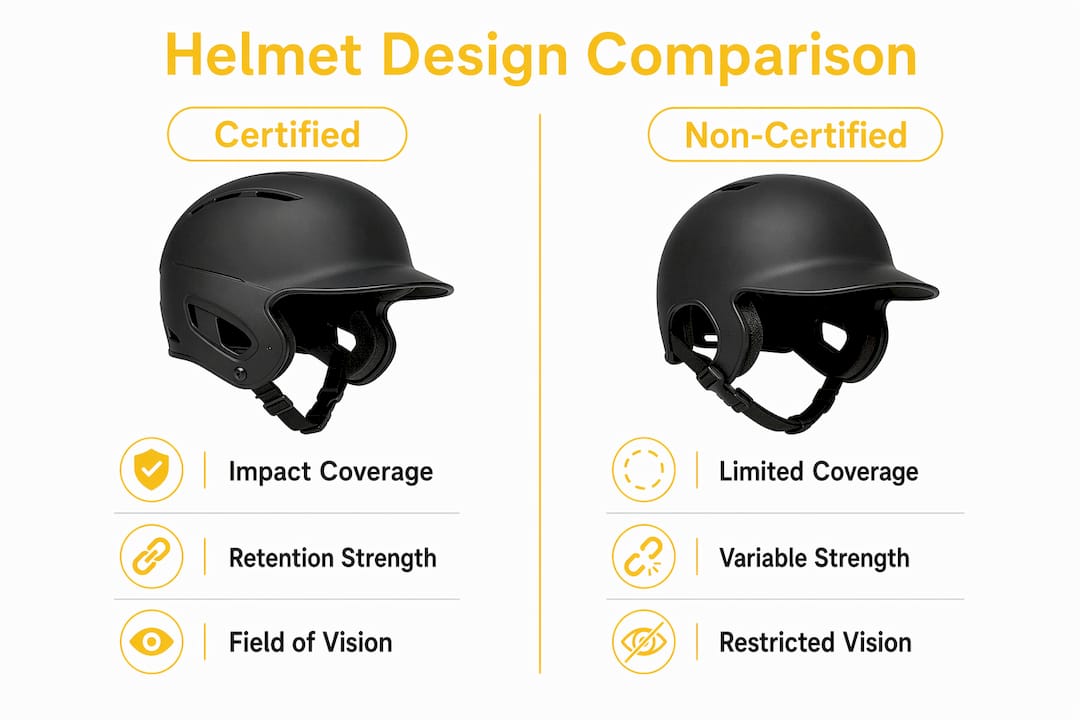
The CE certification mark confirms that an accredited lab has verified the helmet’s design meets all of these criteria through physical testing, not just documentation review. It is the most reliable signal that a helmet’s design actually performs under stress.
Pro Tip: The CE mark appears on thousands of helmets, but always verify it is accompanied by the EN 1078 standard number. That specific pairing confirms the helmet was tested for cycling, not just generic head protection.
Key design features that separate good helmets from great ones
Modern cycling helmets succeed or fail based on how well individual design features work together. Here is what actually matters and why:
-
Shell geometry and coverage: A rounder, lower-cut shell wraps further around the skull, covering the temporal and occipital areas where fractures from cycling crashes are statistically significant. Aerodynamic shapes reduce drag without reducing coverage when the geometry is designed correctly.
-
Ventilation channel placement: Vents must be positioned to allow airflow without creating stress concentrations in the foam liner. Poorly placed vents weaken structural integrity. Well-designed vents route air through channels that preserve the liner’s energy-absorbing capacity while keeping core temperature down on long rides.
-
Retention system design: A well-engineered retention system does far more than hold the helmet on. Retention system design prevents the helmet from rotating or displacing during a crash, which is what keeps the liner positioned over the impact point. Look for rear cradles that wrap around the occiput, not just strap tension to hold position.
-
Padding placement and material: EPS foam density should be highest over the most vulnerable impact zones. Interior comfort padding affects fit consistency and plays a secondary role in absorbing lower-energy impacts. Padding that compresses permanently after one hard knock is a design warning sign.
-
Reflective and visibility elements: Design features that enhance your visibility to drivers, like integrated reflective strips and rear light mounting points, are safety features, not afterthoughts. The positioning matters. A reflective strip hidden under a strap is functionally useless at night.
-
Weight distribution: A helmet that is heavy at the front tilts forward during a ride, shifting its coverage zone upward and exposing the back of the head. Good weight distribution keeps the helmet neutral and correctly positioned without constant adjustment.
Design trade-offs cyclists need to understand
Every piece of protective gear involves compromises. Understanding them helps you choose the right product for how you actually ride, not the right product for an idealized version of your riding.
The most common trade-off in cycling helmet design is weight against impact resistance. A thicker EPS liner absorbs more energy but adds weight and bulk. Manufacturers address this with materials like MIPS-compatible liner geometries and multi-density foam, but overprotection in safety gear creates real problems too. Excessive bulk causes heat stress, increases neck fatigue on long rides, and in some cases leads riders to remove the helmet entirely during climbs. That is the design paradox: gear that is technically more protective gets worn less.
Here is how to navigate the main trade-offs when choosing gear:
-
Weight vs. protection level: For high-speed road or gravel riding, prioritize impact performance over weight savings. For commuting at lower speeds, a lighter design with solid certification is a reasonable balance.
-
Ventilation vs. coverage: More vents mean less foam. Open ventilation designs favor warm-weather performance but reduce liner surface area. If you ride in variable conditions, look for a design that maintains lower-cut coverage even with generous vent channels.
-
Modularity vs. simplicity: Some helmets offer removable chin guards or adaptable fit systems. Modular designs can address more riding contexts but add mechanical complexity. More moving parts means more things to check before each ride.
-
Comfort vs. correctness: Ergonomic design that mirrors actual user movement improves the likelihood of correct use. A retention system with too many micro-adjustments tends to get left in a compromised position. The best design makes the correct fit feel natural.
Pro Tip: Always test a helmet’s retention system with one hand. If you cannot tighten or loosen it while wearing gloves, you will not adjust it properly mid-ride. Ease of adjustment is a safety feature.
How to evaluate safety gear design before you buy
You do not need an engineering degree to assess whether a helmet or piece of protective gear is well-designed. You need the right questions.
- Does the helmet sit level on your head with two finger-widths between the front edge and your eyebrows, without you having to force it? A shell that requires unusual positioning to clear your eyes is a geometry problem.
- Does the chin strap route under your ear and sit flat against your jaw without gaps? Strap routing is a design decision that determines whether the helmet stays on in a crash.
- Can you turn your head fully left and right without the shell entering your peripheral vision? If not, the design does not meet the spirit of EN 1078’s 210-degree vision standard, even if it technically passed the test.
- Does the ventilation feel adequate for your typical riding intensity? A helmet you overheat in will come off.
- Are there reflective elements positioned where they are visible from multiple angles, not just the rear?
- Is the retention system intuitive enough that you will actually use it correctly every time?
Understanding how helmet design protects your head is the most practical cycling safety education you can get. Gear that scores well on all these points does not need to be expensive. It needs to be thoughtfully made.
My take on where design gets overlooked
I’ve spent years watching cyclists make gear decisions based almost entirely on certification logos and price. And I get it. The CE mark feels like a guarantee. But what I’ve learned is that certification sets a floor, not a ceiling.
What I’ve seen again and again is that two helmets can share identical certifications and produce completely different real-world outcomes. The difference is always design execution: how the liner is distributed, how the retention system behaves on a range of head shapes, whether the vent channels weaken structural zones. Those details are not captured in a certificate.
My honest take is that ergonomics and user behavior determine real-world safety outcomes more than any single material choice. Gear that is uncomfortable, annoying to adjust, or too hot to wear consistently is functionally unsafe regardless of what it would do in an ideal lab impact. The safety and community culture around cycling matters here too. When gear feels like a natural extension of how you ride, you wear it correctly without thinking about it.
The brands that are moving the needle treat design as their primary safety mechanism, not a visual layer over engineering. That’s the standard cyclists should hold every purchase to.
— Sophie
Gear built for how you actually ride
At Thebeamofficial, every helmet in our collection is built around the design principles covered in this article: liner geometry that meets EN 1078 across all impact zones, retention systems engineered for correct positioning under crash forces, and ventilation that preserves structural integrity. Our flagship VIRGO integral helmet incorporates MIPS technology within a design that balances full coverage with real-world wearability. If you are ready to choose gear where design and protection are treated as the same thing, explore our cycling helmets collection. For riders who want to go further, our helmet accessories add visibility and functionality without compromising the original design intent.
FAQ
What does design actually mean in cycling safety gear?
In protective equipment, design refers to the deliberate engineering of geometry, material placement, retention systems, and visibility features that determine how gear performs under stress. It goes far beyond appearance to shape every aspect of protection and usability.
How does EN 1078 influence helmet design?
EN 1078 acts as a design envelope, requiring specific impact coverage zones, retention strength between 150 and 250 Newtons, and a minimum 210-degree horizontal field of vision. These requirements force helmet designers to make specific geometric and structural decisions before a product can be certified.
Why does ergonomic design matter for safety?
Gear that fits naturally and adjusts intuitively gets worn correctly on every ride. Studies show that complex interfaces and difficult adjustments reduce compliance, which means ergonomic design directly improves real-world protection outcomes.
What should I check when evaluating helmet design?
Check that the helmet sits level with two finger-widths above your eyebrows, that the chin strap routes cleanly under your ear, that your peripheral vision is fully clear, and that the retention system adjusts easily with gloved hands.
Does the CE mark guarantee good design?
The CE mark confirms that a helmet’s design passed accredited lab tests for impact absorption, retention strength, and vision clearance. It is the most reliable signal of design integrity available to consumers, though the quality of design execution can still vary between certified products.


