

TL;DR:
- Urban helmets should include impact protection, rotational injury mitigation, extended coverage, and high visibility.
- Comfort, ventilation, and adjustable fit are crucial for consistent daily helmet use in variable weather.
- Connected features like integrated lights, crash sensors, and Bluetooth enhance safety and visibility for city commuters.
Navigating city streets every day means dealing with car doors swinging open, unpredictable pedestrians, slick pavement after rain, and intersections where visibility is your best defense. Your helmet is the single piece of gear that stands between a bad moment and a life-changing injury. But with so many options on the market, ranging from stripped-down road shells to fully connected smart helmets, choosing the right one takes more than a quick glance at a price tag. Knowing exactly which features matter for urban commuting gives you a real advantage before you even step into a store or click “add to cart.”
Table of Contents
- Key safety features every commuter helmet must have
- Comfort and fit: Don’t compromise on ventilation and adjustability
- Smart and integrated helmet technology: A new era of safety
- Commuter helmet characteristics comparison table
- What most helmet guides miss for real-world commuters
- Find your perfect commuter helmet and ride smarter
- Frequently asked questions
Key Takeaways
| Point | Details |
|---|---|
| Safety is paramount | Choose helmets with advanced impact protection and visibility for busy urban riding. |
| Comfort encourages use | Opt for adjustable fit, excellent ventilation, and lightweight materials to make daily wear effortless. |
| Technology boosts safety | Integrated features like LED lights and crash alerts can greatly enhance city cycling confidence. |
| Fit matters most | A helmet only protects if you wear it right—find one that feels secure and comfortable every ride. |
Key safety features every commuter helmet must have
Safety is the foundation, and it starts with what’s inside the shell. EPS foam (expanded polystyrene) is the standard impact-absorbing liner in most quality helmets. It works by crushing on impact, dispersing energy away from your skull. What EPS alone doesn’t address is rotational force, which is the twisting motion your brain experiences in angled impacts. That’s where MIPS (Multi-directional Impact Protection System) comes in. MIPS adds a low-friction slip layer inside the helmet that rotates independently by a few millimeters on impact, reducing the rotational energy transferred to your brain. For urban riding, where you’re more likely to hit a curb at an angle than a wall head-on, this matters enormously.
Shell coverage is another overlooked factor. Road helmets are cut high for aerodynamics. Commuter helmets, by contrast, tend to offer extended rear coverage, protecting the back of your head where falls in traffic tend to happen. This urban helmet design philosophy acknowledges that city crashes are different from racing crashes, and the geometry of the helmet reflects that reality.
High-visibility elements are not optional for urban riders. Reflective panels, reflective tape strips, and integrated rear LED lights dramatically improve how visible you are at dawn, dusk, and in tunnel underpasses. Studies consistently show that increased cyclist visibility reduces collision risk, particularly at intersections. As noted in our guide on types of commuter helmets, different helmet profiles are built for different environments, and urban-specific models prioritize being seen.
Key point: Urban helmets are designed to specifically protect against common city cycling dangers, which means their construction choices are deliberate, not cosmetic.
Here’s what to verify on any commuter helmet you’re evaluating:
- EN 1078 certification for riders in Europe
- CPSC certification for riders in the United States
- MIPS or equivalent rotational protection system
- EPS liner with multi-density zones for varied impact speeds
- Reflective detailing visible from at least 50 meters
- Extended rear shell for occiput (lower back of skull) coverage
- Integrated or mountable rear light compatibility
Don’t treat certifications as a formality. A helmet sold without EN 1078 or CPSC marking has not been independently tested for impact performance. In urban environments, where low-speed but complex impacts are common, tested protection is the baseline, not a bonus.
Comfort and fit: Don’t compromise on ventilation and adjustability
A helmet you find uncomfortable will spend more time hanging on your handlebars than protecting your head. Comfort isn’t a luxury consideration. It’s a direct safety factor, because ventilation and comfort directly influence whether you actually wear your helmet consistently.
Ventilation in a commuter helmet works through a system of intake vents at the front and exhaust vents at the rear, with internal channeling that moves air across your scalp. More vents don’t always mean better airflow. The shape and position of internal channels matter just as much as the number of openings. A helmet with 12 well-positioned vents will cool your head more effectively than one with 20 shallow slots that don’t direct airflow.
Adequate ventilation and a secure fit are vital for long commutes and fitness-focused riders who need consistent performance across varying temperatures.
Dial-adjust fit systems (often called retention systems) let you fine-tune the fit at the back of the helmet with a single-handed twist. This is enormously practical for commuters. You can tighten up when switching from a fast lane to a high-traffic zone or loosen slightly when cruising on a protected bike lane. Fixed-size helmets require you to find your exact size and rely on padding alone to compensate. Adjustable systems are simply more forgiving and more secure.
Moisture-wicking liners are a feature that separates commuter-optimized helmets from sports-focused designs. When you arrive at work sweaty, removable, washable pads make a real difference to hygiene and comfort. Look for pads made from anti-bacterial materials. Some premium helmets include interchangeable pad sets in different thicknesses so you can customize the fit further. Check our helmet fit guide for detailed sizing advice before buying.
Weight matters more than most people expect. A 350g helmet feels fine for a 20-minute ride but becomes noticeable over a 45-minute commute, especially if you’re checking traffic over your shoulder constantly. Quality commuter helmets typically land between 220g and 320g. Anything over 380g will likely feel heavy by the time you reach your office.
Pro Tip: Before adjusting the retention dial, position the helmet level on your head (two finger-widths above your eyebrow), then tighten until you feel firm but not painful contact around the entire circumference. Shake your head side to side. If the helmet shifts, keep adjusting.
Smart and integrated helmet technology: A new era of safety
The commuter helmet has become a platform for connected safety technology, and the pace of innovation is accelerating. These aren’t gimmicks. Each feature solves a specific urban commuting problem.
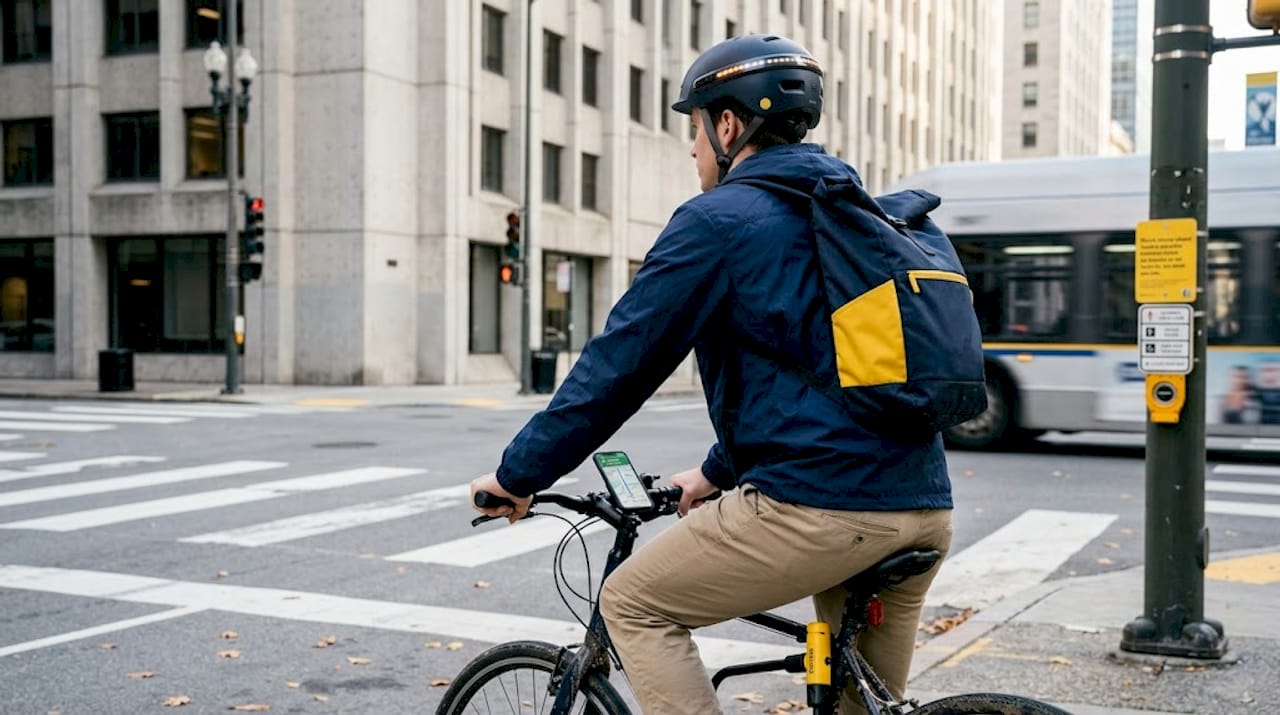
Integrated LED lights built into the helmet eliminate the need for clip-on rear lights that drain AAA batteries and fall off on rough roads. Helmet-mounted rear lights sit at head height, making you visible above car bumpers and significantly improving your sight line to drivers approaching from behind. Some models now include directional turn signals controlled by a handlebar remote, a feature that keeps your hands on the bars and your intentions clear to traffic.
Bluetooth connectivity and built-in speakers let you receive turn-by-turn navigation audio without removing your phone from your pocket. This is particularly valuable in dense European cities where street layouts are complex. The key here is safety: bone-conduction speaker designs in particular allow ambient sound to pass through, so you hear the navigation cue and the ambulance behind you at the same time.
Crash sensors represent the most significant safety advancement in recent years. Accelerometers inside the helmet detect impact signatures and, if you don’t manually dismiss the alert, automatically send your GPS location to pre-set emergency contacts. For solo commuters who ride early mornings or late nights, this feature is a real safety net. The integrated helmet technologies emerging from brands focused on urban safety are reshaping what we expect a helmet to do.
App-enabled ride tracking adds a layer of awareness that goes beyond safety in the immediate sense. Reviewing your commute data, elevation, average speed, and route patterns, can help you identify which streets are fastest or safest over time. As our overview of connected helmet features explains, this category of technology is now mature enough for everyday riders, not just early adopters.
| Smart Feature | Urban Benefit | Best For |
|---|---|---|
| Integrated rear LED | Higher visibility at head height | All commuters |
| Turn signal system | Clear lane change communication | Urban traffic riders |
| Bluetooth speakers | Hands-free navigation audio | Complex route commuters |
| Crash sensor + alert | Automatic emergency notification | Solo or early morning riders |
| App ride tracking | Route optimization, data review | Data-driven cyclists |
Pro Tip: When comparing smart helmets, check the battery life and charging interface. A helmet with a 6-hour battery that charges via proprietary cable is less practical for daily use than one with a 10-hour USB-C charge that you can top up at your desk.
As noted in our research on integrated helmet design, these technology-driven features are advancing urban cyclist safety in measurable ways. They represent the direction the entire category is moving.
Commuter helmet characteristics comparison table
Understanding individual features is useful, but seeing them side by side reveals the real trade-offs you’ll make based on your commuting priorities.
| Characteristic | Speed-focused commuter | Safety-maximalist | Everyday urban rider |
|---|---|---|---|
| Shell coverage | Minimal (road cut) | Extended (full rear) | Moderate (balanced) |
| Ventilation | High (15+ vents) | Moderate (8-12 vents) | Good (10-14 vents) |
| Weight | Ultra-light (under 250g) | Heavier (280-350g) | Mid-weight (250-300g) |
| MIPS / rotational protection | Optional | Essential | Strongly recommended |
| Integrated lights | Rare | Common | Common |
| Adjustable retention | Standard | Advanced dial system | Dial-adjust standard |
| Smart connectivity | Uncommon | Available | Growing feature |
As our breakdown of choice of helmet types makes clear, different helmet types cater to different needs and environments in urban cycling. There’s no single best answer, only the best match for your specific ride.
Tips for matching helmet features to your commute:
- Short, fast urban commute (under 20 minutes): Prioritize low weight, high ventilation, and MIPS protection. Smart features are a plus but not essential.
- Long distance daily commute (30+ minutes each way): Prioritize adjustable fit, moisture-wicking pads, and ventilation. A crash sensor is worth serious consideration.
- Low-light or mixed-traffic commuting: Integrated rear lighting and reflective coverage should be non-negotiable. Extended shell coverage adds meaningful protection.
- E-bike commuters: Choose a helmet rated for higher speeds where available. Many e-bike helmets offer extended lower shell coverage and visor compatibility.
- Year-round riders: Look for interchangeable liner systems and compatibility with thermal caps or ear covers for winter use.
What most helmet guides miss for real-world commuters
Most helmet buying guides are written from a lab perspective. They compare certifications, weight, and vent counts on paper. What they skip is the actual daily reality of commuting: rain-soaked rides, carrying a helmet into a meeting, slamming it into a locker, and pulling it on again with cold fingers while running late.
Here’s what we’ve learned from real urban riders: the quick-adjust retention dial is one of the most important features you can have on a commuter helmet, not because of fine-tuning, but because commuters put their helmets on and take them off dozens of times a week under variable conditions. Gloves, cold hands, rush-hour stress. If the adjustment system is fiddly or placed awkwardly, riders default to leaving it loose. A loose helmet is a failed helmet.
Cleaning is another topic almost no guide addresses. EPS foam cannot be washed with soap and water without degrading over time. But a commuter helmet collects sweat, pollution, and humidity every single day. Helmets with fully removable, machine-washable liner systems solve this problem practically. Those without them develop odor, and riders subconsciously avoid wearing them. Consistent use is the entire point.
Weather handling is equally important. A helmet with a strong visor or front brim sheds rain from your eyes on a wet commute. Some urban helmets include a secondary internal sun visor that drops down for bright-sky segments. These aren’t gimmicks. They’re features that keep your eyes clear and your attention on the road where it belongs.
The bottom line is this: real-life helmet fit recommendations consistently show that consistent helmet use is driven by simplicity, comfort, and confidence in safety features. The technically superior helmet you leave at home because it’s uncomfortable is less safe than the slightly heavier one you actually wear every single day. Buy for daily life, not for the idealized commute you imagine.
Find your perfect commuter helmet and ride smarter
If this article has shifted how you think about helmet features, the next step is straightforward: find a helmet that checks your specific boxes without compromise.
At THE BEAM, we design helmets specifically for urban and commuting cyclists who refuse to choose between safety and real-world usability. Our commuter helmet collection includes models with MIPS protection, integrated rear lighting, and dial-adjust fit systems built for daily wear. The VIRGO integral helmet is our flagship answer to riders who want full coverage and connected safety in a single, polished design. Browse all helmets available to compare specifications directly and find the model that matches your commute, your city, and your pace.
Frequently asked questions
What safety standards should a commuter helmet meet in Europe and the US?
Commuter helmets should meet EN 1078 certification in Europe and CPSC certification in the United States. Both standards require independent impact testing and are the minimum baseline for any helmet you should consider.
Is MIPS technology necessary for urban cycling helmets?
MIPS is highly recommended for urban riders because city crashes frequently involve angled impacts that generate rotational force. As detailed in our guide on urban helmet dangers, urban helmets are designed specifically to address these common city cycling injury patterns.
How do I ensure my helmet fits properly for daily commutes?
A properly fitting helmet should feel snug, sit level on your head, and remain stable when you shake it. The straps should form a “V” shape just below each ear, and the chin strap should allow only one finger of space beneath it. Proper ventilation and fit are both vital for the comfort that keeps you wearing it consistently.
What are the advantages of smart or connected commuter helmets?
Smart helmets provide integrated LED lighting for visibility, crash sensors that send automatic emergency alerts, and Bluetooth audio for hands-free navigation. As shown in our coverage of integrated helmet design, these technology-driven features are now accessible to everyday urban riders and offer meaningful safety improvements over passive helmets.


