

Yes, MIPS is worth it for gravel riding. The technology adds a low friction slip layer that reduces rotational force on your brain during the angled, off-camber impacts common on loose terrain. Your next move: try on a MIPS-equipped helmet with deep rear coverage and confirm the fit before you buy.
TL;DR:
- MIPS helmets are especially beneficial for gravel riding, where oblique impacts are more common due to loose terrain and unpredictable falls.
- It is essential to choose a helmet with deep rear coverage, proper fit, and adequate ventilation to ensure safety and comfort during long gravel rides.
- Independent impact ratings, such as Virginia Tech’s star system, provide objective benchmarks for comparing helmet rotational protection beyond brand claims.
- Proper fit testing, including static fit and ride testing, is critical before purchase, as helmet comfort and stability directly impact protection effectiveness.
- Regular helmet maintenance and replacement after a crash or every 3 to 5 years help maintain safety levels, since materials degrade over time.
Table of Contents
- What Is MIPS and Why Does Rotational Protection Matter on Gravel?
- How to Choose a Gravel Helmet With MIPS
- How Do You Test a Helmet Before You Buy It?
- Caring for Your Helmet and Knowing When to Replace It
- Why We Build MIPS Into the VIRGO Gravel Helmet
- Comparison of MIPS vs Other Helmet Safety Technologies
- What Certifications Should a Gravel Helmet With MIPS Meet?
- Popular Gravel Helmet Models Featuring MIPS
- Common Misconceptions About MIPS in Gravel Helmets
- What Actually Matters When You’re Choosing a Gravel Helmet
- Find Your MIPS-Equipped Gravel Helmet at THE BEAM
- Sources
What Is MIPS and Why Does Rotational Protection Matter on Gravel?
MIPS stands for Multi-Directional Impact Protection System, and it works on a simple idea. Standard helmets rely on expanded polystyrene (EPS) foam to absorb straight-line impact energy, the kind you get from a head hitting pavement dead center. But most real crashes aren’t dead center. They come in at an angle, and that’s where a plain foam shell falls short.
A MIPS liner is a thin, low friction layer sitting between your head and the foam. On impact, it lets the helmet shell shift a few millimeters relative to your skull, absorbing rotational motion before it transfers to your brain. Rotational forces are the ones linked to diffuse brain injuries, because your brain tissue twists inside the skull rather than just compressing against it.
Gravel riding produces exactly this kind of oblique impact more often than road cycling does. Loose surfaces, ruts, and unpredictable line changes mean a fall is more likely to involve a glancing blow, a shoulder-first tumble that whips the head sideways, or a slide across gravel at an angle rather than a straight drop. That’s the scenario MIPS was built to address.
You don’t have to take a brand’s word for how well any of this actually performs. The Virginia Tech Helmet Lab runs angled impact tests on commercial helmets and publishes independent star ratings that quantify both energy absorption and rotational mitigation. Checking a model’s Virginia Tech score is one of the few genuinely objective ways to compare helmets across brands, rather than relying on marketing copy. For a deeper technical breakdown of how the liner itself is engineered, THE BEAM’s own explainer on MIPS technology walks through the mechanics in more detail.
How to Choose a Gravel Helmet With MIPS
Picking the right helmet is a balancing act between five variables: fit, coverage, ventilation, weight, and features. Get the first two right and the rest becomes a matter of preference.
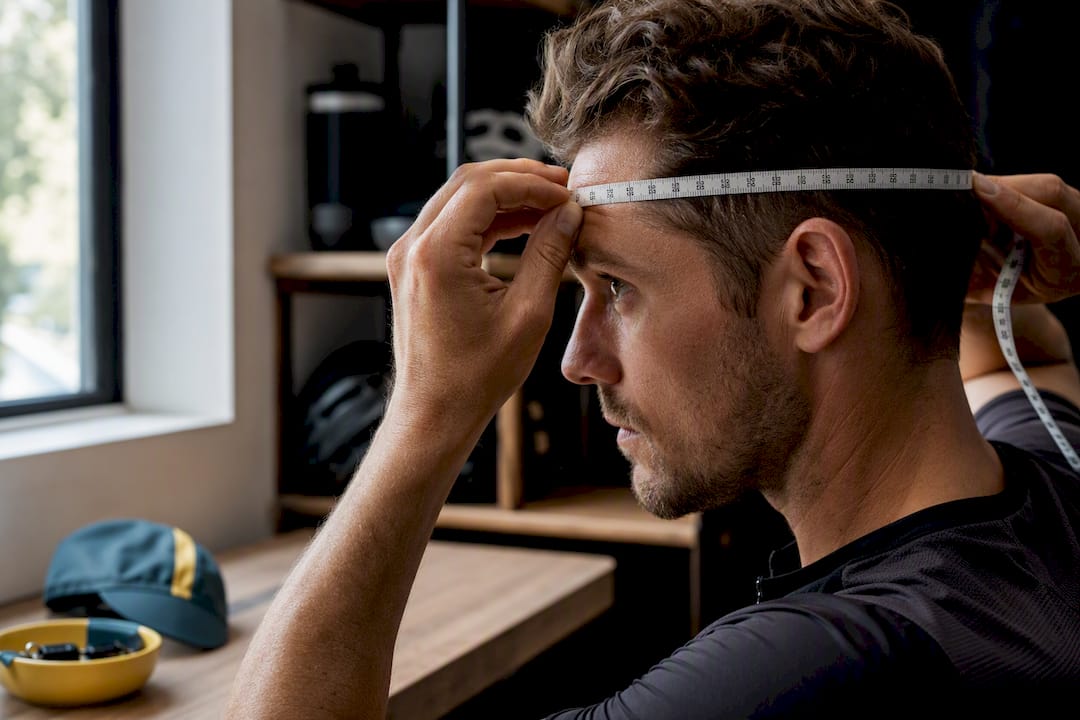
Fit starts with measuring your head circumference with a soft tape, about an inch above your eyebrows, and matching it against the brand’s size chart rather than guessing from a T-shirt size. Retention systems (the rear dial that cinches the cradle) should let you fine-tune between whole sizes, which matters if you fall between a small and a medium.
Coverage deserves more attention for gravel than for road. Look for helmets with noticeably deeper rear-cranial coverage. A fall onto a rutted trail is more likely to catch the back or side of your head than a road crash typically is, and a shell that stops short above the ears leaves that zone exposed.
Ventilation matters most on long climbs at low speed, where you don’t get the airflow a fast road descent generates. Editorial testers at Cyclingnews note that vent channeling, meaning how air is directed through internal pathways, matters more than raw vent count. Vent channeling, meaning how air is directed through internal pathways, often matters more than the sheer number of vents for keeping your head cool.
Weight for lightweight cycling helmets in the gravel category generally runs in the 250 to 300 gram range. Anything meaningfully heavier starts to create pressure points on rides past the two-hour mark.
Useful extras to check for:
- A rear shell reinforced enough to securely mount a small blinking light for bikepacking or low-light riding
- Visor or eyewear channels that let sunglasses arms sit flush without pinching
- A removable, washable liner pad
- Confirmation of which MIPS variant is used, since MIPS now ships in several forms (MIPS SL, MIPS Air, and others), and each integrates differently into fit and feel
Pro Tip: Don’t get locked into the “gravel helmet” label at the store. Some riders end up happiest in a road or cross-country mountain bike helmet that happens to fit better and has the coverage and vents they actually need. The category name on the box matters less than how the specific model performs on your head.
How Do You Test a Helmet Before You Buy It?
A five-minute check in a store, or a careful ten minutes at home before your return window closes, catches most fit problems before they become a 40-mile mistake.
- Check the initial fit. The helmet should sit level, about one to two finger-widths above your eyebrows, with even side clearance and no gaps you can slide more than a finger into.
- Test retention and movement. Fasten the chin strap so exactly one finger fits underneath it, then shake your head side to side and bend forward. The helmet shouldn’t shift, and you shouldn’t feel it slide toward your forehead.
- Ride and monitor for hotspots. A 10 to 15 minute ride is enough to reveal pressure points that a static try-on misses, along with whether your sunglasses sit cleanly in the vent channels without pinching your temples.
- Plan for online returns. If you’re buying a gravel bike helmet online rather than in a shop, confirm the retailer’s return window before purchase and keep the box and tags intact until you’ve done a real ride, not just a hallway walk.
Most ill-fitting helmets fail at step 2. A helmet that feels fine standing still can still slip during the head movement a technical descent actually demands.
Caring for Your Helmet and Knowing When to Replace It
A helmet is a consumable safety product, not a permanent piece of gear, and treating it that way protects you.
Clean the pads, liner, and straps with mild soap and water, never a washing machine or dishwasher, and let everything air dry away from direct heat or sunlight, which degrades foam and adhesive over time.
Replacement triggers to watch for:
- Any crash, even one that looks minor. EPS foam compresses on impact and doesn’t spring back, so a helmet that looks fine can have already used up its protective capacity.
- Visible cracks, dents, or a shell separating from the foam.
- Age. Most manufacturers recommend replacing a helmet every 3 to 5 years even without a crash, since UV exposure, sweat, and oils degrade the materials.
- A worn or brittle chin strap, which can fail exactly when you need it most.
Never attempt to repair a MIPS liner yourself. The slip plane depends on precise material properties and clearances, and a glued patch or trimmed edge can quietly disable the rotational protection while leaving the helmet looking intact. For step-by-step adjustment and care guidance specific to MIPS models, THE BEAM’s guide to using a MIPS helmet covers the maintenance routine in more depth.
Why We Build MIPS Into the VIRGO Gravel Helmet
One helmet model is built around the exact trade-offs this guide walks through, designed specifically for the terrain it targets. Rotational protection can be a fundamental feature in such designs.
Here’s how VIRGO maps to the criteria that actually matter for gravel:
- Full MIPS integration for rotational impact mitigation, not a bolted-on afterthought
- Extended rear-cranial coverage designed for the oblique falls gravel terrain produces
- A ventilation layout built for climbing pace, not just descent speed
- Mounting points that accept a rear light without compromising the shell
You can check the fit specs and see official product photos on THE BEAM’s product collection before deciding whether VIRGO suits your head shape and riding style. As with any helmet, we’d rather you try it and confirm the fit than buy on our word alone.
Comparison of MIPS vs Other Helmet Safety Technologies
MIPS isn’t the only rotational protection system on the market, but it’s the most widely adopted. Competing systems generally take one of two approaches: an internal flexible cage structure, or a segmented foam design that allows small independent movements within the shell itself, rather than a single slip layer between liner and head.
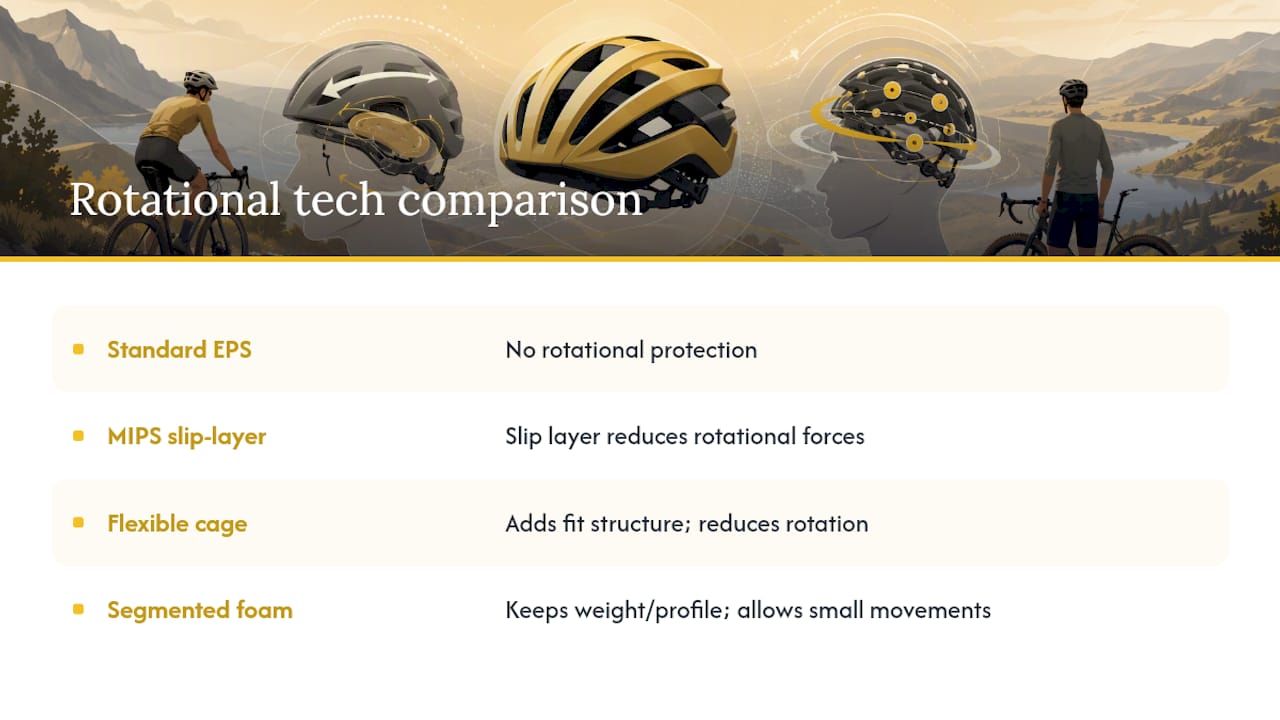
The practical difference between MIPS and its alternatives usually comes down to feel and packaging rather than protection level. A flexible-cage design can add slightly more structure to the fit, which some riders prefer, while a segmented-foam approach tends to keep the helmet’s weight and profile closer to a non-MIPS model. Independent angled impact testing, like the ratings published by Virginia Tech, is the most reliable way to compare outcomes across these different engineering approaches, since manufacturer marketing rarely gives you an apples-to-apples number.
What all of these systems share is the same underlying goal: reducing the rotational force transmitted to your brain during an angled impact, as opposed to standard EPS foam alone, which is built almost entirely around absorbing linear, head-on force. For gravel riding specifically, where oblique impacts are common, any of these rotational systems represents a meaningful upgrade over a helmet with none at all. The specific brand name on the liner matters less than confirming the helmet you’re considering has one.
What Certifications Should a Gravel Helmet With MIPS Meet?
Certification tells you a helmet cleared a legal safety floor, not how it performs beyond that floor, and understanding the difference matters when you’re comparing options.
In the United States, helmets sold to consumers must meet the CPSC (Consumer Product Safety Commission) standard, a mandatory federal requirement covering impact absorption, retention system strength, and peripheral vision. In Europe, the equivalent baseline is EN 1078, which tests shock absorption, retention, and field of vision using different test parameters than CPSC but a comparable safety philosophy. Some helmets also carry ASTM certification (commonly ASTM F1447), a voluntary standard frequently referenced for multi-sport or recreational use.
None of these standards test for rotational impact specifically. That’s the gap MIPS and similar systems fill, and it’s why a helmet can be fully CPSC or EN 1078 certified while still lacking any rotational protection at all. When you’re evaluating a gravel bike helmet, certification confirms it’s legal to sell and meets a baseline linear-impact threshold. MIPS integration and independent rotational testing, like Virginia Tech’s star ratings, tell you what happens beyond that baseline. Treat certification as the minimum bar cleared, not the ceiling of what the helmet can do.
Popular Gravel Helmet Models Featuring MIPS
The gravel helmet category has grown fast enough that MIPS integration is now closer to standard than exception among serious off-road models. Editorial roundups from outlets like Cyclingnews consistently list MIPS as a baseline expectation rather than a premium extra when evaluating top rated bike helmets for gravel use.
What separates one MIPS-equipped model from another usually isn’t whether MIPS is present, but how it’s implemented and what else the helmet offers around it. Some models prioritize minimal weight, shaving grams by trimming coverage or vent structure. Others, including THE BEAM VIRGO, prioritize extended rear coverage and mounting versatility for riders doing longer, more remote routes where a dropped light mount or a cracked visor clip becomes a real problem 40 miles from the car.
Retailer product listings will show you dozens of MIPS options, but a long list on a shopping page isn’t independent validation of anything. Cross-reference any model you’re considering against Virginia Tech’s published ratings and, where available, hands-on editorial testing, rather than trusting the spec sheet alone. The number of MIPS models on the market has grown quickly, and quality varies more than the shared acronym suggests.
Common Misconceptions About MIPS in Gravel Helmets
The biggest myth is that MIPS makes a helmet crash-proof. It doesn’t, and no helmet does. MIPS reduces rotational force transmission during an angled impact. It doesn’t eliminate impact force altogether, and it isn’t a substitute for riding within your skill level on technical terrain.
A second misconception: that all MIPS is the same. As covered earlier, MIPS ships in multiple variants with different physical implementations, and how a given variant feels against your head can vary noticeably between models. Assuming “it has MIPS” settles the safety question without checking fit is a mistake.
A third myth: that a heavier, bulkier helmet with visible MIPS hardware is automatically safer than a sleeker one. Rotational protection design has gotten thinner and more integrated over recent model generations, and a slim profile doesn’t necessarily mean reduced protection. The only way to know is to check independent test scores rather than judge by how substantial the helmet looks or feels in your hands.
Last one: assuming a helmet’s discipline label (road, gravel, MTB) determines whether it will work for you. Fit, coverage, and ventilation matter more than the category printed on the box, and plenty of riders end up happiest in a helmet built for a different discipline that simply fits their head better.
What Actually Matters When You’re Choosing a Gravel Helmet
Most buying guides treat MIPS like a checkbox: does the helmet have it, yes or no, done. That framing misses the more useful question, which is whether the specific MIPS implementation in front of you actually fits your head without creating a new problem. A liner that shifts freely for rotational protection but also shifts during a hard climb because the retention system is loose isn’t protecting you better. It’s just moving.
The conventional advice to “buy the highest-rated helmet” also undersells how much fit variance exists between skulls that are technically the same circumference. Two riders with identical head measurements can get completely different results from the same model, because head shape, not just size, determines pressure points.
If there’s one thing worth prioritizing above brand names, star ratings, or gram counts, it’s the unglamorous 15-minute test ride before you commit. Everything else on the spec sheet is secondary to whether the helmet disappears on your head once you’re actually riding.
— Sophie
Find Your MIPS-Equipped Gravel Helmet at THE BEAM
Most gravel riders shopping for a MIPS helmet end up choosing between a handful of specs on a page, without ever confirming the fit that actually determines whether the protection works. THE BEAM sells directly, so you’re buying the same helmet you researched, at the price listed, with no added retail markup layered on top.
The VIRGO integral helmet was built around the fit and coverage priorities this guide walks through: deep rear-cranial protection, MIPS integration, and mounting points for a rear light if you ride long or low-light gravel routes. If you’re already carrying a rear light or reflector setup, FRAME FLASH bike reflectors pair well with a helmet-mounted light for added visibility on exposed roads. Browse the full helmet and accessory collection to compare fit specs and official photos, and check sizing against your own head measurement before you order.


