

TL;DR:
- Bluetooth now serves as the core communication system for cycling safety gear, connecting sensors and alerts for rider awareness. It enables real-time warnings from radar tail lights, helmets, and lights, enhancing safety without requiring rider attention. However, Bluetooth’s limited range and potential connection failures mean riders must verify device compatibility and perform routine pre-ride checks to maximize protection.
Most cyclists think of Bluetooth as the thing that streams music to their earbuds or syncs their heart rate monitor to an app. That framing sells the technology dramatically short. Bluetooth is quietly becoming the central nervous system of modern cycling safety gear, connecting radar sensors, warning lights, helmet communication systems, and smartphone apps into a unified awareness network. This article breaks down exactly how Bluetooth works inside your safety equipment, which devices depend on it most, where it genuinely protects you, and where it can let you down if you’re not careful.
Table of Contents
- The basics: How Bluetooth powers cycling safety gear
- Inside the gear: What devices use Bluetooth for safety?
- The strengths — and limits — of Bluetooth for road safety
- Bluetooth, regulations, and real-world standards
- Smartest practices: Getting the most from Bluetooth cycling gear
- A cyclist’s perspective: The overlooked realities of Bluetooth safety tech
- Safer riding with advanced Bluetooth gear from The Beam
- Frequently asked questions
Key Takeaways
| Point | Details |
|---|---|
| Bluetooth links safety gear | Bluetooth provides vital connectivity for real-time alerts from modern cycling radar, helmet, and lighting devices. |
| Device setup is critical | Pair and check Bluetooth devices before riding to avoid dropped connections and missed alerts. |
| Tech has limits | Bluetooth is powerful but not foolproof; always combine it with traditional safety habits and visibility tools. |
| No legal Bluetooth mandate | No cycling laws in the EU or U.S. require Bluetooth—focus on performance, not buzzwords. |
The basics: How Bluetooth powers cycling safety gear
Think of Bluetooth as a short-range wireless messenger. In cycling, that messenger carries critical information between a sensor mounted on your bike and the display or device you’re watching while you ride. That sounds simple, but the implications for your safety are significant.
For cycling safety, Bluetooth most commonly plays a communication role between rear-radar or lighting devices and a phone or bike computer, delivering visual and sometimes audible approach alerts that help riders stay aware of vehicles behind them. Rather than twisting your neck every few seconds, you get a real-time warning on your handlebar display or a pattern of flashing lights coded to tell you how fast a vehicle is closing in.
Here’s a quick breakdown of what Bluetooth enables across common safety device categories:
- Rear radar tail lights: Detect vehicles approaching from behind and transmit threat data wirelessly to your bike computer or phone
- Helmet-to-helmet communication systems: Let riders in a group talk without shouting, keeping focus on the road
- Connected lighting: Allow lights to sync with apps for flash patterns, ride tracking, and low-battery alerts
- App-based notifications: Push reminders for firmware updates, battery levels, and connectivity status before you roll out
“Bluetooth most commonly plays a communication role between rear-radar/lighting devices and a phone or bike computer, delivering visual (and sometimes audible) approach alerts that help riders stay aware of vehicles behind them.” — Bicycling Magazine, Wahoo Trackr Radar Review
The result is a system where your safety gear speaks to you rather than demanding your attention. That hands-free loop is what makes Bluetooth genuinely valuable on a fast descent or a busy commute.
Inside the gear: What devices use Bluetooth for safety?
Now that you know Bluetooth serves as the messenger for your safety device, it’s time to spotlight the devices themselves and why the right match matters.
The market for Bluetooth-enabled cycling safety gear has grown considerably. The category is no longer limited to radar tail lights from a handful of brands. Helmets, mirrors, lights, and phone mounts have all entered the conversation.
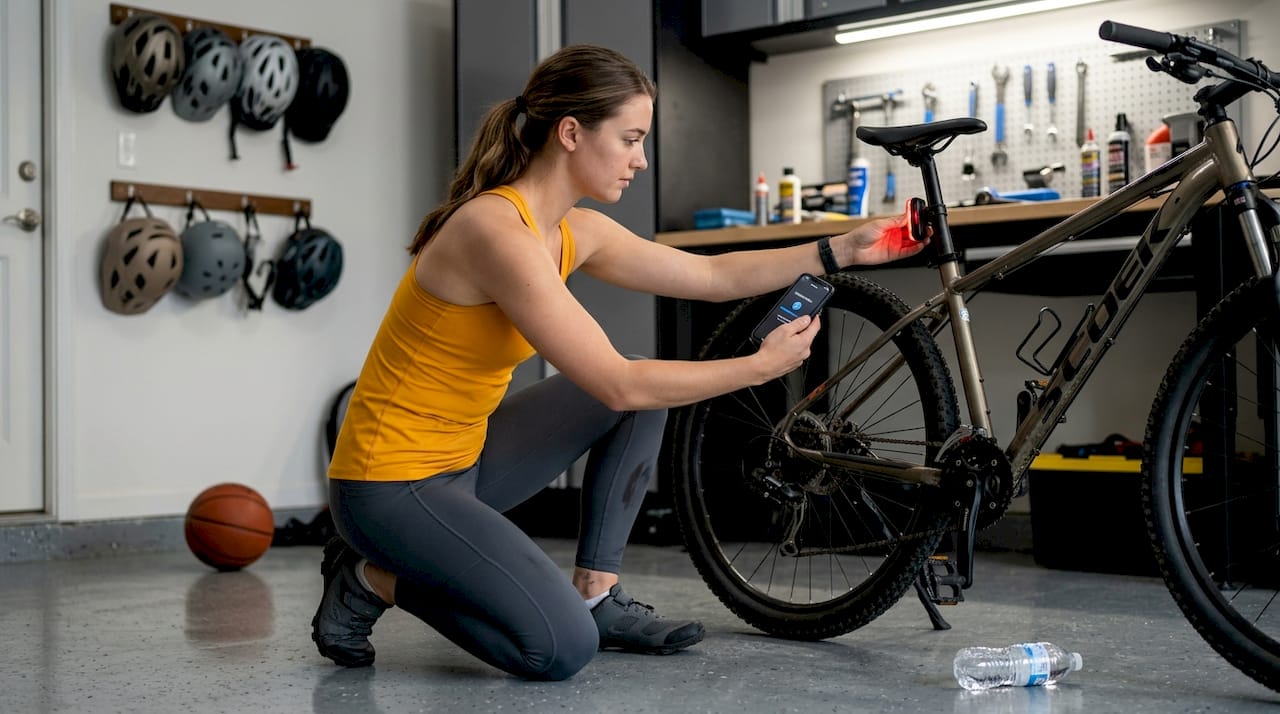
Bluetooth is integral to radar tail light ecosystems that combine a sensor plus a rear light, categorize threats by speed and proximity, and deliver on-screen or app-based alerts to the rider. The Garmin Varia series represents one well-known approach, while the Wahoo Trackr offers an alternative ecosystem. Both rely on Bluetooth as the data bridge.
Here’s how the major device categories compare:
| Device type | Bluetooth role | Key safety benefit | Pairing required |
|---|---|---|---|
| Radar tail light | Sends vehicle alerts to display | Rear vehicle awareness | Yes, bike computer or phone |
| Communication helmet | Enables voice between riders | Group coordination | Yes, paired devices |
| Smart rear light | Syncs with app for patterns/alerts | Visibility optimization | Yes, smartphone |
| Bike computer | Receives data from multiple sensors | Central safety dashboard | Yes, multiple devices |
| Rearview mirror (connected) | Sends alert signals to rider | Lane awareness | Some models |
When selecting gear, device compatibility is the most overlooked factor. A radar tail light paired with an incompatible bike computer won’t deliver alerts where you need them. Before buying, verify that your hands-free Bluetooth helmet kit or radar device is compatible with the head unit or smartphone app you already use. Checking your bicycle safety checklist before upgrading your system is a smart first move.
Key questions to ask when evaluating any Bluetooth safety device:
- Does it pair with my current bike computer or only a proprietary app?
- How many devices can it connect to simultaneously?
- Does the companion app require an active subscription for core safety features?
- What happens to safety alerts if Bluetooth drops mid-ride?
The strengths — and limits — of Bluetooth for road safety
While these gadgets look impressive on the surface, it’s important to know exactly what Bluetooth can and cannot do for your safety and how to avoid the most common mistakes.
Bluetooth operates in the 2.4 GHz band and, under ideal conditions, delivers reliable data transfer across distances of roughly 30 to 100 meters depending on the Bluetooth version and device class. For cycling purposes, that range is typically more than sufficient for the rear radar to communicate with a handlebar display. Latency, meaning the delay between the sensor detecting a vehicle and you seeing the alert, is generally low enough to be practical.
But Bluetooth also introduces failure modes around pairing, firmware, connectivity, and app behavior. For safety, riders should treat pairing as a pre-ride checklist item, not something to figure out on the fly. That’s expert-level advice that too many riders ignore.
| Bluetooth feature | Real-world strength | Common limitation |
|---|---|---|
| Short-range data transfer | Fast, low-latency alerts | Signal drops in interference-heavy areas |
| Multi-device pairing | Sync radar, phone, and display | Complex setup, potential conflicts |
| App-based alerts | Rich visual and audio notifications | App dependency, battery drain |
| Firmware update delivery | Keeps safety features current | Requires smartphone; easy to skip |
Pairing reliability and firmware experience can affect safety utility, with some products requiring app relaunches for initial setup or showing connectivity quirks under specific conditions. This is not a reason to avoid the technology. It is a reason to test everything before your first serious ride with new gear.
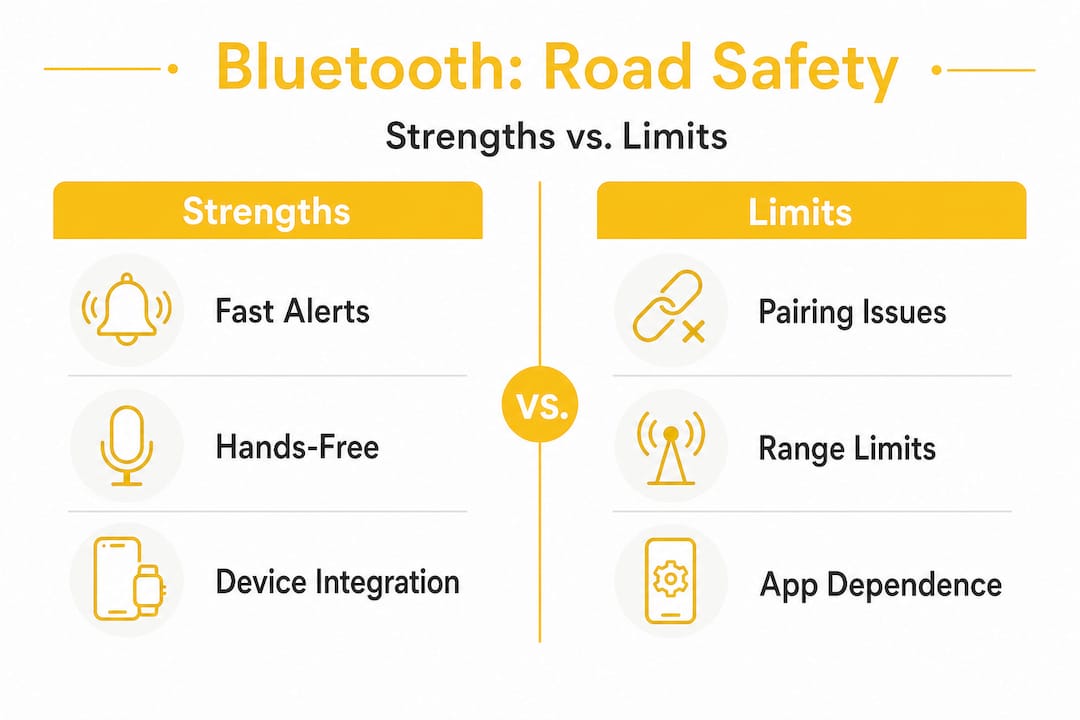
Additionally, some smart cycling devices use Bluetooth via companion apps and phone connectivity to provide alerts and communications, which introduces latency and range trade-offs compared to other wireless approaches like ANT+. For most riders, these trade-offs are acceptable. For time-trial racers or riders in high-traffic urban environments, understanding them matters.
Pro Tip: Run a full Bluetooth device test at home before every major ride. Pair all devices, launch your app, and simulate an alert. This five-minute routine catches 90% of the connection problems that could fail you on the road.
Safety technology extends your awareness. It doesn’t replace it. If your Bluetooth drops, you still need the skills and habits to ride safely without electronic backup.
For further performance, some riders combine Bluetooth safety gear with proper nutrition and preparation, part of a wider cycling performance approach that treats the body and the gear as equally important variables.
Bluetooth, regulations, and real-world standards
Beyond device features, it helps to know the legal and standards landscape so you don’t get lost in technical jargon or false safety claims.
Here’s the clear picture: there is no Bluetooth-specific regulation for cycling safety equipment in either the European Union or the United States. Not one. Regulatory frameworks focus on how safe a product must be in terms of physical protection, impact resistance, and visibility, not on which wireless protocol it uses to communicate.
In Europe, safety work on micromobility and cycling focuses mainly on vehicle and infrastructure design and safety frameworks rather than mandating Bluetooth specifically. The EU Horizon program funds research into operational safety for micromobility, but specific Bluetooth connectivity standards are not on that regulatory checklist.
In the U.S., Bluetooth cycling safety discussions in established media appear almost entirely in the context of consumer device reviews and product features rather than nationwide regulatory mandates. The Consumer Product Safety Commission addresses general product hazards, not Bluetooth version requirements.
What this means for you as a buyer:
- The label “Bluetooth-enabled” is a feature, not a safety certification
- A radar tail light’s real safety value comes from its detection accuracy and alert speed, not merely its wireless protocol
- Helmet certifications like MIPS, EN 1078 in Europe, or CPSC in the U.S. address physical protection, not connectivity
- App permissions and data privacy, especially in connected devices, are worth reviewing even if regulations don’t require it
- Buying from brands with transparent cycling safety standards documentation matters more than chasing the latest Bluetooth version number
The practical takeaway is that a well-made helmet with a reliable strap system and certified impact protection is legally and functionally more important than whether it has Bluetooth built in. Smart riders use connectivity to enhance their safety layer, not to substitute for the fundamentals.
Smartest practices: Getting the most from Bluetooth cycling gear
Knowing how Bluetooth works isn’t enough. Let’s make sure your cycling routine puts this safety technology to work for you, not against you.
Bluetooth introduces failure modes that range from minor pairing annoyances to complete mid-ride disconnections. The good news is that nearly all of these are preventable with a consistent pre-ride routine. Here’s the sequence we recommend:
- Charge all devices the night before. Most Bluetooth safety devices have battery lives between six and fifteen hours. A dead battery at mile ten is entirely avoidable.
- Open your companion app before leaving home. Verify that the radar, lights, and any communication devices show as connected and active.
- Check for firmware updates. Many devices push safety-critical improvements through firmware. Skipping updates means riding on outdated software.
- Do a 60-second pairing test. Pair all Bluetooth devices in the same environment where you’ll start your ride, not just at home where interference is different.
- Set a fallback plan. Decide in advance what you’ll do if Bluetooth drops. For most riders, this means keeping a traditional mirror or a non-connected rear light as backup.
- Log any quirks after the ride. If a device dropped connection or showed a delayed alert, note it. Patterns in failures tell you when a device needs service or replacement.
Pro Tip: Use a physical cycling safety checklist that includes your Bluetooth pairing status as a line item. Checklists beat memory every single time, especially on early morning rides when focus is low.
Some riders also prepare their bodies alongside their gear, incorporating smart physical habits similar to how UV-protective cycling apparel treats sun exposure as a preventable hazard rather than an afterthought. The mindset is the same: layered protection works better than a single line of defense.
A cyclist’s perspective: The overlooked realities of Bluetooth safety tech
Here is something worth saying plainly: Bluetooth safety gear is one of the most meaningful technology advances for cyclists in the past decade. And it is also one of the most misunderstood.
The risk we see most often is overconfidence. A rider straps on a radar tail light, sees the alert icon on their bike computer, and mentally clocks out from the job of staying aware. That is exactly backwards. Rearview radar does not make riders invincible; it reduces missed hazards by improving awareness, but still depends on detection performance and attention management. A radar detects vehicles approaching from directly behind. It does not detect a car pulling out from a driveway ahead of you, a pedestrian stepping off a curb, or a pothole hidden under standing water.
The riders who get the most out of Bluetooth safety tech are the ones who treat it as an extension of their situational awareness, not a replacement for it. They glance at the alert, acknowledge the approaching vehicle, and continue scanning the full road picture. They also invest time in understanding their full connected cycling setup so they know what each alert means and when to trust it.
There is also an important distinction between attention management and gear checks. Even the best radar system won’t help you if you are mentally checking your phone notifications at the same time the alert fires. Technology amplifies good habits. It cannot create them from scratch.
The smartest approach blends old-school vigilance with new tools. Signal clearly. Take the lane when appropriate. Look over your shoulder at intersections regardless of what your radar says. Use the tech to catch what your natural senses might miss, not to outsource the entire job of staying alive on public roads. That combination is what separates riders who thrive with connected gear from those who collect it and still get surprised.
Safer riding with advanced Bluetooth gear from The Beam
Equipping yourself with the right Bluetooth safety gear doesn’t require a complete overhaul of your setup. It starts with choosing components that are designed to work together and backed by a brand that understands what real-world cycling safety demands.
At The Beam, we design high-end helmets and connected accessories specifically for road, gravel, urban, and e-bike cyclists who take safety seriously. Our product lineup is built around real-world usability: clear Bluetooth pairing, reliable performance, and visibility features that function whether your phone is in your pocket or mounted on your bar. Browse our selection of men’s cycling helmets engineered for both protection and connectivity, or explore our full range of Bluetooth cycling accessories to find the right safety upgrade for your riding style. Every product we offer is available internationally through our e-commerce platform, with strong support for riders across France, the U.S., Germany, and beyond.
Frequently asked questions
How does Bluetooth make cycling safer compared to regular lights or mirrors?
Bluetooth connects radar sensors and devices to give audible and visual alerts about approaching vehicles, extending your awareness beyond what mirrors or static lights alone can provide. It transforms passive visibility into active, real-time situational data delivered directly to your display.
Are there risks if my Bluetooth connection fails mid-ride?
Yes, if Bluetooth drops you may not get vehicle approach alerts, so always supplement with mirrors or traditional lights and check your gear before each ride. Bluetooth failure modes including pairing drops and app issues are preventable with a consistent pre-ride checklist.
Is Bluetooth required by law for cycling safety equipment in the EU or U.S.?
No, Bluetooth is not legally required on cycling safety gear in Europe or the U.S. Bicycle safety standards focus on design and performance testing requirements, not on connectivity protocols.
Do Bluetooth cycling helmets help in group rides?
They can allow for group voice communication, though Bluetooth range is approximately one kilometer and unreliable reception in some conditions means reliability depends on signal quality and device compatibility. Testing the system before a long group ride is essential.


