

TL;DR:
- Multi-shell helmet design uses layered foam densities to improve impact absorption more effectively than single-density helmets. Proper fit and certification are essential to ensure the engineered protection performs as intended during a crash. Combining multi-shell construction with systems like MIPS provides comprehensive protection against both linear and rotational impacts.
If you’ve ever compared cycling helmets and wondered why two helmets with similar price tags feel completely different on impact, the answer often comes down to multi-shell helmet design. This is the engineering principle that uses layered materials and multiple foam densities inside a helmet to absorb crash energy more effectively than a single block of foam ever could. Understanding how it works, what materials are involved, and why sizing matters so much will make you a sharper, safer buyer the next time you’re choosing a lid.
Table of Contents
- Key takeaways
- What is multi-shell helmet design and how does it work
- Safety standards and what they mean for multi-shell helmets
- Comparing multi-shell design with other helmet technologies
- Choosing, fitting, and maintaining a multi-shell helmet
- My honest take on the multi-shell conversation
- Upgrade your protection with Thebeamofficial
- FAQ
Key takeaways
| Point | Details |
|---|---|
| Multi-shell design uses layered foam | Multiple EPS density zones collapse at different rates to manage impact energy more precisely. |
| Fit determines protection quality | Foam density zones are engineered per shell size, so wearing the wrong size reduces their effectiveness. |
| Certification is non-negotiable | More layers do not guarantee safety. A helmet must pass EN 1078 or equivalent standards regardless of construction complexity. |
| MIPS and multi-shell are complementary | Rotational impact protection and multi-density foam solve different crash physics problems and work best together. |
| Multi-shell helmets cost more for a reason | Precision manufacturing and quality control for bonded foam zones add production cost but deliver measurable protective gains. |
What is multi-shell helmet design and how does it work
At its core, multi-shell helmet design refers to a construction method where the helmet liner is built from multiple materials or foam densities rather than a single uniform piece. The term gets used loosely in the industry, so it helps to separate the concept into its actual components.
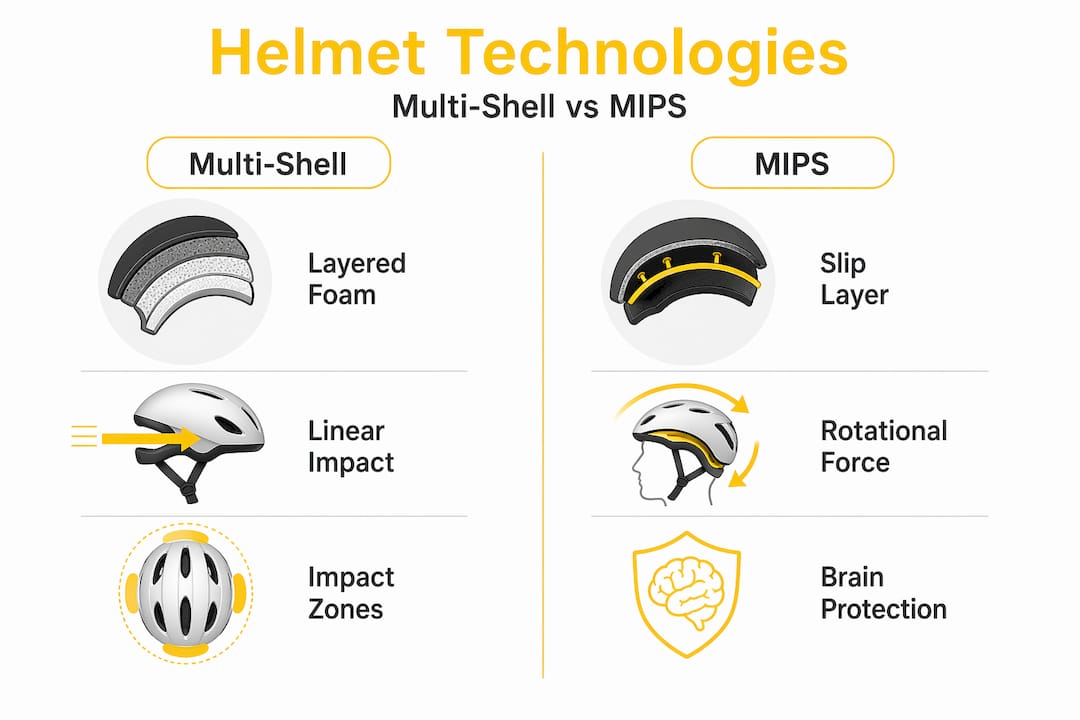
The most meaningful part of the technology is the multi-density EPS liner. EPS stands for expanded polystyrene, the firm white foam that forms the structural core of virtually every cycling helmet. In a standard helmet, this foam is a single density throughout. In a multi-shell or multi-density design, three to five EPS foam densities are arranged within one liner component, each tuned to absorb energy at a specific rate.
Here’s why that matters. When your head hits a surface, the impact energy needs to go somewhere. A single-density foam either compresses too quickly for a light hit or too slowly for a severe one. Multi-density zones fix this by creating staged collapse. The softer outer zones deform first and absorb lower-energy impacts. If the crash is more severe, the denser inner zones take over and manage the remaining force. Research shows that peak g-forces reduce by 10 to 30% with multi-density foam compared to single-density designs, depending on impact parameters.
The outer shell plays its own role. Rather than absorbing energy, it spreads impact forces laterally across the surface before they reach the foam. Materials like polycarbonate and composite laminates handle this job. Some manufacturers use reinforced construction methods that increase shell strength while also lowering the helmet’s center of gravity, which keeps the helmet from rotating excessively on the head during a glancing impact.
Several elements work together in a well-built multi-shell helmet:
- Outer shell layer: Typically polycarbonate or composite material. Spreads point impact forces across a wider area before energy reaches the foam.
- Multi-density EPS liner: The main structural core. Contains zones of varying foam density bonded together to create staged energy absorption.
- Comfort liner: A soft inner padding layer. Affects fit and feel but also contributes to keeping the head positioned correctly over the foam density zones.
- Retention system: The rear cradle and strap system. Holds the helmet in position so the designed foam zones stay aligned with the right areas of your head.
Pro Tip: When trying on a multi-shell helmet, push the helmet gently side to side after buckling the chin strap. If it moves more than about an inch, your head is not aligned with the protective foam zones. A snug, centered fit is not just about comfort. It is about where your skull actually lands in the liner during a crash.
Safety standards and what they mean for multi-shell helmets
More foam layers does not automatically mean a safer helmet. This is one of the most persistent misconceptions in the market. A helmet with four EPS densities that has not been tested and certified offers no verified protection at all.
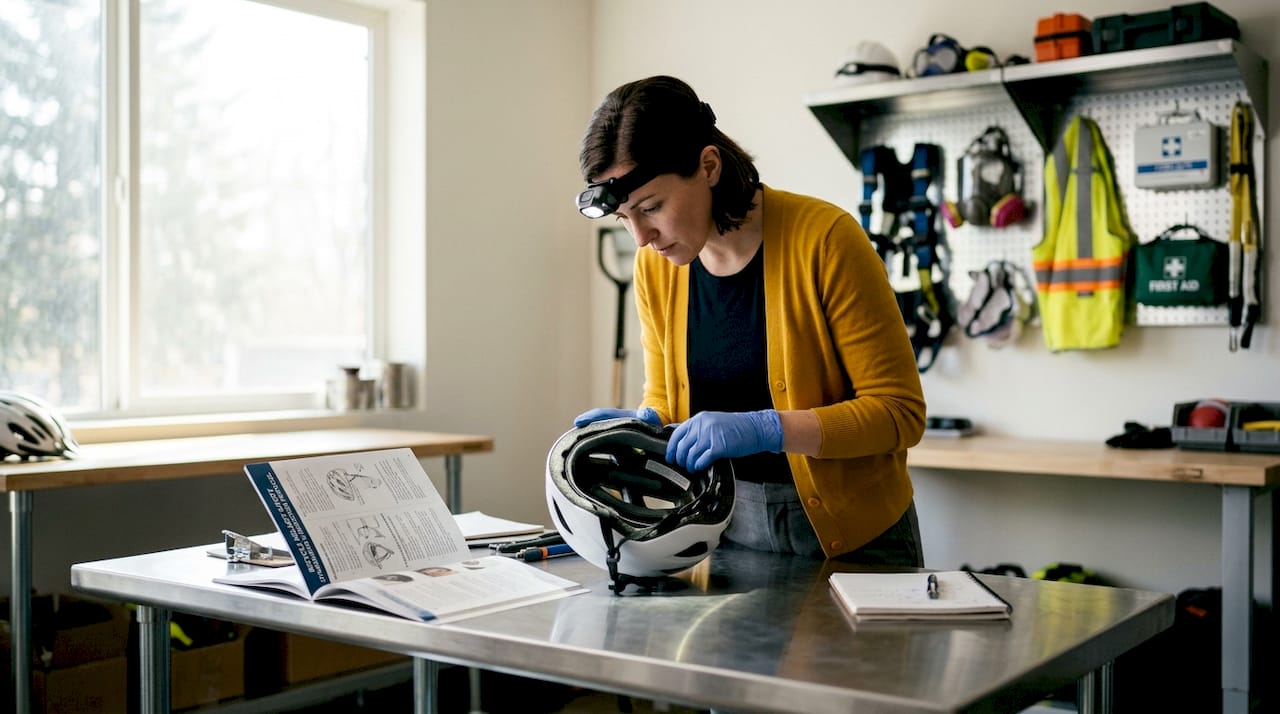
In Europe, the governing standard is EN 1078. EN 1078 specifies test methods for shock absorption, retention system durability, and labeling for cycling helmets. It tests how the helmet performs under controlled impact conditions and whether the retention system can hold the helmet on your head when it matters most.
Key things EN 1078 covers:
- Shock absorption: Impact tests at defined velocities and anvil shapes. The helmet must keep transmitted g-forces below specified thresholds.
- Retention system strength: The chin strap and attachment points must not fail under load.
- Coverage area: The standard defines the minimum zone of the head the helmet must protect.
- Marking requirements: Certified helmets must carry specific labels confirming compliance.
The important nuance is that added layers improve impact management but do not replace the certification requirement. A multi-shell helmet still needs to prove its performance under the same tests as a basic single-density helmet. The design just gives manufacturers more tools to pass those tests by wider margins while also improving real-world performance on impacts that fall outside the standard test parameters.
Always check for the CE mark and EN 1078 reference on any helmet sold in Europe. For the U.S. market, look for CPSC certification. These are your baseline guarantees, regardless of what the marketing copy says about shell layers.
Comparing multi-shell design with other helmet technologies
Understanding multi-shell design becomes clearer when you put it side by side with other approaches. The table below covers the most common construction types you’ll encounter in the cycling helmet market.
| Technology | What it does | Key benefit | Limitation |
|---|---|---|---|
| Single-density EPS | One foam density throughout | Simple, low cost | Less effective across varied impact severities |
| Multi-density EPS | Multiple foam zones in one liner | Staged energy absorption for a wider range of impacts | Higher production cost, slight weight penalty |
| Multi-shell outer construction | Different shell sizes matched to foam densities | Optimized fit and protection per head size | Adds manufacturing complexity |
| MIPS slip layer | Low-friction layer inside the helmet | Reduces rotational acceleration to the brain | Does not address linear impact forces on its own |
| MIPS + multi-density EPS | Combined systems in one helmet | Addresses both linear and rotational impact physics | Higher cost, heavier than basic helmets |
MIPS deserves a specific note here. Rotational protection systems reduce angular acceleration separately from foam density layering. Many falls involve oblique impacts where the head both decelerates rapidly and rotates. Multi-density foam handles the deceleration side. MIPS handles the rotation side. They solve different parts of the same crash problem, which is why pairing them makes sense for serious cyclists.
The tradeoff with multi-density foam is real but modest. Dual-density foam can add 5 to 15 grams compared to single-density construction, with small increases in cost and marginal effects on ventilation depending on the design. For most cyclists, that tradeoff is an easy one. The protection gains are measurable. The weight difference is barely noticeable on a long ride.
If you’re shopping for an e-bike helmet specifically, multi-density EPS combined with MIPS is particularly relevant. E-bike speeds are higher than standard cycling, which means impacts carry more energy and rotational forces are more pronounced in a fall.
Choosing, fitting, and maintaining a multi-shell helmet
Knowing what multi-shell design does is one thing. Getting the full benefit of it requires a few practical steps that most cyclists skip.
-
Measure your head before buying. Use a soft tape measure around the widest part of your skull, about an inch above your eyebrows. Helmet sizing charts vary by brand, so use the measurement, not your hat size. Foam density zones are engineered per shell size, and wearing the wrong size shifts your head away from the zones designed to protect it.
-
Position the helmet correctly on your head. The front edge should sit about two fingers above your eyebrows. Tilting a helmet too far back exposes your forehead and misaligns the impact protection zones with the most common crash contact points.
-
Adjust the retention system, not just the chin strap. The rear cradle should hold the base of your skull snugly. If your helmet rocks forward or backward when you push it, the cradle is too loose, and the liner is not where it needs to be relative to your head.
-
Inspect your helmet after any significant impact. EPS foam crushes permanently during a crash. It may look undamaged on the outside while the inner structure has already collapsed and lost its protective capacity. Replace any helmet that has absorbed a real impact, even if it shows no visible cracks.
-
Replace helmets on a schedule. The adhesives, foams, and shell materials degrade over time. Most manufacturers recommend replacing helmets every three to five years under normal use, and sooner if the helmet is exposed to frequent UV, sweat, or chemical contact.
Pro Tip: Match your helmet choice to your typical terrain and speed. Road cyclists at higher speeds benefit most from stiffer outer shells and denser inner EPS zones that handle harder impacts. Gravel and urban riders who tend to fall at lower speeds and awkward angles benefit more from softer outer zones and MIPS integration. Multi-shell designs can be tuned differently for these use cases, so reading the manufacturer’s construction details is worth your time rather than picking by look alone.
My honest take on the multi-shell conversation
I’ve watched the helmet market long enough to notice a pattern. Brands introduce a construction term, cyclists latch onto it as a shorthand for “safer,” and the nuance gets lost almost immediately.
Multi-shell design is a genuinely meaningful advance in protection. The staged energy absorption data is real. The fit nuances are real. But what I keep seeing is riders buy a multi-density helmet in the wrong size because it looked great, skip the fitting step, and walk away thinking they’re protected. They might be significantly less protected than someone in a properly fitted standard helmet.
My take: the technology only works when the fit works. A well-fitted helmet with proper liner construction will outperform a poorly fitted premium helmet every single time. The construction matters enormously. But it matters in proportion to how well it sits on your specific head.
The other thing worth saying: look for certifications first, marketing claims second. Every helmet worth buying will tell you exactly which standards it has passed. That’s the floor. Multi-shell construction is what raises the ceiling above that floor.
— Sophie
Upgrade your protection with Thebeamofficial
At Thebeamofficial, every helmet is built on the same foundational principle: protection that actually works in the real world, not just in lab conditions. The VIRGO integral helmet integrates MIPS technology with carefully engineered liner construction to manage both linear and rotational impact forces, precisely the combination that multi-shell design makes possible at its best.
If you’re ready to put what you’ve learned into practice, explore the Thebeamofficial helmet range to find a helmet designed with the materials, fit, and certification standards that match how and where you ride. You can also check out the latest thinking on 2026 helmet safety upgrades to see how emerging technologies continue to push protection further.
FAQ
What is multi-shell helmet design in simple terms?
Multi-shell helmet design uses multiple layers or densities of EPS foam inside a helmet so different zones absorb energy at different rates, providing staged protection across a wider range of impact severities than single-density foam can.
Does more foam layers automatically mean better protection?
No. A helmet with multiple foam layers must still pass certified safety standards like EN 1078 or CPSC testing to guarantee real-world protection. Layers improve performance potential but do not replace certification.
How does multi-shell design differ from MIPS?
Multi-shell or multi-density EPS design manages linear impact forces by staged foam compression. MIPS adds a slip layer to reduce rotational acceleration to the brain. They address different aspects of crash physics and work best when combined.
Why does helmet sizing matter so much with multi-shell designs?
Each shell size in a multi-shell helmet has foam density zones calibrated for that specific size. Wearing the wrong size misaligns your head with those protective zones, reducing the effectiveness of the engineering you paid for.
How often should I replace a multi-shell cycling helmet?
Replace your helmet every three to five years under normal use, and immediately after any significant impact. EPS foam permanently deforms during a crash and cannot recover its protective capacity, even when the helmet looks intact from the outside.


