

TL;DR:
- Adaptive lighting improves cyclist visibility by automatically signaling intent and enhancing recognition distance. Positioning helmet-integrated lights and retroreflectors at head height extends driver awareness more effectively than traditional bike lights. Proper calibration of sensors and focus on biological motion cues are essential for maximizing safety benefits.
Adaptive lighting actively changes what drivers see when they look at you. It raises brightness in low light, flashes a brake signal when you decelerate, and brightens on cue when a vehicle closes from behind — all without touching a button. The result: drivers detect your presence and your intent, not just a static blinking dot. SAGE Journals research recommends measuring vertical illuminance (the light reaching a driver’s eye level) as the true safety metric, not raw lumens. A 2022 conspicuity study confirmed that pairing a helmet-mounted light with lower-leg retroreflectors extended driver recognition distance by highlighting pedaling motion. Before you buy, check three things:
- Sensor compatibility: Does the light pair with your helmet, bike computer, or phone?
- Placement: Helmet for biological-motion conspicuity, rear seatpost for brake signaling, handlebar for road illumination.
- Feature set: Ambient sensor, accelerometer brake-light simulation, and radar proximity alerts are the features that change driver behavior.
Table of Contents
- What is the role of adaptive lighting in cycling?
- What does the research say about visibility and safety gains?
- Where does adaptive lighting actually go — and what are the trade-offs?
- Which adaptive features actually improve how drivers see you?
- How should you position adaptive lights for maximum effect?
- What do adaptive lights cost, and how long do batteries last?
- How THE BEAM applies adaptive lighting in the VIRGO helmet and accessories
- What are the real limitations of adaptive lighting?
- Key Takeaways
- Why most riders are still underusing adaptive lighting
- THE BEAM’s adaptive lighting gear for U.S. cyclists
- Useful sources
What is the role of adaptive lighting in cycling?
Adaptive lighting is any system that changes its output automatically based on sensor data rather than staying at a fixed brightness or flash rate. The core hardware stack is straightforward: an ambient light sensor reads surrounding brightness, an accelerometer detects deceleration, and a PIR or radar module watches for approaching objects. A microcontroller processes those inputs and adjusts beam intensity, flash pattern, or both in real time.
Smart bike lights commonly combine accelerometers and ambient-light sensors to handle brightness and brake-light simulation simultaneously. Radar-equipped rear lights can detect vehicles approaching from roughly 140 meters, pushing an alert to a paired bike computer before the driver is close enough to be a hazard.
Connectivity matters here. ANT+ and Bluetooth Low Energy (BLE) let lights pair with Garmin, Wahoo, or similar head units. GPS integration can trigger pre-set brightness profiles at known dark spots on a regular commute. Without pairing, many of these features simply stay dormant.
Setup is not optional. Firmware calibration sets the ambient threshold (the brightness level at which the light switches modes) and brake sensitivity. Get those wrong and you get false triggers on rough pavement or no brake signal at all on smooth descents.
What does the research say about visibility and safety gains?
Adaptive lighting is associated with measurable, documented safety and uptake benefits across multiple study types. The evidence spans infrastructure, conspicuity, and energy efficiency.
| Study / Source | Key Finding |
|---|---|
| Tvilight Münster case study | Adaptive street lighting cut energy use by over 70% and increased cycling uptake by more than 30% |
| 2022 conspicuity study | Helmet light + lower-leg retroreflectors extended driver recognition distance |
| SAGE Journals 2026 | Vertical illuminance recommended as a lighting standard metric to reduce glare and improve contrast |
| Road lighting review | Many studies found a positive relationship between road lighting and cycling rates |
Three benefit categories stand out:
- Conspicuity: Recognition distance increases when lights highlight biological motion (pedaling rhythm) rather than just marking a static position.
- Intent communication: Adaptive systems signal braking and turning to drivers without rider input, making behavior more predictable.
- Battery efficiency: High output only when needed means longer runtime per charge in real-world use.
The Münster field test also found that PIR sensors outperform radar for slow-moving cyclists on dedicated paths, because radar can miss detection at low speeds. That distinction matters for urban commuters more than road riders.
Where does adaptive lighting actually go — and what are the trade-offs?
Three deployment categories cover most riders’ needs.
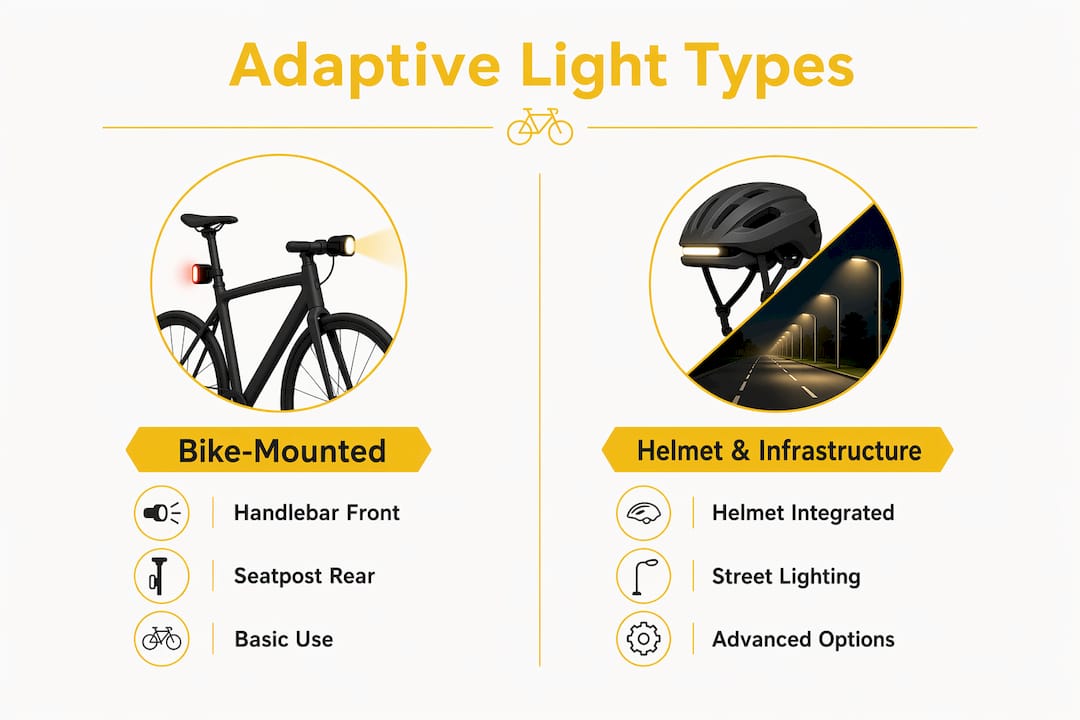
Bike-mounted (handlebar front / seatpost rear) is the baseline. Front lights illuminate the road; rear lights signal presence and braking. Beam geometry here is horizontal, which serves road illumination well but does less for vertical illuminance toward a driver’s eye line. Battery life is typically strong because the housing is larger.
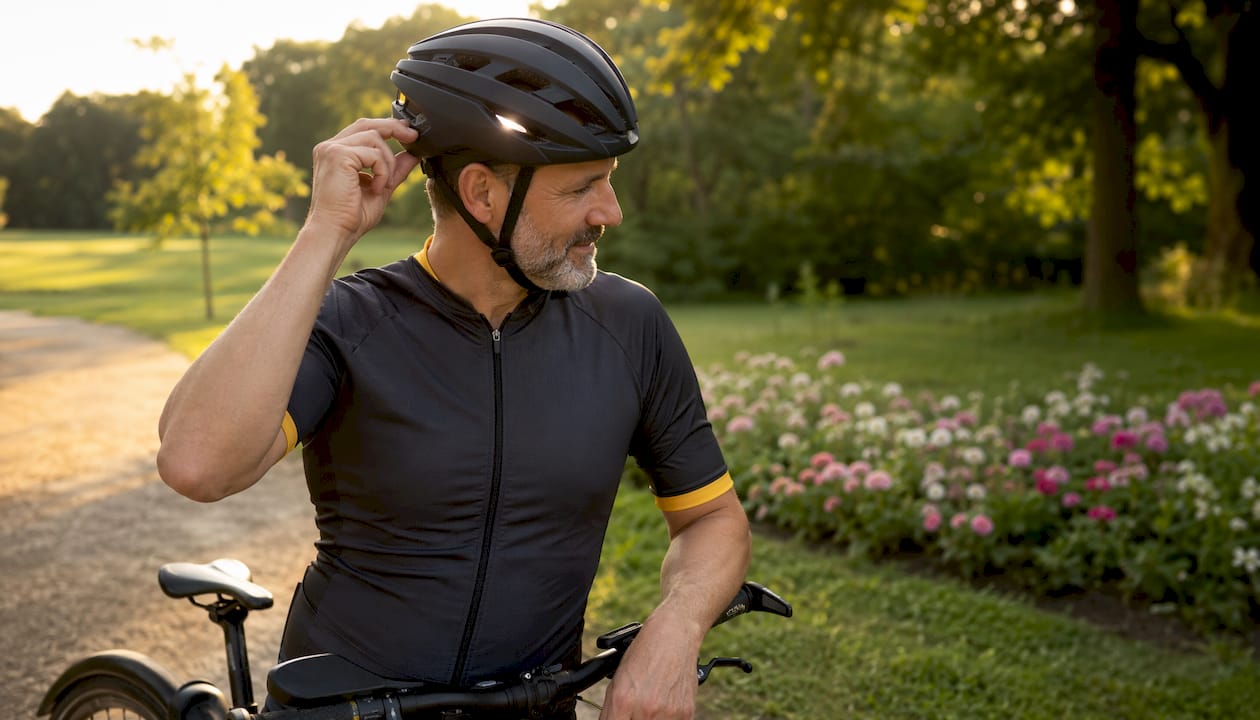
Helmet-integrated lighting (the approach behind the VIRGO helmet) solves the biological-motion problem directly. A light at head height moves with your gaze and your pedaling rhythm, producing the dynamic cues the 2022 conspicuity study identified as recognition-distance extenders. The trade-off is a smaller battery and the need to pair with rear lights for full signaling coverage. Integrated helmet lights also point where you look, which is genuinely useful at intersections.
Infrastructure-level adaptive street lighting (motion-triggered path lighting) benefits every cyclist without requiring any gear purchase. The Münster data showed cycling uptake increased by more than 30% after installation. The limitation: coverage is patchy, and riders cannot rely on it beyond specific corridors.
| Deployment | Best for | Conspicuity strength | Key limitation |
|---|---|---|---|
| Handlebar/seatpost | Road night riding, e-bike | Road illumination, rear brake signal | Lower vertical illuminance |
| Helmet-integrated | Commuting, urban, gravel | Biological motion, gaze-directed beam | Smaller battery |
| Infrastructure (path lighting) | Urban commute corridors | Full-body illumination | No rider control |
Interoperability is the hidden variable. Helmet lights and bike-mounted radar units may need to share a protocol (ANT+ or BLE) to unlock synchronized signaling. Check compatibility before assembling a mixed system.
Which adaptive features actually improve how drivers see you?
Raw lumen counts are a marketing number. The features that change driver behavior are the ones that communicate motion and intent.
- Ambient-light sensor: Automatically raises brightness at dusk or in tunnels; prevents blinding oncoming riders in daylight.
- Accelerometer brake-light simulation: Triggers a distinct flash pattern on deceleration. Drivers read it the same way they read a car’s brake light.
- Radar/proximity alerts: Rear radar detects vehicles up to ~140 meters back and brightens the tail light or pushes a head-unit alert. Commuters and road riders both benefit.
- Vertical illuminance beam pattern: Directs light toward drivers’ eye level rather than purely forward. SAGE Journals flags this as the metric lighting standards should adopt.
- Turn-signal capability: Relevant for urban commuters navigating intersections; less critical on open roads.
- App calibration and firmware updates: Lets you tune brake sensitivity and ambient thresholds to your specific route conditions.
- IP weather rating: IP65 or higher keeps sensors functional in rain. A light that fails in wet conditions defeats the purpose.
- Charging design: Magnetic or USB-C charging cases reduce the friction of daily top-ups, which means riders actually keep lights charged.
How should you position adaptive lights for maximum effect?
Place lights to highlight biological motion first, road illumination second. The 2022 conspicuity study is clear: a helmet light combined with lower-leg retroreflectors produces the longest recognition distances because it makes your pedaling rhythm visible from a distance.
Practical placement rules:
- Helmet light: Angle slightly downward (5–10 degrees below horizontal) to maximize vertical illuminance without blinding oncoming traffic.
- Rear seatpost light: Level with traffic sightlines; pair with FRAME FLASH reflectors on the frame for side-angle conspicuity.
- Handlebar front light: Aim just below the horizon for road illumination; use a secondary helmet light for cornering visibility.
- Reflectors and clothing: Layer FRAME FLASH reflectors with high-visibility clothing to cover the angles active lights miss.
Pro Tip: After mounting, open the app and run a calibration ride on your actual commute route. Urban vibration from rough pavement can trigger false brake signals; raise the accelerometer threshold one step until false positives disappear.
What do adaptive lights cost, and how long do batteries last?
Adaptive lights cost more upfront than basic LEDs, but they often run longer per charge because output is demand-driven rather than constant. A light running at 50% brightness in moderate ambient conditions uses significantly less power than one locked at maximum.
Entry-level adaptive lights (ambient sensor, basic accelerometer) typically sit at the lower end of the smart-light price range. Integrated helmet systems with radar pairing and app control sit higher. The ongoing cost is firmware updates and occasional sensor recalibration, both of which are free.
Maintenance checklist:
- Firmware updates: Check the companion app monthly; manufacturers push sensitivity improvements regularly.
- Sensor calibration: Re-run ambient and brake-sensitivity calibration after any significant route change or season shift.
- Waterproofing inspection: Check gaskets and port covers every few months; IP ratings degrade with heavy use.
- Mount security: Tighten or replace worn straps before they loosen on rough roads.
For night riding best practices and a full calibration checklist, THE BEAM’s blog covers the setup steps in detail.
How THE BEAM applies adaptive lighting in the VIRGO helmet and accessories
THE BEAM builds adaptive and connected-lighting principles directly into the VIRGO helmet and FRAME FLASH reflectors to address full-body conspicuity from head to lower frame. The VIRGO’s helmet-integrated lighting positions output at head height, where it contributes to the biological-motion signal the 2022 conspicuity research identifies as the most effective recognition-distance driver. FRAME FLASH reflectors add passive side-angle visibility that active lights alone cannot cover.
Practical buying notes:
- VIRGO + FRAME FLASH bundle: Covers helmet-height active lighting and frame-level retroreflection in one purchase. Recommended for commuters and urban riders.
- Accessory compatibility: VIRGO pairs with add-on lighting modules; check the helmet add-ons page for current compatible accessories.
- Charging: Magnetic charging reduces daily friction; charge after every ride rather than waiting for a low-battery warning.
- Rider types: Commuters benefit most from the brake-signal and ambient-response features; road night riders should add a dedicated high-output handlebar light for road illumination.
Pro Tip: After first use, check the default brightness mode in the VIRGO app. The factory default is often set for moderate ambient conditions; switch to “auto” mode so the helmet responds to actual light levels on your route rather than a fixed output.
What are the real limitations of adaptive lighting?
Adaptive lighting improves visibility but introduces specific failure modes that riders need to manage.
False triggers are the most common complaint. Accelerometers on rough urban streets can fire brake-light signals on every pothole. Calibration (raising the deceleration threshold) fixes this in most cases, but it requires time with the app.
Radar blind spots at low speed are a documented issue. The Münster field test found PIR sensors more reliable than radar for slow-moving cyclists on cycle paths. If you commute at low urban speeds, a PIR-based system or a combined PIR/radar unit is more reliable than radar alone.
Glare is a real risk with high-output beams. SAGE Journals specifically flags that poorly aimed high-intensity lights can create veiling glare that reduces contrast for drivers rather than improving it. Aim beams correctly and avoid maximum brightness in group rides.
Flashing modes in groups are a courtesy issue. Bright daytime flash modes that work well in solo traffic can be disorienting for riders directly behind you. Switch to a steady or low-flash mode in a paceline.
Check your local vehicle code for rules on flashing signals. Regulations vary by state, and some jurisdictions have specific requirements for bicycle lighting modes. This article is general information; confirm current rules with your state’s DMV or a qualified professional for your situation.
Pro Tip: Before your first regular commute with a new adaptive system, do a short test ride with a friend following in a car. Confirm that the brake-light triggers correctly on normal deceleration and that the beam angle does not create glare at driver eye level.
Key Takeaways
Adaptive lighting improves cyclist safety by communicating intent and adjusting output automatically, but only when sensors are correctly calibrated and lights are positioned to maximize vertical illuminance and biological-motion conspicuity.
| Point | Details |
|---|---|
| Helmet + lower-leg reflectors | Pairing a helmet light with retroreflectors extends driver recognition distance by highlighting pedaling motion. |
| Vertical illuminance matters | Aim beams toward driver eye level; SAGE Journals recommends this metric over raw lumens for safety standards. |
| Calibration is not optional | False triggers and missed brake signals both stem from factory-default settings; tune ambient threshold and brake sensitivity to your route. |
| Infrastructure lighting helps | Adaptive street lighting increased cycling uptake by more than 30% in the Münster case study. |
| THE BEAM’s VIRGO + FRAME FLASH | Combines helmet-height active lighting with frame-level retroreflection for full-body conspicuity on commutes and night rides. |
Why most riders are still underusing adaptive lighting
Most cyclists who own smart lights are running them on factory defaults, which means they are getting maybe half the safety benefit the hardware can deliver. The brake-light simulation is the feature that most directly changes driver behavior, and it is also the one most likely to be miscalibrated out of the box. A threshold set too high means no brake signal on normal deceleration. A threshold set too low means the light flashes on every cobblestone.
The research is consistent: it is not the brightness that extends recognition distance, it is the motion signal. A helmet light at moderate output, moving with your head and your pedaling rhythm, outperforms a 1,000-lumen seatpost light aimed at the road. That is the finding from the 2022 conspicuity study, and it is the design logic behind helmet-integrated systems. Riders who understand this stop chasing lumen specs and start thinking about placement and calibration instead.
THE BEAM’s position is straightforward: start with the helmet, add FRAME FLASH reflectors for passive side coverage, and treat firmware updates as part of your regular maintenance routine, not an optional extra. Sophie’s adaptive lighting guide covers the full setup walkthrough for riders who want step-by-step instructions.
THE BEAM’s adaptive lighting gear for U.S. cyclists
The VIRGO helmet and FRAME FLASH reflectors are available now for U.S. riders through THE BEAM’s online store. The VIRGO delivers helmet-height adaptive lighting with MIPS protection in one package; FRAME FLASH adds passive retroreflection at frame level to cover the angles active lights miss. Together, they address the full-body conspicuity profile the research consistently identifies as most effective.
U.S. customers can browse the full adult helmets collection and pick up FRAME FLASH reflectors directly. Check the product pages for current compatibility notes, battery specs, and mounting options. If you want to explore the full accessory range, including mounting kits and add-on lighting modules, the all accessories page lists everything currently in stock. For a step-by-step installation guide, DR.Ebike’s how-to resource covers mounting and calibration in detail.
Useful sources
- Tvilight Münster case study: Field data on energy savings (>70%) and cycling uptake (+30%) from adaptive path lighting; includes sensor comparison (PIR vs. radar).
- BikeRadar smart bike lights guide (2026): Practical buyer’s guide covering sensor types, pairing requirements, and feature trade-offs; best starting point for feature evaluation.
- 2022 night-time cyclist conspicuity study (ScienceDirect): Academic study on recognition distance; key source for helmet + lower-leg reflector placement recommendations.
- SAGE Journals commentary on vertical illuminance (2026): Technical argument for adding vertical illuminance to lighting standards; essential for understanding beam design and glare risks.
- Road lighting and cycling review (ScienceDirect): Systematic review of 10 studies on road lighting and cycling rates; useful for infrastructure-level context.
- IDHUS Institute — Bicycle Illumination and AI in Smart Cities: Broad overview of AI-driven lighting evolution; best for technical readers interested in smart-city integration.
- THE BEAM blog — Sophie’s adaptive lighting guide: Setup walkthroughs and product-pairing recommendations for VIRGO and FRAME FLASH; most practical resource for THE BEAM product owners.


