

TL;DR:
- Smart cycling technology includes connected devices, AI systems, and sensors that enhance safety, navigation, and performance. The most useful systems depend on riders’ environments, with GPS computers, safety tech, and visibility gear being essential for different riding profiles. Practical safety improvements rely more on basic visibility and well-chosen gear than on advanced concepts like V2X or onboard AI.
Smart tech for cyclists is defined as the category of connected devices, AI-driven systems, and sensor-based accessories that improve safety, navigation, and performance on the bike. From V2X communication systems that talk to cars to GPS cycling computers with 32 GB of onboard storage, the field has expanded well beyond basic fitness trackers. Thebeamofficial, a French brand building high-end cycling safety gear, sits inside this broader ecosystem alongside GPS platforms like Garmin and concept bikes from Canyon. Understanding what each technology does, and which type of rider it serves, is the fastest way to spend your money well.
What are the essential categories of smart tech for cyclists?
Connected cycling technology falls into five clear categories. Each one solves a different problem, and the best setups combine two or more of them.
- GPS cycling computers: Dedicated handlebar-mounted devices that provide turn-by-turn navigation, ride metrics, and platform integration with apps like Strava, TrainingPeaks, and Zwift.
- Advanced safety systems: Radar detectors, cameras, and V2X (vehicle-to-everything) communication units that alert you to approaching vehicles before you can see or hear them.
- Smart helmets: Helmets with integrated heads-up displays (HUDs), audio systems, and haptic feedback that deliver alerts without requiring you to look down at a screen.
- Connected accessories: High-visibility reflectors, rear-view mirrors, and frame-mounted sensors that extend your awareness in low-light or high-traffic conditions.
- Cycling apps: Software platforms that analyze ride data, plan routes, and connect with hardware for a complete picture of your training and commuting patterns.
The right combination depends on your riding environment. Urban commuters prioritize safety systems and visibility gear. Long-distance riders lean on GPS computers and app ecosystems. Performance-focused cyclists often want all five categories working together.
1. Premium GPS cycling computers
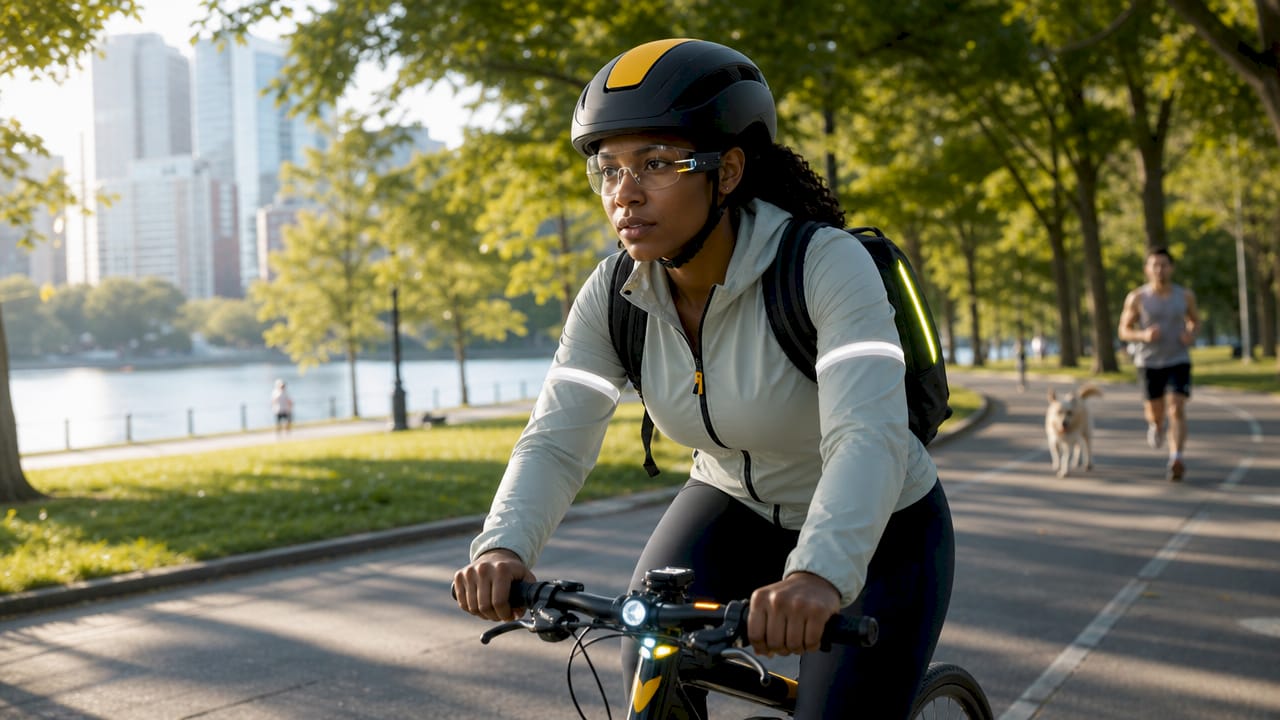
A premium GPS cycling computer is the command center of any data-driven ride. The Garmin Edge 1050 retails at $699.99 with a 20-hour battery in standard mode, extendable to 60 hours in power-saver mode. That runtime covers multi-day bikepacking trips without a recharge stop.
The screen matters more than most riders expect. The Edge 1050 delivers 1,000-nit full-color brightness with 32 GB of onboard storage. That brightness level keeps the display readable in direct midday sun, which cheaper units consistently fail to do.
Group ride messaging, turn-by-turn navigation, and incident detection round out the feature set. The Garmin Connect ecosystem syncs ride data directly to Strava, TrainingPeaks, and Zwift after every session. That integration removes the manual export step that frustrates riders who track training loads across multiple platforms.
Pro Tip: Riders logging under 4,000 km per year rarely use more than 30% of a premium GPS computer’s features. A mid-range unit with navigation and heart rate pairing covers most needs at half the price. Pair it with a dedicated safety accessory instead.
2. V2X communication safety systems
V2X technology is a wireless communication standard that lets your bike exchange real-time position data with equipped vehicles and road infrastructure. The practical result is a warning system that sees around corners and through blind spots. Canyon’s V2X e-bike system detects vehicles up to 300 meters ahead and 150 meters behind, then delivers alerts through haptic feedback in the handlebars.
That 300-meter detection range gives you roughly 10 seconds of warning at 30 mph. Ten seconds is enough time to change your line, slow down, or signal to a driver who has not seen you yet.
The technology’s main limitation is adoption. V2X effectiveness depends on widespread vehicle and infrastructure uptake to create a full protective communication bubble. A V2X-equipped bike communicating with zero V2X-equipped cars provides limited benefit. The ecosystem has to grow on both sides of the road simultaneously.
Pro Tip: If V2X infrastructure is sparse in your area, pair a radar tail light with a handlebar-mounted display as a practical interim step. It covers the rear-approach threat that causes the most serious cyclist injuries.
3. AI-powered predictive safety systems
The Canyon Predict concept bike represents the most advanced application of onboard AI in cycling safety. It uses 4 cameras and 4 radar sensors to build a continuous 360-degree picture of the road environment. The system processes all of that data locally, with no internet connection required.
Local processing is the key design decision. Edge computing eliminates latency and privacy risks by keeping data on the bike rather than routing it through a cloud server. A cloud-dependent system introduces a delay measured in fractions of a second. At cycling speeds, that fraction can be the difference between a warning and a collision.
The Predict system also integrates with the Stingr Smart helmet, sending peripheral visual alerts through the helmet’s HUD alongside audio and haptic signals. That multimodal approach means you receive the alert through whichever channel you are most likely to notice at that moment. Modern safety tech acts as a secondary observer, adding a layer of situational awareness that no single human sense can maintain alone.
4. Smart helmets with integrated HUDs
A smart helmet combines head protection with an information display, audio system, and alert delivery. The Stingr Smart helmet uses a HUD to push navigation prompts and hazard alerts into your peripheral vision. You read the information without moving your eyes off the road.
Voice commands let you control the system without touching the handlebars. That matters most in technical riding situations where both hands need to stay on the bike. Haptic alerts, visual cues, and voice commands together improve situational awareness while keeping rider distraction low.
The tradeoff with smart helmets is weight and battery management. Integrated electronics add grams and require charging on a separate schedule from your other devices. Riders who already manage a GPS computer, lights, and a power meter battery often find one more charging cycle frustrating. The best smart helmets address this with USB-C fast charging and multi-day battery life.
5. Connected cycling apps
Apps are the software layer that makes hardware data useful over time. Platforms like Strava, TrainingPeaks, and Zwift each serve a different function. Strava tracks social performance and segment comparisons. TrainingPeaks structures training load and recovery. Zwift converts indoor rides into a social, gamified experience.
The best apps for cyclists do more than log rides. They identify patterns across weeks and months, flagging when training load spikes faster than your body can adapt. That kind of longitudinal analysis is impossible to do manually with a spreadsheet.
Cycling apps deliver the most value when matched to skill level and usage patterns. A beginner who downloads a professional training platform and ignores 80% of its features gets less value than a rider who uses a simpler app consistently. Start with one platform, learn it fully, then add integrations as your needs grow.
6. High-visibility and connected safety accessories
Visibility gear is the most underrated category of technology for bike riders. A reflector or light that a driver sees at 200 meters is doing more safety work than a sensor system that alerts you after a car is already 50 meters away. The two approaches are complementary, not competing.
Thebeamofficial’s FRAME FLASH reflectors are designed for minimalist mounting with maximum low-light visibility. Products like these address the most common crash scenario: a driver who simply did not see the cyclist. Connected accessories in this category are evolving to include smart sensors that detect motion and adjust output automatically.
Smart sensors in bike safety systems now include accelerometers that trigger crash detection and automatic emergency alerts. That function works independently of any V2X network, making it useful today regardless of local infrastructure adoption. Rear-view mirrors with integrated camera feeds represent another practical step for urban riders who want eyes behind them without turning their head.
7. Matching tech to your rider profile
The right technology depends on how you ride, where you ride, and how often. Matching gear to your actual riding profile prevents overspending on features you will never use.
- Urban commuters need visibility gear, a rear radar or mirror, and a basic navigation app. Safety in stop-and-go traffic comes from being seen and from knowing what is approaching from behind.
- Recreational weekend riders benefit from a mid-range GPS computer with navigation and a fitness platform integration. Group ride messaging becomes useful once your regular group is large enough to split on routes.
- Long-distance and adventure cyclists justify a premium GPS computer with extended battery life, offline maps, and incident detection. Multi-day rides in remote areas demand self-sufficiency from every device.
- Performance-focused road cyclists get the most from a full ecosystem: GPS computer, power meter, smart trainer integration, and a coaching platform like TrainingPeaks.
- E-bike riders should prioritize V2X or radar safety systems, since higher speeds reduce reaction time and increase the consequences of a missed threat.
Incremental tech adoption works better than buying everything at once. Add one category, learn it, then layer in the next. Riders who do this consistently report higher satisfaction and fewer unused devices collecting dust.
Key takeaways
Smart cycling technology delivers the most value when you match the device category to your specific riding environment and skill level.
| Point | Details |
|---|---|
| GPS computers suit high-mileage riders | Riders logging over 4,000 km annually get the most from premium GPS features like navigation and platform sync. |
| V2X requires ecosystem growth | V2X safety systems work best when vehicles and infrastructure also adopt the standard. |
| Edge AI protects privacy | Onboard processing keeps your ride data local and eliminates the latency that cloud-dependent systems introduce. |
| Visibility gear works everywhere | High-visibility reflectors and lights improve safety regardless of local tech infrastructure. |
| Match tech to your rider profile | Commuters, recreational riders, and professionals each need a different combination of devices and apps. |
What I’ve learned after years of watching cycling tech evolve
The cycling tech industry has a habit of announcing concepts that take five years to reach production and another five to become affordable. V2X is genuinely promising. So is onboard edge AI. But the riders who benefit most from technology right now are not the ones chasing the newest concept bike. They are the ones who bought a solid GPS computer, learned their data, added a rear radar, and made their visibility gear impossible to miss.
Futuristic safety concepts prioritize context-aware assistance over raw data output, and that philosophy is the right one. A system that alerts you only when something actually threatens you is more useful than one that floods you with information. The Canyon Predict’s edge computing approach gets this right. The privacy benefit is real, but the latency benefit is what will actually save lives.
My honest concern is usability at scale. The riders who most need better safety technology are not early adopters. They are commuters on city bikes who have never heard of V2X. Getting that technology to them requires price points and installation simplicity that the current generation of products has not reached yet. Until then, a quality reflector, a rear radar, and a helmet that fits correctly do more for the average rider than any concept bike.
— Sophie
Gear up for your next ride with Thebeamofficial
Thebeamofficial builds safety gear for cyclists who take protection seriously without sacrificing style or practicality. The FRAME FLASH bike reflectors are designed for riders who want maximum low-light visibility in a minimal, clean mount. They work on road bikes, gravel setups, and urban commuters alike.
For riders who want to push their limits in a structured, technology-forward environment, Thebeamofficial’s ultracycling event brings together endurance cycling and advanced gear in one immersive experience. Whether you are refining your safety setup or looking for your next challenge, Thebeamofficial has the gear and the events to match where you are going.
FAQ
What is smart tech for cyclists?
Smart tech for cyclists refers to connected devices and AI-driven systems, including GPS computers, V2X safety units, smart helmets, and cycling apps, that improve safety, navigation, and performance on the bike.
How does V2X technology protect cyclists?
V2X systems communicate with equipped vehicles and infrastructure, detecting threats up to 300 meters ahead and 150 meters behind, then alerting the rider through haptic handlebar feedback before a collision risk develops.
Do I need an internet connection for AI cycling safety systems?
No. Systems like the Canyon Predict use onboard edge computing to process sensor data locally, delivering real-time hazard alerts with zero cloud dependency and no latency from a network connection.
Which cycling app is best for beginners?
Strava is the most accessible starting point for most riders. It tracks rides automatically, provides segment comparisons, and connects with nearly every GPS cycling computer on the market.
How do I improve my visibility as a cyclist?
High-visibility reflectors and lights are the most reliable first step. Products like the Thebeamofficial FRAME FLASH reflectors improve low-light detection by drivers and work independently of any connected tech infrastructure.


