

TL;DR:
- Effective helmet ventilation depends on system design, not just vent count.
- Modern designs use intake vents, internal airflow channels, and exhaust outlets to cool efficiently.
- Safety standards and proper fit are crucial, as ventilation features should not compromise impact protection.
Most cyclists assume that counting vents on a helmet tells the whole story. More holes, more airflow, cooler head, done. But that logic misses something important. Effective ventilation is a system, not a number, and getting it wrong affects more than just comfort. Overheating on a ride can dull your focus, slow your reactions, and push you toward dangerous decisions. In this article, we break down the science of heat management, explain how modern ventilation systems actually work, walk through the real safety trade-offs, and give you a practical framework for choosing the right helmet for how and where you ride.
Table of Contents
- Why helmet ventilation is vital for cyclists
- How modern helmet ventilation systems work
- Safety trade-offs: Ventilation versus impact protection
- Choosing the right helmet for your riding conditions
- Our perspective: Why most cyclists get helmet ventilation wrong
- Explore advanced helmets for your next ride
- Frequently asked questions
Key Takeaways
| Point | Details |
|---|---|
| Ventilation boosts safety | Proper helmet airflow helps prevent overheating, maintaining rider focus and comfort. |
| System design over vent count | Channeling and vent placement work together to deliver real cooling, not just the number of holes. |
| Modern helmets meet both goals | Today’s helmets can provide excellent ventilation without sacrificing certified impact protection. |
| Fit and personal needs matter | Factors like helmet fit, hair, and riding style impact how effectively a helmet ventilates. |
Why helmet ventilation is vital for cyclists
Your head is one of the most active heat-radiating zones on your body. During moderate to intense cycling, your core temperature rises and your body works hard to shed that excess heat. A significant portion of that heat escapes through your scalp, which makes what sits on top of your head a critical factor in how well your body regulates temperature.
Effective helmet ventilation is critical for cyclists’ comfort and safety by facilitating heat dissipation and moisture removal from the head, which is essential during exercise as the head radiates excess heat.
When ventilation is poor, heat builds up under the helmet. Sweat accumulates, the skin becomes irritated, and your core temperature keeps climbing. The consequences go beyond discomfort. Heat-related fatigue sets in faster than most riders expect, and with it comes reduced concentration, slower reaction times, and a higher risk of making mistakes in traffic or on technical terrain.
This is not just a problem for road cyclists grinding up long climbs. Urban riders stuck in slow city traffic face a different but equally real challenge. Without speed-generated airflow, a helmet with poor internal channel design traps heat even on a short commute. E-bike riders, who often sustain higher speeds with less physical effort, can also underestimate how much their head needs active cooling.
Moisture management is the other side of this equation. Sweat that cannot escape creates a damp microclimate against your scalp. That leads to skin irritation, odor, and in longer rides, genuine discomfort that distracts you from the road. Good ventilation moves both heat and moisture out of the helmet continuously.
Here is what effective ventilation actually does for every type of cyclist:
- Road cyclists: Reduces fatigue on long efforts and keeps focus sharp during high-speed descents
- Urban commuters: Manages heat buildup during stop-and-go riding where speed-driven airflow is minimal
- E-bike riders: Compensates for reduced physical exertion that would otherwise generate less natural cooling
- Gravel and off-road riders: Handles variable intensity and sun exposure across mixed terrain
Understanding helmet aerodynamics design helps explain why shape and airflow are inseparable when it comes to real-world performance. Now that you know why the basics of helmet ventilation matter, let’s break down the mechanics behind modern designs.
How modern helmet ventilation systems work
A well-ventilated helmet is an engineered system with three interdependent components: intake vents at the front, internal airflow channels running over and around the head, and exit vents at the rear. Each part depends on the others. Without proper channels, even large front vents do little more than let air in with nowhere to go.
Ventilation mechanics involve front vents for intake, internal channels to direct airflow over the head, and rear exits. Larger front vents improve cooling, but optimal performance requires channeled airflow rather than just more vents.

This is the part most marketing materials skip. Brands love to advertise vent counts because it is a simple number to compare. Sixteen vents sounds better than twelve. But a helmet with twelve well-positioned vents and deep internal channels will outperform a helmet with twenty shallow vents every time.
Several real-world factors also interfere with airflow that lab specs never capture:
- Hair volume and style: Thick or long hair can block internal channels, reducing effective airflow significantly
- Head angle: Looking down in an aggressive road position changes how air enters the front vents
- Riding speed: At speeds below 15 mph, passive airflow drops sharply, making channel design even more important
- Helmet fit: A helmet sitting too low or too high shifts vent alignment and disrupts the intake-exit flow path
The table below shows how vent count compares to channel quality in real-world performance:
| Feature | High vent count, poor channels | Moderate vents, deep channels |
|---|---|---|
| Low-speed cooling | Weak | Strong |
| High-speed cooling | Moderate | Excellent |
| Moisture removal | Poor | Good |
| Weight impact | Higher | Lower |
Looking at integrated helmet design reveals how the best helmets treat structure and airflow as a single engineering problem, not two separate ones.
Pro Tip: Never judge a helmet’s ventilation in a shop. The only reliable test is a real ride. Wear it for 20 minutes at your typical pace and intensity. If you feel heat building at the crown or temples, the channel design is not working for your head shape.
Understanding how these systems work makes it easier to judge which helmet features will actually help on the road.
Safety trade-offs: Ventilation versus impact protection
Here is the tension every helmet designer faces. More ventilation means more open space in the foam shell. More open space means less material to absorb impact energy. For years, this was a genuine compromise that pushed safety-conscious riders toward less-ventilated helmets.
Modern engineering has changed that equation significantly. Reinforced EPS (expanded polystyrene) structures, internal skeleton frames, and MIPS (Multi-directional Impact Protection System) technology allow manufacturers to maintain certified protection levels even with aggressive vent designs. More ventilation can mean less foam coverage, but reinforced EPS and standards like CPSC and EN1078 ensure protection is maintained.
The proof is in the data. Well-ventilated helmets like POC Cytal achieve top safety ratings in Virginia Tech testing, proving that high ventilation and superior protection are not mutually exclusive with modern design.
Here are the key safety standards to look for before evaluating any ventilation feature:
- CPSC: The U.S. Consumer Product Safety Commission standard, mandatory for helmets sold in America
- EN1078: The European standard covering impact absorption and retention system performance
- MIPS certification: Not a pass/fail standard but a meaningful indicator of rotational force management
- Virginia Tech ratings: Independent star ratings that go beyond minimum certification requirements
The table below shows how safety standards and ventilation levels interact across helmet categories:
| Helmet type | Typical vent count | Key standard | MIPS available |
|---|---|---|---|
| Urban/commuter | 8-14 | EN1078/CPSC | Sometimes |
| Road performance | 16-28 | CPSC/EN1078 | Commonly |
| E-bike specific | 10-18 | EN1078 | Increasingly |
| Integral/full-face | 4-10 | EN1078 | Select models |
Always check helmet safety standards first. Certification is your baseline. Ventilation is the upgrade you evaluate after that baseline is confirmed. And for city riders, urban helmet innovation has made it possible to get both protection and airflow in a single package that does not look like racing gear.
Pro Tip: If a helmet does not list its certification standard on the packaging or product page, treat that as a red flag regardless of how impressive its vent count looks.
Knowing the safety trade-offs lets you tailor your choice to your riding style and environment.
Choosing the right helmet for your riding conditions
There is no single best-ventilated helmet. There is only the right helmet for how you ride, how fast you go, and what your head needs. Here is how to match features to your reality.
Slow urban and e-bike riding relies more on internal channels due to low natural airflow. Hot heads need hyper-vented designs, and hair and improper fit both affect cooling in ways that specs cannot predict.
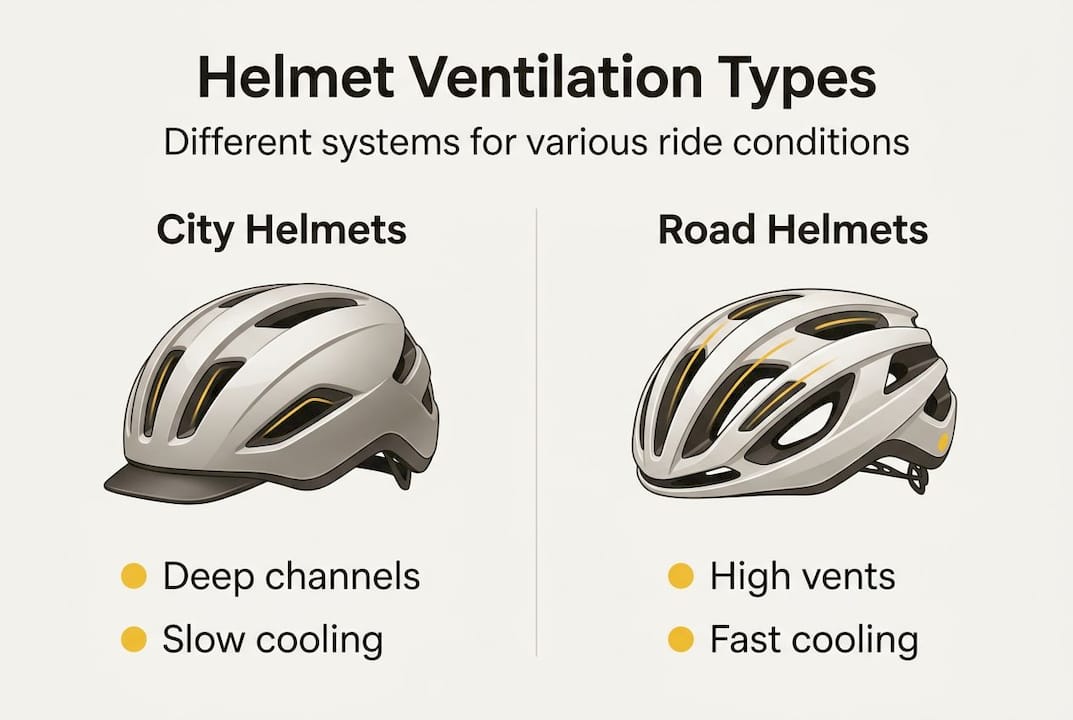
For city and e-bike riders, vent count is almost irrelevant below 15 mph. What matters is deep internal channeling that moves air even when the wind is not doing the work for you. Look for helmets that explicitly describe their internal airflow architecture, not just the number of openings.
For road cyclists, performance helmets with high Virginia Tech ratings give you both the safety assurance and the ventilation efficiency you need at speed. At 20 mph or faster, even a moderately channeled helmet performs well, so the priority shifts toward certified impact protection and fit.
Personal factors matter more than most buyers realize:
- Thick or curly hair compresses inside the helmet and blocks channels
- A round head shape may not align well with vents designed for an oval profile
- Wearing a cap or bandana under the helmet changes airflow dynamics entirely
- Helmet retention systems that sit too tight around the skull restrict edge airflow
Here is a simple checklist to match your helmet to your needs:
- Confirm CPSC or EN1078 certification before anything else
- Identify your typical riding speed to determine how much you rely on passive versus active airflow
- Test internal channel depth by feeling inside the helmet before purchase
- Do a real-ride test of at least 20 minutes before committing
- Check fit with your usual hair style and any headwear you wear underneath
For urban riders especially, integral helmet advantages show that full-coverage designs have evolved to include meaningful ventilation without sacrificing the protection that city traffic demands.
Equipped with a clear understanding of helmet selection, let’s step back and reconsider what really matters as brands and cyclists chase ventilation innovation.
Our perspective: Why most cyclists get helmet ventilation wrong
We have seen the pattern repeat itself constantly. A rider walks into a shop, picks up two helmets, counts the vents, and chooses the one with more. It feels logical. It is not.
Vent count is misleading. The intake-channel-exit system is what determines real cooling performance, and the only honest way to evaluate it is to test in actual riding conditions, not in a store under fluorescent lights.
The cycling industry has trained consumers to shop by specs. Vent count, weight in grams, claimed aerodynamic savings. These numbers are easy to print on a box and easy to compare. But they rarely tell you how a helmet will feel after 45 minutes on a hot day in city traffic.
What we have learned from building helmets for real-world use is that design synergy matters far more than any single metric. A helmet where the shell geometry, foam structure, and vent placement all work together will outperform a helmet with impressive numbers but disconnected execution. The design impacts on ride quality are felt, not measured on a spec sheet.
Our advice is simple. Start with certified protection. Then ride the helmet. Your experience on the road is the only review that matters for your head.
Explore advanced helmets for your next ride
If this article has changed how you think about ventilation, the next step is finding a helmet that actually delivers on the system design principles we have described. At THE BEAM, every helmet we design starts with certified protection and builds airflow architecture around it, not the other way around.

Whether you ride urban streets, open roads, or e-bike trails, we have options engineered for your conditions. Explore our full range of adult helmets designed to balance airflow, safety certification, and real-world comfort. Or browse the complete helmets collection to find the right fit for your riding style. Protection and comfort are not a trade-off. They are the standard.
Frequently asked questions
Do more vents always make a helmet cooler?
Not always. Proper channel design and vent placement matter more than sheer vent quantity for effective cooling, especially at lower riding speeds.
Can a helmet be both highly ventilated and safe?
Yes. Top-rated helmets like POC Cytal prove that high ventilation and certified impact protection are fully compatible with modern materials and engineering.
What should I look for in a helmet for city or e-bike use?
Prioritize good internal channeling and certified safety standards. Slow urban riding generates less natural airflow through vents, so internal channel quality becomes the primary cooling driver.
How does helmet fit affect ventilation?
A poor fit can block edge airflow and misalign vents with your head’s heat zones. Improper fit blocks airflow in ways that even a well-designed helmet cannot compensate for, so always adjust and test before buying.


