

TL;DR:
- E-bike injury rates are lower overall than traditional bikes but head injuries can be severe.
- Layered safety gear including helmets with rotational protection, lights, mirrors, locks, and maintenance checks enhances safety.
- A comprehensive, synergistic approach combining gear, habits, and awareness reduces crash risks more effectively than individual expensive accessories.
Most riders assume e-bikes are more dangerous than regular bicycles. The reality is more nuanced. Research shows that e-bike injury rates are actually lower overall than those for conventional bikes, but head injuries drive the most severe outcomes. That gap between perception and reality is exactly where smart accessory choices make the biggest difference. In this article, we break down which accessories genuinely move the needle, what the latest research says about helmet technology, visibility, and maintenance, and how layering your safety gear produces results that no single product can deliver alone.
Table of Contents
- Why safety accessories matter more for e-bikes
- Helmets: The frontline defense against e-bike head injuries
- How lights and visibility enhancements prevent collisions
- Situational awareness and theft prevention: Mirrors, bells, and locks
- Maintenance and daily checks: The overlooked safety accessory
- What most e-bike riders miss about safety
- Next steps: Gear up with proven safety accessories
- Frequently asked questions
Key Takeaways
| Point | Details |
|---|---|
| Helmet tech matters | Rotational and air-filled helmets reduce serious injuries far better than basic models. |
| Visibility prevents crashes | Quality lights and reflective gear drastically lower your risk of being hit, day or night. |
| Layer for safety | No single accessory suffices—combine helmet, lights, mirrors, locks, and pre-ride checks for full protection. |
| Regular checks save money | Simple pre-ride inspections prevent 80 percent of accidents and dramatically cut repair costs. |
| Right gear fits your ride | Match accessories to your route, speed, and environment for the safest results. |
Why safety accessories matter more for e-bikes
E-bikes are not just faster bikes. They weigh more, often between 50 and 70 pounds, they accelerate more quickly, and riders tend to use them in mixed urban traffic for longer distances. Those factors combine to shift your risk profile in ways that matter. The good news is that e-bikes have a lower overall injury rate than conventional bikes, but when crashes happen at higher speeds, the severity of head injuries climbs sharply.
Urban and winter riding environments add another layer of complexity. Wet pavement, poorly lit intersections, and distracted drivers all raise the stakes for riders who reach speeds of 20 to 28 mph on an assisted bike. The solution is not one perfect product. It is a deliberate combination of essential e-bike safety gear that addresses both the predictable and the unexpected.
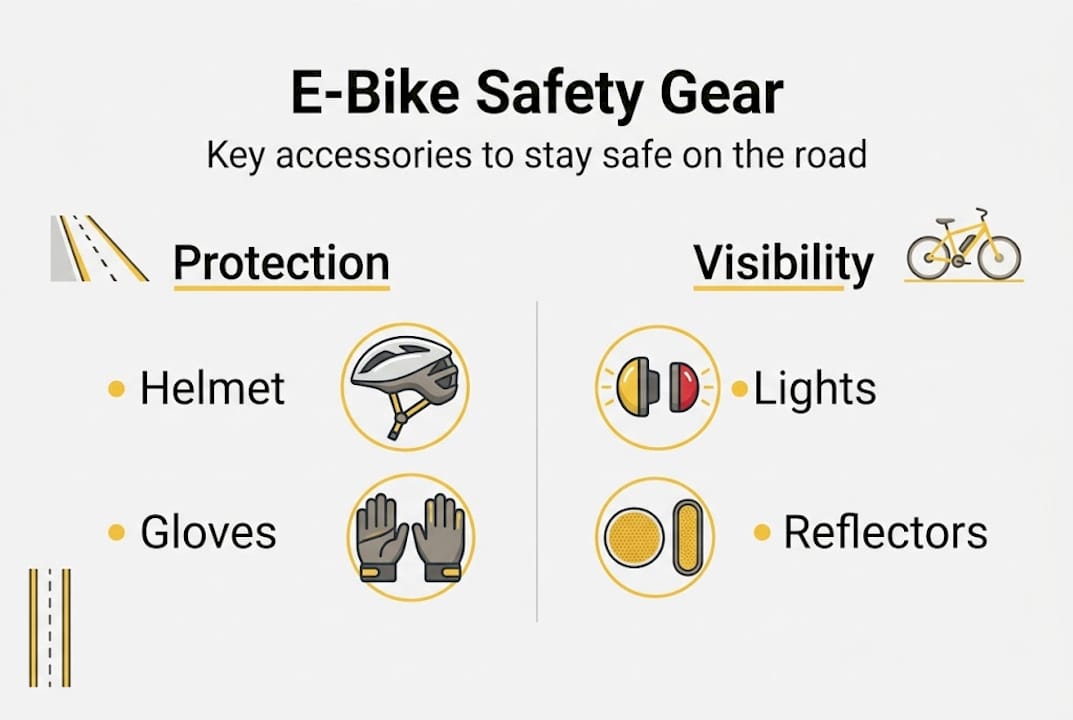
Here is what that layering looks like in practice:
- Helmet with rotational protection for head and brain injury mitigation
- Front and rear lights for visibility in all lighting conditions
- Mirrors and bells for situational awareness in traffic
- High-quality lock to protect your investment from theft
- Regular maintenance checks as a proactive safety habit
A helpful way to think about it: no single lock secures your home better than a combination of a deadbolt, a chain, and motion-activated lighting. Your e-bike safety works the same way. According to best e-bike accessories research, layering protection across multiple categories is the only strategy proven to cover both common and edge-case risks.
Stat to know: E-bike riders face unique exposure at the intersection of speed, weight, and urban traffic density. Accessories designed for standard bicycles may simply not be adequate at e-bike speeds.
If you want a starting framework, our guide on cycling accessories safety tips walks through how each category interacts with real-world riding conditions.
Helmets: The frontline defense against e-bike head injuries
Head protection is not just the most important accessory category. It is the one where the technology gap between products matters most. Modern helmets fall into two broad categories based on how they handle impact energy: those that only manage linear (straight-line) forces, and those that also address rotational forces.
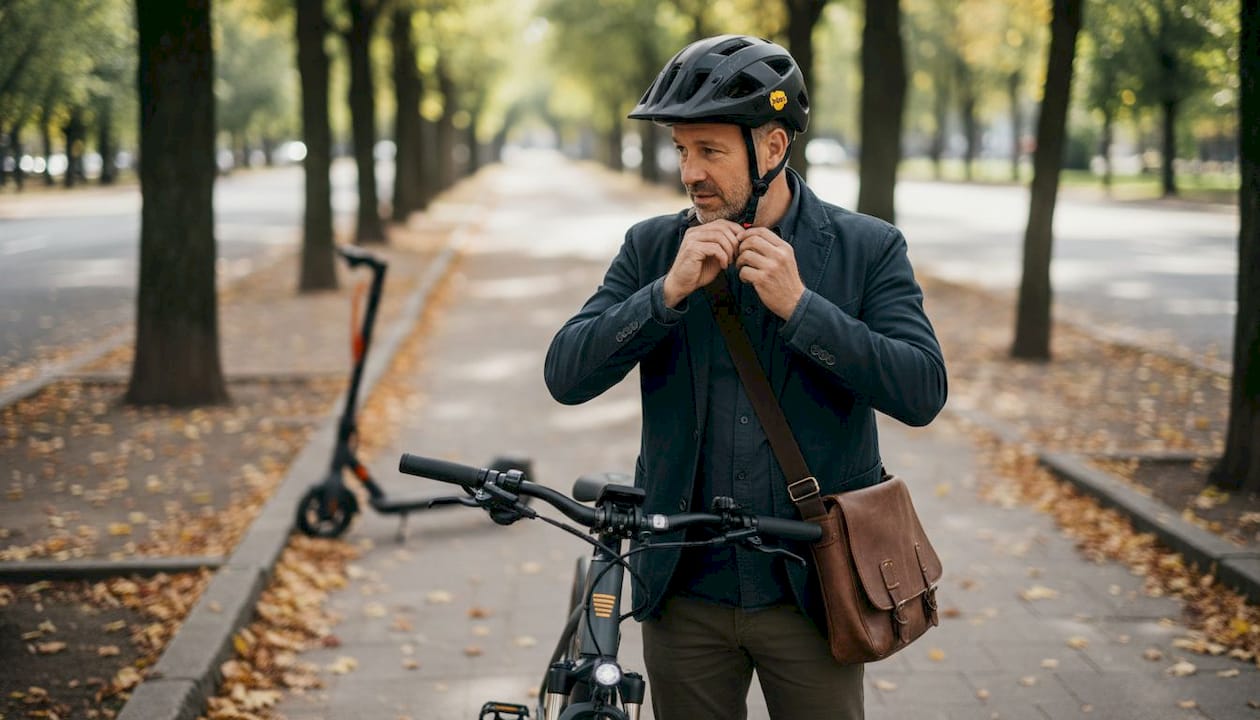
Rotational forces are what actually cause traumatic brain injuries (TBI) in most crash scenarios. When your head hits a surface at an angle, which is what happens in nearly every real-world crash, your brain twists inside the skull. Technologies like MIPS and WaveCel are engineered specifically to reduce that rotational motion. The data is compelling: rotational helmet technology cuts TBI risk by 21 to 29 percent for moderate impacts and up to 45 percent for severe ones, especially in rear-impact scenarios.
Air-filled helmets represent another leap forward. Rather than relying on a single layer of expanded polystyrene (EPS) foam, air-chamber designs can absorb and redistribute energy more efficiently across a range of impact angles. Studies show that air-filled helmets reduce linear brain injury risk by 44 percent compared to top EPS alternatives.
| Feature | Standard EPS helmet | MIPS/WaveCel helmet | Air-filled helmet |
|---|---|---|---|
| Linear impact protection | Good | Good | Excellent |
| Rotational impact protection | Minimal | Significant | Significant |
| TBI risk reduction | Baseline | Up to 45% | Up to 44% |
| Suited for e-bike speeds | Marginal | Recommended | Recommended |
There is an important regulatory gap worth knowing: the NTA8776 certification used for speed pedelecs does not require rotational impact testing. This means a helmet can carry an e-bike safety certification without having been tested for the injury mechanism most likely to cause serious harm. Certification is necessary but not sufficient.
Pro Tip: When choosing a helmet, look past the certification label and check for specific rotational protection technology. If the product page does not mention MIPS, WaveCel, or a similar system, assume it does not have one.
Our e-bike helmet technology guide covers how to read between the lines of helmet marketing and zero in on features that actually protect at speed. For a broader look at what the industry recommends, best helmet technologies are increasingly built around rotational systems.
How lights and visibility enhancements prevent collisions
Being seen is not the same as being seen well. This distinction matters enormously when you are riding at e-bike speeds through urban intersections at dusk or in early morning traffic.
Lighting requirements vary by environment. In dense urban areas with ambient streetlighting, a front light producing 100 to 200 lux is typically sufficient for visibility without blinding oncoming traffic. In rural or unlit settings, you need closer to 600 to 1,000 lux to see obstacles on the road ahead. The challenge is that most riders pick a single light and use it everywhere. That is the wrong approach.
A recent e-bike light test found that high-end headlights rated at 220 lux offer superior road illumination, but even 30-lux lights can dazzle drivers when the beam pattern is poorly designed. Dazzle is a real hazard because a blinded driver is a dangerous driver.
Here is a practical pairing strategy:
- Front light: Choose a model with a defined cutoff beam pattern, similar to a car headlight, to maximize visibility without blinding oncoming road users
- Rear light: Prioritize brightness and a wide viewing angle; flashing mode improves conspicuity in daylight
- Reflectors: Add reflective accessories to wheels, frame, and clothing for passive visibility at all times
- Helmet lights: A light mounted at head height adds a visibility dimension that wheel-level lights cannot provide
Our e-bike light recommendations include options rated for both urban and rural riding conditions.
Pro Tip: Do not assume a light labeled as road-legal is optimized for safety. Legality sets a minimum floor, not a best practice. Always check beam pattern specifications, not just lumen or lux output.
Situational awareness and theft prevention: Mirrors, bells, and locks
Visibility cuts both ways. You need to be seen, and you also need to see what is happening around you. Mirrors and bells address the second half of that equation, and locks protect the investment you have made in your safety setup.
A good rear-view mirror lets you check traffic without taking your eyes off the road ahead. For e-bike riders who change lanes or merge at speed, that matters. You can explore the bike rear-view mirror benefits in detail, but the core value is simple: fewer blind spots mean fewer surprises.
Bells are often dismissed as a relic of slower riding, but they are genuinely useful for alerting pedestrians and slower cyclists on shared paths. A quiet warning at 5 mph prevents the kind of low-speed collision that still results in falls and injuries.
Locks sit at the intersection of safety and economics. E-bikes cost anywhere from $1,500 to $8,000. A stolen e-bike is not just a financial loss; it is a direct setback to your commuting safety infrastructure. As noted in e-bike safety gear research, no single accessory delivers complete protection. Mirrors, bells, and locks each address risks that helmets and lights simply cannot.
Key insight: The best accessory strategy is one where each item covers a gap the others leave open. Mirrors cover blind spots. Bells cover low-speed path hazards. Locks cover overnight and unattended risks.
For riders choosing between mirror styles, our roundup of mirror options for cyclists compares handlebar-mounted, helmet-mounted, and eyeglass-mounted designs across different riding scenarios.
Maintenance and daily checks: The overlooked safety accessory
No accessory list is complete without talking about maintenance. A well-equipped bike with under-inflated tires or worn brake pads is not a safe bike. Routine checks are the one safety habit that amplifies the value of every other accessory you own.
Four pre-ride checks cover the majority of preventable failures:
- Tires: Check pressure before every ride. Low tire pressure is a leading cause of punctures and handling instability at speed.
- Brakes: Squeeze both levers and verify stopping power. E-bike brakes absorb more energy than standard bike brakes due to the added weight and speed.
- Lights: Confirm front and rear lights are charged and functioning. A dead rear light on a morning commute is an invisible hazard.
- Battery: Check charge level and inspect the battery connection for signs of wear or corrosion.
The payoff is significant. Pre-ride inspections prevent roughly 80 percent of drivetrain failures, reduce repair costs by 50 percent, and low tire pressure specifically raises puncture risk by 30 percent.
Pro Tip: Make your check a ritual tied to something you already do, like putting on your helmet. Attach the habit to the action, and you will never skip it.
For riders looking to build out a full maintenance and accessory routine, our guide on maintenance essentials for e-bikes covers what to check and how often.
What most e-bike riders miss about safety
Here is something the typical gear review will not tell you: most riders over-invest in one accessory and treat safety as a solved problem. They buy an expensive helmet or a premium lock and mentally check the box. That is the wrong mental model.
Real safety on an e-bike is not additive. It is synergistic. A top-tier helmet does not compensate for poor visibility. Excellent lights do not replace situational awareness from a mirror. And even the most advanced helmet features only protect you in a crash. They do nothing to prevent the crash in the first place.
The riders we see building the most robust safety setups do not obsess over any single product. They ask: what gap does this fill? They combine certified protective gear with visibility tools, situational awareness accessories, and daily habits. They treat maintenance as part of their safety kit, not a separate chore.
Our broader take on cycling safety insights comes back to this point repeatedly: habits and gear reinforce each other. Neither alone is enough. That is the uncomfortable truth that most product-focused conversations skip entirely.
Next steps: Gear up with proven safety accessories
Building a layered safety setup does not have to be complicated. Start with the basics and build from there.
At THE BEAM, we design helmets and accessories specifically for e-bike riders and commuters who take their safety seriously. Our HELMETS collection features options built with rotational impact technology, including MIPS-equipped models like the VIRGO integral helmet, tested and certified for real-world e-bike conditions. Our all e-bike accessories extend your protection with mirrors, reflectors, and connected safety tools. Every product we offer is chosen because it fills a genuine gap in your safety setup, not just because it looks good on the bike.
Frequently asked questions
Are e-bikes really more dangerous than regular bikes?
No. E-bike injury rates are lower overall than those for regular bikes, but crashes at higher speeds tend to produce more severe head injuries, which is why helmet quality matters so much.
Which safety accessories are must-haves for e-bike riders?
At minimum, prioritize a helmet with rotational technology, bright front and rear lights, and a high-quality lock. Layered accessories covering visibility, protection, and situational awareness deliver the most complete coverage.
Do all helmet standards for e-bikes test for rotational impacts?
No. Standards like NTA8776 do not include rotational impact tests, so a certified helmet may still lack protection against the most common TBI mechanism. Always look for MIPS or WaveCel technology independently of certification.
How do daily checks impact e-bike safety?
Pre-ride inspections prevent about 80 percent of drivetrain failures and cut repair costs in half. A five-minute check before each ride is one of the highest-return safety habits you can build.
Are expensive accessories always safer?
Not necessarily. Price does not guarantee protection. What matters is whether the accessory has tested, certified features that fill a real gap. No single accessory delivers complete safety regardless of cost. Layering well-chosen gear produces far better outcomes than spending heavily on one item.


