

TL;DR:
- Many riders overlook helmet retention systems, which are critical for ensuring the helmet stays securely in place during impacts. Proper adjustment, inspection, and understanding of retention components significantly enhance crash safety and helmet performance. Prioritizing retention system quality and correct fitting can prevent helmet failure and improve overall cycling safety.
Most cyclists spend hours researching helmet shells, MIPS liners, and aerodynamic profiles. Almost nobody reads the fine print about retention systems. That is a costly oversight. A helmet retention systems guide will never be as photogenic as a sleek carbon shell, but it addresses the single factor most responsible for whether your helmet actually protects you when it counts: does it stay on your head? This guide breaks down how retention systems work, what federal standards require, and how to adjust and maintain yours for real crash protection.
Table of Contents
- Understanding helmet retention systems and why they matter
- Helmet retention standards and testing protocols
- Types of helmet retention systems and how they work
- Adjusting and maintaining your helmet’s retention system correctly
- How helmet retention impacts real-world cycling safety and fit
- Why retention systems deserve more attention than helmet shells alone
- Explore advanced helmet retention systems with The Beam
- Frequently asked questions
Key Takeaways
| Point | Details |
|---|---|
| Retention system criticality | Helmet retention systems are essential for safety, ensuring helmets stay on during impacts. |
| Separate safety testing | Retention systems undergo distinct federal tests apart from impact absorption to confirm reliability. |
| Proper adjustment matters | Correctly fitting and buckling the retention system prevents failures during crashes. |
| Wear and maintenance | Damaged or worn retention components must be replaced promptly to keep helmets safe. |
| Education enhances safety | Cyclists often undervalue retention systems; learning proper use improves protection significantly. |
Understanding helmet retention systems and why they matter
A helmet retention system is the combination of components that keeps a helmet firmly positioned on your head through every ride and, critically, through every impact. It is not just the chin strap. It includes the rear fit cradle or dial system, the strap routing, and the buckle locking mechanism working together as an integrated unit.
Here is the part that surprises most riders: retention is evaluated as a completely separate test category in federal safety certification. FMVSS 218 treats retention as its own test category, which means a retention system failure is a certification failure, not a footnote. A helmet can have excellent impact attenuation in its EPS liner and still fail certification entirely because the chin strap gives way.
Why does positioning matter so much? Because the protective liner has to be in the right place at the moment of impact. A helmet that slides back two inches before your head hits the pavement exposes your forehead completely. No liner, no protection.
“A technically sound shell means nothing if your helmet is somewhere other than your head during an impact.”
Key reasons retention systems are non-negotiable for serious cyclists:
- They prevent helmet ejection during rollover crashes
- They maintain correct liner positioning throughout impact sequences
- They are independently tested under helmet certification standards
- They determine whether a helmet passes or fails federal safety requirements
Pro Tip: Before buying any helmet, ask specifically about the retention system design, not just the liner technology. A premium MIPS liner paired with a flimsy retention buckle is a false sense of security.
Helmet retention standards and testing protocols
Federal standards do not leave retention system testing to chance. In the United States, bicycle helmets fall under 16 CFR Part 1203, which includes dynamic strength and positional stability tests designed specifically for retention. The two key test categories are:
- Dynamic strength test. A weighted headform wearing the helmet is dropped in a way that places maximum load on the chin strap and buckle assembly. The strap must not elongate beyond a specified limit or break.
- Positional stability test (roll-off resistance). The helmet is placed on a headform and a cable is attached to create a forward or rearward pull. The helmet must not roll off the headform beyond a defined angle, simulating what happens when your head pitches forward in a crash.
- Buckle durability checks. Buckle mechanisms are cycled repeatedly to confirm they hold under repeated use without degrading locking reliability.
These tests simulate the kind of chaotic, multi-vector forces a cyclist’s head experiences in a real crash. A helmet that passes all three is far more trustworthy than one that has only been tested for impact attenuation.
The table below shows how the major U.S. standards approach cycling helmet certification tests:
| Standard | Applies to | Retention tests included | Key metrics |
|---|---|---|---|
| 16 CFR Part 1203 | Bicycle helmets | Dynamic strength, roll-off resistance | Strap elongation, helmet displacement angle |
| FMVSS 218 | Motorcycle helmets | Retention strength, buckle release force | Load limits, buckle release thresholds |
| EN 1078 | Bicycle helmets (EU) | Dynamic retention, roll-off | Displacement angle, strap force |
One underappreciated point: compliance with these standards is the floor, not the ceiling. Helmets sold in the U.S. must meet 16 CFR Part 1203, but some manufacturers exceed those requirements significantly. When reading retention system reviews, look for brands that publish independent test results, not just a certification badge.
Types of helmet retention systems and how they work
Modern cycling helmets use three interconnected components to create a functional retention system. Misunderstand any one of them and the whole system can fail.
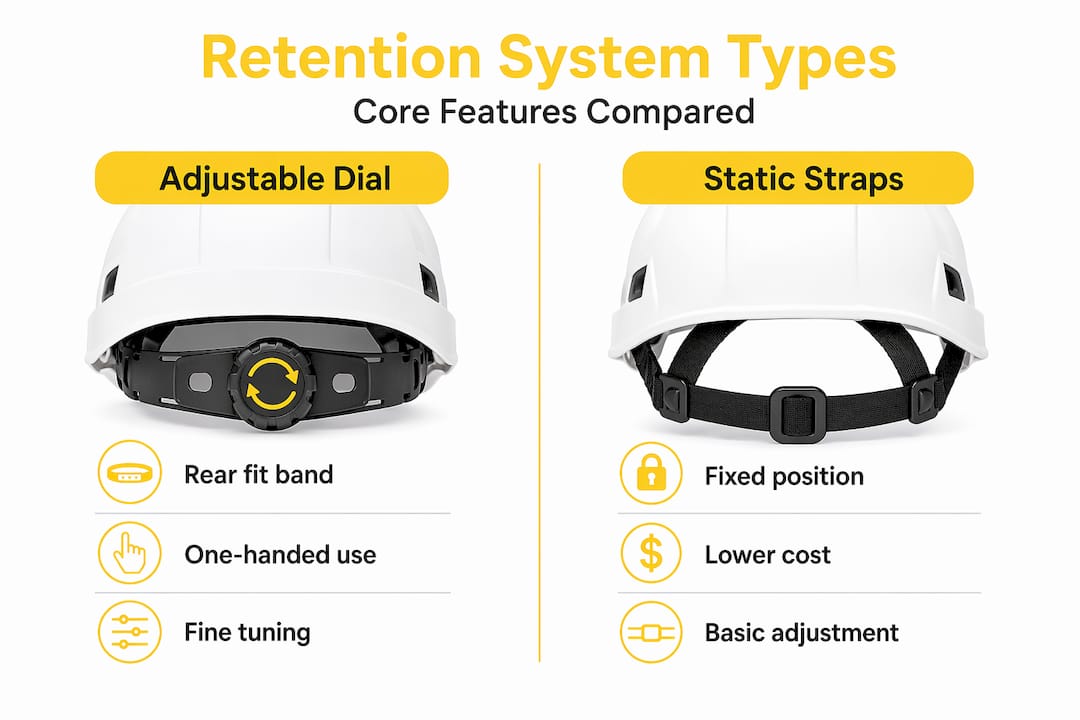
1. The fit system (rear cradle or dial). This is the adjustable ring or cradle that wraps around the back of your skull, usually tightened with a dial mechanism. It handles positional stability during normal riding and contributes to preventing roll-off in a crash. The dial allows micro-adjustments for different head shapes within a helmet’s size range.
2. Chin strap routing. The straps that run from the helmet’s shell to the buckle under your chin must be routed through the correct anchor points. Incorrect routing creates uneven load distribution. If one side of the strap takes more force than the other in a crash, the geometry of retention breaks down.
3. Buckle locking mechanism. Three main buckle types exist in the market:
- Side-release buckles. The most common in cycling helmets. Fast to operate, reasonably secure when clicked fully into position.
- Double D-ring buckles. More common in motorcycle helmets but seen in some high-end cycling lids. Widely regarded as the most mechanically reliable under high loads.
- Magnetic closure systems. Increasingly used in cycling helmets for convenience. Easy to fasten one-handed, but not all designs have been tested to the same load standards as mechanical buckles.
The critical insight here is that many retention failures occur not because the hardware is defective, but because the adjustment was wrong from the start. A buckle clicked halfway, a strap with a twist in it, or a dial set too loose will cause the system to behave as though it isn’t there.
A useful comparison of buckle types for cyclists:
| Buckle type | Security level | Ease of use | Best suited for |
|---|---|---|---|
| Side-release | Moderate-High | Very easy | Road, commuting, recreational |
| Double D-ring | Very High | Requires practice | High-performance, endurance |
| Magnetic closure | Moderate | Easiest | Urban, commuting |

Pro Tip: When you buckle your chin strap, you should be able to fit two fingers flat between the strap and your chin, nothing more. If you can fit a fist, the system offers almost zero crash protection regardless of hardware quality. Visit helmet fit and retention systems for a detailed fit walkthrough.
Adjusting and maintaining your helmet’s retention system correctly
Correct adjustment is where the best helmet retention tips become actionable. The process is methodical, and doing it once properly beats re-doing it sloppily before every ride.
Follow these steps for a properly adjusted retention system:
- Set the rear dial first. Place the helmet level on your head, two finger-widths above your eyebrows. Tighten the rear dial until you feel even, firm pressure across the back of your skull. You should feel it, but it should not pinch or create a pressure headache.
- Check the side straps. The two straps running down each side of your head should form a “V” shape that meets just below each ear. If the junction sits on your ear or far below it, re-thread the strap through the correct anchor points.
- Route under the chin and buckle. Pull both strap ends under your chin and click the buckle until it locks fully. Do not stop at the first resistance click on a side-release buckle. Push until you hear a clean, definitive snap.
- Verify the two-finger rule. With the helmet buckled, try to push two fingers upward between the strap and your chin. Snug but passable is correct. Easy clearance means re-tighten.
- Test roll-off resistance. With the system fully adjusted, try rolling the helmet forward over your head. If it shifts more than a couple of inches before stopping, your rear dial needs tightening.
Maintenance follows the same level of care. The CAM FIT retention manual illustrates how rigorous tension management and regular lock/unlock cycling is fundamental to long-term retention reliability. Apply that principle to your cycling helmet: test the buckle click quality monthly. Inspect straps for fraying, UV degradation, or stiffening. Replace retention components after any crash, even a minor one, because the forces involved can compromise buckle geometry invisibly.
Pro Tip: After adjusting your helmet for the first time, take a photo of the strap routing from the front and sides. If the straps ever get re-threaded incorrectly after washing or storage, you have a reference point to restore correct geometry instantly. For more detail, see helmet safety upgrade tips.
How helmet retention impacts real-world cycling safety and fit
The practical stakes become clearest in crash data. Helmets with poor retention can fail crash tests entirely and be pulled from the market, not because their foam failed, but because they came off the test headform before impact could even be measured.
What retention quality means for you on a real ride:
- A helmet that stays put during sudden braking or a low-speed tumble keeps the liner between your skull and the ground
- Consistent helmet positioning through hour-long rides reduces fatigue from adjustment fidgeting
- A secure fit increases the confidence to ride assertively, particularly in traffic or at speed
- Retention system quality is what separates a certified helmet from one that simply looks like it should be certified
“Fit and retention are not just comfort features. They are structural safety requirements that determine whether a helmet performs as designed in a crash.”
Comfort and safety are not separate conversations in this context. A well-adjusted retention system means the helmet sits correctly, moves with your head rather than on top of it, and does not require constant repositioning. Riders who wear poorly fitting helmets tend to loosen them for comfort, which directly degrades retention performance.
There is also a regulatory angle worth noting: consumer testing programs actively remove helmets with retention failures from store shelves. The standard does not give partial credit. Retention failure equals product failure, full stop. To understand how modern helmets address all of this in design, modern helmet protection is worth reading alongside this guide.
Why retention systems deserve more attention than helmet shells alone
Here is an uncomfortable observation: helmet marketing almost exclusively sells shells and liners. You see images of aerodynamic profiles, cutaway diagrams of MIPS layers, and color options. Almost nobody shows you the buckle in detail. That omission is commercially convenient but safety-relevant in the worst way.
Retention systems are a distinct certification failure mode, which means standards bodies have explicitly recognized that the retention system is a standalone point of failure, independent of shell or liner quality. Yet most riders treat it as background hardware.
The majority of real-world retention failures we hear about are not hardware defects. They are user errors. A buckle not fully engaged, a strap twisted through the wrong anchor point, a dial set to the loosest position because the rider “didn’t like the pressure.” These are fixable with one minute of education and one minute of practice.
The underrated part of any helmet sizing guide or bike helmet retention tip conversation is this: knowing your head circumference and buying the correct size helmet gets you halfway there. What gets you all the way there is understanding why the dial, the strap routing, and the buckle snap each matter individually. The evolution of helmet safety standards is pushing toward better retention hardware. But until every helmet ships with a 90-second retention adjustment video rather than a folded paper diagram, the responsibility lands on the rider.
Prioritize learning proper retention adjustment the same way you prioritize choosing a helmet brand. The brand gets you a certified shell. Your adjustment technique makes it actually work.
Explore advanced helmet retention systems with The Beam
At The Beam, every helmet we design is built around the understanding that protection starts with a system that stays in place. The VIRGO integral helmet with MIPS technology integrates a rear retention cradle and chin strap geometry that meet real-world demands for road, gravel, and urban cycling alike.

If you want to see our helmets performing under demanding conditions, visit our Ultracycling event page to see how our gear holds up in high-performance environments. For guidance on taking the next step with your safety setup, our helmet safety upgrade guide walks you through everything from retention adjustment to choosing protective accessories that complement your helmet system.
Frequently asked questions
What is a helmet retention system and why is it important?
A helmet retention system is the combination of rear cradle, chin straps, and buckle that keeps the helmet on your head, and retention system failure is a standalone certification failure under federal safety standards, not just a comfort issue.
How do federal standards test helmet retention systems?
The U.S. standard 16 CFR Part 1203 requires both dynamic strength tests and positional stability tests to confirm that the retention system holds under crash-like loads and does not allow the helmet to roll off the head.
Can I adjust the retention system myself for better fit?
Yes, and you should. Following manufacturer adjustment workflows, set the rear dial for even skull pressure first, then route and buckle chin straps fully to achieve a snug, properly positioned fit.
How do I know when my helmet retention system needs replacing?
Inspect straps monthly for fraying or stiffening, and if the buckle no longer clicks firmly or any component shows visible wear or damage, replace the system or the entire helmet before your next ride.
Are all helmet retention systems equally safe?
No. Double D-ring systems remain the most mechanically reliable under high loads, while quick-release side buckles are acceptable for general cycling when fully engaged and correctly adjusted.


