

TL;DR:
- Many cyclists overlook the helmet liner, which is the critical component managing impact energy and protecting the brain. The liner, made of engineered foam or microstructures, absorbs force, distributes impact, and reduces rotational injuries during crashes. Choosing helmets with advanced, multi-density, and rotational protection liners tailored to your riding style offers the best safety and performance.
Most cyclists spend their time comparing helmet shells, aerodynamics, and ventilation slots, while the component that actually saves your brain sits quietly inside, completely ignored. The liner is where real protection happens. It is the engineered layer between your skull and disaster, and understanding how it works will permanently change how you shop for and think about helmets. Whether you ride road, gravel, urban streets, or e-bike trails, the liner inside your helmet is doing far more than you probably realize.
Table of Contents
- What is a helmet liner and why does it matter?
- Impact protection: How liners manage forces
- Rotational protection: Why angled impacts demand innovation
- Emerging liner technologies: Microstructures and next-gen designs
- Practical tips for evaluating and choosing cycling helmet liners
- A fresh perspective: What most cyclists get wrong about helmet liners
- Find your ideal safety and comfort with advanced helmet liners
- Frequently asked questions
Key Takeaways
| Point | Details |
|---|---|
| Liners absorb impact energy | Helmet liners transform crash forces into deformation and heat to reduce trauma. |
| Rotational protection is essential | Tiered liner systems like MIPS help shield your brain from dangerous rotational impacts. |
| Material innovation enhances protection | New technologies—air-chamber and microstructured liners—can offer better safety than traditional EPS foam. |
| Don’t confuse comfort padding with liner utility | Comfort pads make the helmet feel good, while liners are the critical safety layer. |
| Match liner features to riding conditions | Smart cyclists select helmet liners based on impact risks, not just fit or aesthetics. |
What is a helmet liner and why does it matter?
A helmet liner is not the soft, washable padding that sits against your forehead. That is comfort padding. The liner is the rigid or semi-rigid structural layer, typically molded foam or an engineered microstructure, that sits between the outer shell and your head. Its entire purpose is to manage energy during an impact.
The most common liner material is Expanded Polystyrene (EPS) foam, the same white, slightly grainy material used in protective packaging. But in a helmet, it is precision-engineered. Density, cell size, and thickness are all tuned by engineers to match specific impact scenarios. You can learn more about this through helmet protection explained and through the broader context of cycling equipment essentials.
Here is how the liner actually protects you:
- Energy absorption: When your head hits a surface, the liner crushes progressively, converting kinetic energy into deformation work and heat instead of transmitting it to your brain.
- Force distribution: A good liner spreads the impact load across a wider area, reducing the peak force at any single point.
- Deceleration control: The liner slows your head down over a longer time and distance, which directly reduces injury risk.
“In cycling helmets, the liner’s primary safety role is impact energy management: it crushes and deforms to slow the head, converting kinetic energy into deformation work and heat, which reduces the peak forces transmitted to the skull and brain.”
Pro Tip: Never confuse the inner comfort padding with the structural liner. If you remove the soft cheek pads and forehead cushion, the hard or firm foam layer underneath is the real protective component. That layer should never be cut, drilled, or modified.
The key insight here is that liner design is not about making a helmet feel soft or comfortable. It is about engineering a controlled failure. A liner that crushes correctly in a crash is doing exactly what it was built to do.
Impact protection: How liners manage forces
Having understood what liners are and their basic role, let us look at how the science behind them translates to real protection in a crash.
When you fall off your bike, your head decelerates rapidly on impact. Without a liner, that deceleration happens in milliseconds, and virtually all the force transfers directly to your skull and brain. With a properly designed liner, the deceleration is stretched across a longer interval because the foam crushes progressively. This is the difference between a survivable and unsurvivable impact.
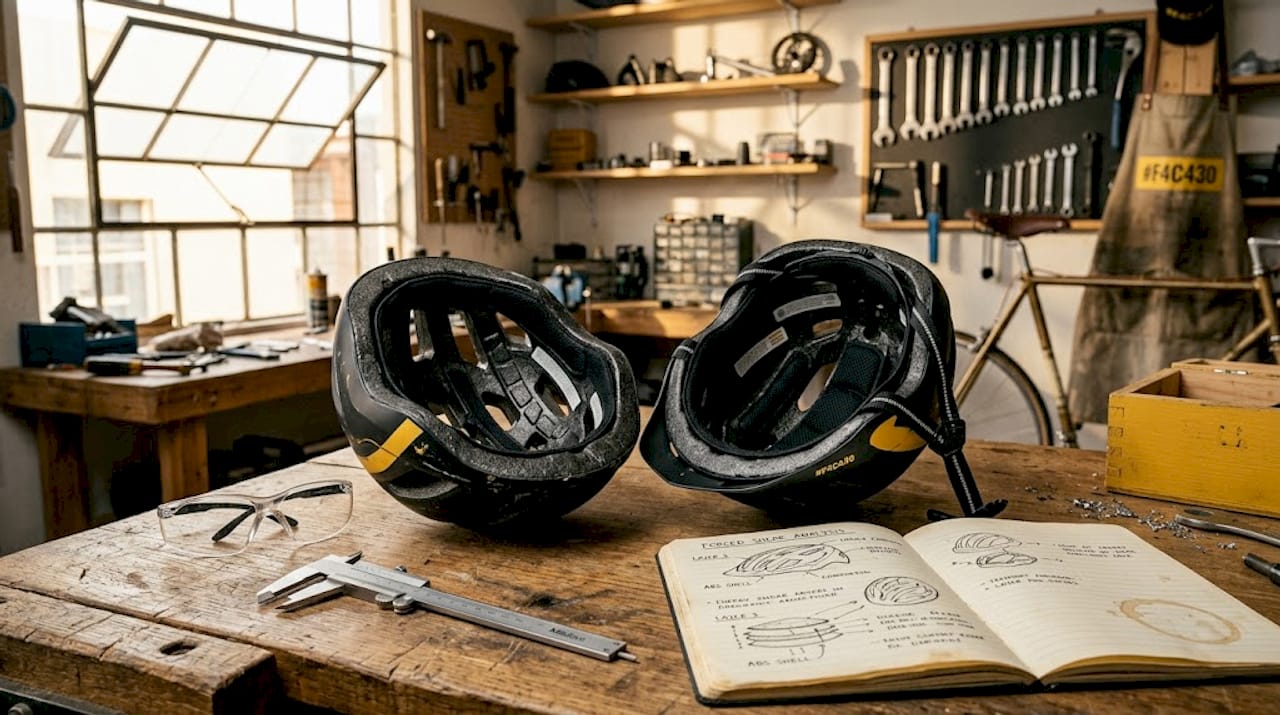
Foam density and stiffness are not one-size-fits-all decisions. Stiffer foams handle high-severity impacts better but can transmit too much force in low-speed crashes. Softer foams absorb low-energy impacts well but bottom out in severe crashes, offering no protection once fully compressed. The most advanced helmets use layered foam systems, combining densities in strategic zones to cover a broader range of impact severities with a single helmet.
| Liner type | Energy dissipation | Impact management | Rotational protection |
|---|---|---|---|
| Standard EPS foam | Moderate to high | Good for direct impacts | Limited |
| Layered/multi-density EPS | High | Excellent across severity range | Limited |
| Air-filled chambers | Variable | Good for oblique impacts | Moderate |
| Microstructured/auxetic | Emerging, very high | Excellent | Promising |
Bench testing of alternative liner technologies shows measurable differences in both linear and rotational protection outcomes under oblique impacts when compared to conventional EPS-liner helmets. Some air-filled liner designs have shown up to 44% reductions in linear injury risk metrics in controlled testing conditions.
Key performance factors in liner impact management include:
- Foam density: Higher density for severe impacts, lower for everyday falls
- Liner thickness: More material means more crush distance and better energy absorption
- Zonal variation: Different areas of the head need different levels of protection
- Shell interaction: How the liner bonds to or slides against the outer shell affects force transfer
Tracking helmet technology trends helps you understand why liner technology is evolving rapidly and why older helmet models may not offer the same protection as current designs. Also worth reviewing are cycling safety standards, which have begun incorporating oblique impact tests specifically because of what we now know about real-world crash dynamics.
Rotational protection: Why angled impacts demand innovation
With linear force management covered, let us explore how helmet liners have evolved to protect against rotational injuries, often overlooked but potentially devastating.
The vast majority of real cycling crashes do not involve straight vertical impacts. They involve oblique, angled contact with the road surface. When the head hits a surface at an angle, it does not just decelerate linearly. It also rotates. That rotational acceleration is transmitted to the brain and is directly associated with diffuse axonal injuries, concussions, and some of the most severe traumatic brain injury patterns seen in cyclists.
Conventional EPS liners handle linear forces well. They handle rotational forces poorly. This is why rotational-protection systems were developed. Technologies like MIPS (Multi-directional Impact Protection System) add a low-friction layer between the liner and the comfort padding, allowing the helmet to rotate slightly relative to the head during an angled impact. This relative motion reduces the rotational energy transmitted to the brain.
Here is how a rotational protection system works, step by step:
- The helmet makes oblique contact with a surface during a crash.
- Without rotational protection, the helmet locks to the head and both rotate together, transmitting full rotational force to the brain.
- With MIPS or similar systems, the inner layer slips relative to the outer helmet body by 10 to 15 millimeters.
- That small amount of relative motion absorbs and redirects rotational energy.
- The brain experiences significantly lower rotational acceleration as a result.
| Feature | Conventional EPS liner | Rotational-protection liner |
|---|---|---|
| Linear impact protection | Good | Good to excellent |
| Oblique/angled protection | Limited | Significantly improved |
| Added weight | None | Minimal (5 to 15 grams) |
| Cost impact | Baseline | Moderate increase |
| Real-world crash relevance | Partial | High |
Bench testing confirms that helmets with rotational-protection systems show measurably better outcomes under oblique impact conditions. This is not just marketing. It is measurable, reproducible physics.
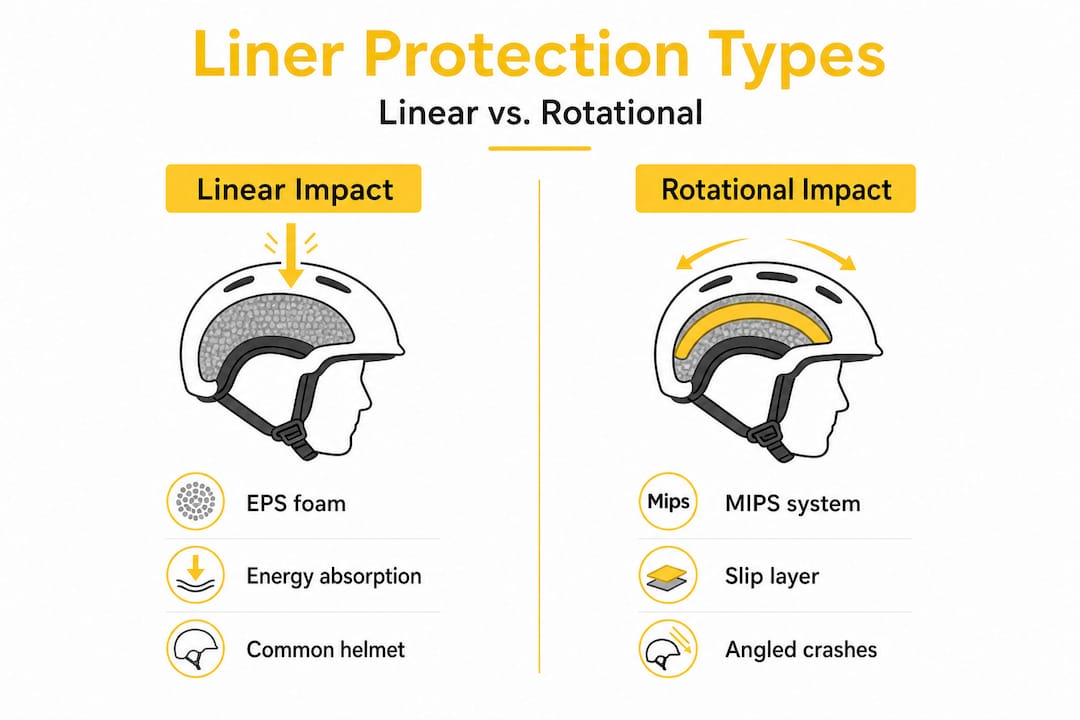
Pro Tip: When reading helmet reviews, check whether rotational protection features were tested under oblique conditions. Reviews that only mention straight-drop test results are missing the most relevant scenario for real cycling crashes.
Check the latest road cycling helmet trends to see how rotational protection has become a baseline expectation in premium helmets rather than an optional upgrade.
Emerging liner technologies: Microstructures and next-gen designs
Beyond rotational protection, research continues to advance liner technology. What does the future hold for cyclists seeking safer, more comfortable rides?
The next generation of helmet liners is moving away from uniform foam blocks toward precisely engineered microstructures. The most promising area involves auxetic metastructures, geometrically complex three-dimensional lattices that behave counterintuitively under compression. Unlike conventional foams that expand laterally when compressed, auxetic structures contract in all directions simultaneously, allowing them to absorb and distribute energy more efficiently across multiple impact vectors.
“Some emerging liner research uses engineered microstructures, including auxetic metastructures, to improve energy dissipation and reduce peak acceleration in impact tests compared with conventional helmet materials.”
These microstructured liners are made possible by advances in 3D printing technology, which allows manufacturers to produce geometrically complex shapes that would be impossible to mold using traditional manufacturing. The result is liners that are:
- Lighter than equivalent-protection EPS foam
- Tunable at a micro level for specific impact zones
- Potentially reusable across minor impacts without full structural compromise
- More breathable because air can flow through the lattice structures
The practical implications for cyclists are significant. Lighter protection means more comfortable long-ride helmets. Better energy dissipation means lower peak accelerations during the types of impacts most cyclists actually experience, which are low-to-medium speed urban falls and trail tumbles rather than high-speed road racing crashes.
For those interested in how these innovations are already influencing product design, our thinking on integrated helmet design covers how structural and liner choices are increasingly made together rather than as separate engineering decisions.
Practical tips for evaluating and choosing cycling helmet liners
With all the science and innovation explained, it is time for practical advice. What should you actually look for when shopping or upgrading your helmet?
-
Look for layered or multi-density foam. Single-density EPS is adequate but not optimal. Helmets with layered foam can protect you across a broader range of impact energies, which is particularly valuable for urban cyclists who face unpredictable crash scenarios.
-
Prioritize rotational protection systems for real-world riding. If your helmet does not include MIPS or an equivalent technology, you are not protected against the most common type of cycling impact. This is not optional for serious riders.
-
Do not conflate comfort padding with liner performance. Liner performance is not about softer versus harder. A helmet that feels plush may simply have thick comfort padding over a mediocre liner. Always research the liner technology specifically.
-
Check for independent test ratings. Organizations like Virginia Tech’s helmet lab rate helmets on real-world oblique impact performance. A helmet rated highly by independent testing consistently outperforms marketing-only claims.
-
Match liner technology to your riding conditions. High-speed road riders need stiffer liners calibrated for higher-energy impacts. Urban commuters and e-bike riders face a wider variety of impact scenarios and benefit most from multi-density or microstructured liners with rotational protection.
-
Replace helmets after significant impacts. EPS foam does not visually show all damage after a crash. Once crushed, it cannot rebound to full protective capacity. A cracked or impacted liner must be replaced, even if the shell looks fine.
Pro Tip: When shopping for e-bike helmets specifically, look for liners tested at higher impact velocities. E-bikes travel faster than conventional bikes, and helmet liner standards calibrated for slower speeds may not offer adequate protection. More on this at e-bike helmet tech.
A fresh perspective: What most cyclists get wrong about helmet liners
Now that you have the science and practical know-how, let us tackle where most cyclists, and even experts, go wrong.
The biggest mistake we see is treating helmet liner selection like mattress shopping. Riders describe helmets as feeling “comfortable” or “stiff” and make purchase decisions based on those sensations. But comfort tells you almost nothing about protective performance. A helmet with thick, plush interior padding can feel luxurious and still have a thin, inadequate protective liner underneath. These are two separate engineering components serving two completely different purposes.
The second mistake is assuming that any certified helmet is equally protective. Certification tests are minimum standards. A helmet that barely passes and a helmet that exceeds those standards by a wide margin both wear the same certification label. The difference lives entirely in the liner.
The third and most technically important mistake involves directionality. Many cyclists and many helmet reviewers evaluate helmets only on straight-drop impact performance. But real crash data makes it clear that liner design choices aimed only at straight-down impacts may not optimally address rotational acceleration. A helmet that scores perfectly on vertical drop tests can still perform poorly on oblique impacts, which are the impacts that actually happen in cycling crashes.
This is precisely why multi-mechanism liners, combining structural foam with rotational systems and, in the future, microstructured materials, represent the real innovation frontier. They do not optimize for one type of impact. They protect across the full spectrum of how crashes actually happen.
We believe the cycling community deserves more transparency about these tradeoffs. Manufacturers and reviewers rarely discuss how a liner’s design choices involve genuine compromises. A very stiff liner that excels in high-speed impacts may underperform in low-speed tumbles. A very soft liner that cushions gentle falls may bottom out in a harder crash. Understanding these compromises puts you in control of your own safety decisions.
The urban helmet innovations space is where this conversation is most active right now, because urban cyclists face the widest variety of impact scenarios and have historically been underserved by helmets designed primarily for racing applications.
Find your ideal safety and comfort with advanced helmet liners
You now understand that the liner is the heart of any helmet’s protective capability. Choosing a helmet means choosing a liner, and that decision should be informed, intentional, and matched to how you actually ride.
At THE BEAM, we design helmets where liner technology is never an afterthought. From our VIRGO integral helmet with MIPS technology to our full range of road, gravel, and urban models, every liner choice is made with real-world protection in mind. Browse our men’s helmets collection or explore options for younger riders in our kids’ helmets collection. If you want to see everything we offer in one place, the complete all helmet models page is the best starting point for matching liner technology to your specific riding needs and style.
Frequently asked questions
What material is best for a helmet liner?
EPS foam is the industry standard for most bike helmets, offering well-understood impact performance across a wide range of densities. However, emerging microstructured liners using auxetic metastructures show promising improvements in energy dissipation and reduced peak acceleration.
How do helmet liners protect against rotational injuries?
Modern liners incorporate rotational-protection systems like MIPS, which introduce a low-friction slip layer that allows the helmet to move slightly relative to the head during angled impacts, significantly reducing rotational acceleration transmitted to the brain.
Is comfort padding the same as a helmet liner?
No. Comfort padding is for fit and feel against your skin, while the structural liner is the engineered foam layer built to absorb and manage impact energy. Confusing the two is one of the most common mistakes cyclists make when evaluating helmets.
What is the latest innovation in helmet liner technology?
The leading edge involves auxetic metastructures, which are 3D-printed microstructured lattices that improve energy dissipation and reduce peak acceleration compared to conventional materials, opening the door to lighter, more breathable, and more protective helmets.
How should cyclists choose the right helmet liner?
Focus on liner technology rather than comfort feel alone, since liner performance depends on tuned foam density, rotational protection systems, and material innovation matched to your specific riding speed and crash risk profile.


